Verse 31821astiiek din
G1
1
we used to drink wine on credit, but we considered that, indeed
2
it will {find resources / accomplish wonders / bring about a change}, our 'cheerfulness in adversity', one day!
'Debt; a loan, money borrowed at interest; credit'.
'To perceive, know, understand, comprehend, apprehend; to learn; —to think, consider, conceive, suppose, deem, imagine, fancy'.
'To flush up, to blush; to present a fine appearance or form, to bloom; to find resources; to accomplish wonders; to bring about a change'.
is an archaic form of ( GRAMMAR )
'Cheerfulness, &c., in want or adversity'.
'Cheerfulness in want or adversity'. (Steingass p.904)
| References | |
|---|---|
| Arshi, Imtiyaz Ali | Ghazal# 87 |
| Raza, Kalidas Gupta | 338 |
| Nuskhah-e-Hamidiyah | 145 |
| Hamid Ali Khan | Open Image |
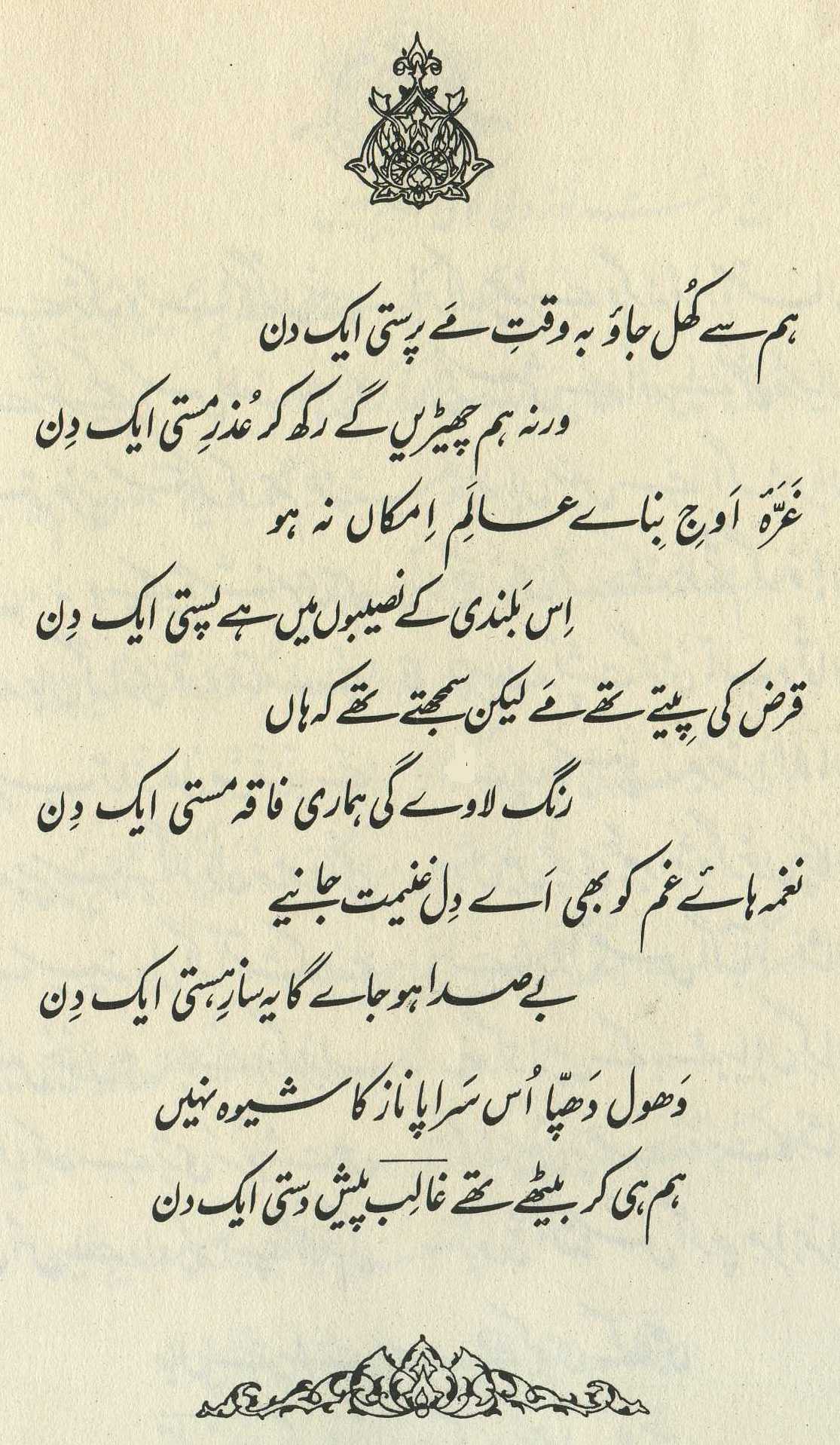
An anecdote: One time Mirza became very much burdened by debt. The creditors took him to court. He was summoned to answer the charges. It was the Mufti Azurdah Sahib’s court. When he was brought before the court, he recited this verse: {90,3}.
== trans.: Pritchett and Faruqi , p. 506
That is, one day he will be disgraced by the wine-sellers in the public market. (89)
== Nazm page 89

Concerning this verse of Mirza Sahib's this anecdote is famous: that before 1857 some shopkeeper had instituted a case against Mirza Sahib for the cost of wine. The case was brought before the court of Mufti Sadr ud-Din Khan Sahib [Azurdah]. In answer to the complaint, Mirza Sahib extemporaneously composed this verse and recited it. The Mufti Sahib paid the plaintiff's money out of his own pocket, and freed Mirza Sahib from the court case. (140)
He was compelled by habit, and borrowed money to drink wine. But along with this, he also believed that this would one day show its true colors []. That is, in this state of poverty the result of wine-drinking is that one must confront humiliation. From this verse it also emerges that after becoming the slave of habit, a man cannot act on the commands of wisdom, and begins to endure humiliations. (183)
On one occasion Mirza had become very indebted, and his creditors made a complaint, and Mirza Sahib was summoned to answer it. He had spent the sum on wine-drinking and its appurtenances. Mufti Sadr ud-Din Ahmad Khan was the judge. By way of an answer to the claim, Mirza Sahib extemporaneously composed and recited this verse. Mufti Sahib understood, and out of respect and poetic appreciation, he paid the whole amount by himself and bid farewell to Mirza Sahib. (233)
That is, through wine-drinking, one day one will be beaten with shoes and slapped around in the public market. (259)
It is a rakish [] verse. By is meant 'certainly'. It is well known that because of Mirza's continually borrowing [money for] wine and not being able to pay it back, his creditors had made a complaint. Maulana Azurda was among Mirza's well-known contemporaries. The case took place in his court. When he made inquiry, Mirza Sahib extemporaneously composed and recited this verse. Maulana Azurdah paid the money to the claimant from his own pocket, and saved Mirza from the humiliation of this indebtedness. By is meant 'to remain content even in poverty'. (180)
We indeed borrowed money to drink wine, but we were sure that the result of this (to drink wine on borrowed money) of ours would turn out to be very bad. (500)
There are two meanings of : one is to remain intoxicated [] even in poverty and straitened circumstances and not to feel the straits; the second is, despite straitened circumstances to drink wine on borrowed money and remain intoxicated.
We drank wine on borrowed money, but we were very well aware of this reality: that our would one day show its true colors [] and would certainly have a bad effect [].
A story is well known, that on one occasion a case was lodged against Mirza Ghalib in connection with debts. Mufti Sadr ud-Din Azurdah, who was the chief justice, heard the case, When it came to be Mirza's turn to speak, he recited this very verse. The chief justice, hearing the verse, smiled. He issued a decree against Ghalib, and paid the money for the debt out of his own pocket.
In connection with this story, the clarification ought to be made that if such a thing took place, then it would have been for some small sum, because the large sums that Mirza owed, he himself paid. (296)
ABOUT : It's worth noticing that , which is often translated as 'to understand', often means something more like 'to consider, suppose, feel, believe' (see the definition above). In English, 'to understand' usually (though not always) implies right understanding, accurate knowledge; if error is implied, we more often use 'to believe' or 'to think'. In Urdu, however, occupies much more of a grey area, and doesn't necessarily imply accuracy of knowledge or judgment. Thus I generally translate it as 'to consider'. It can often appear as a one-shot action with continuing effects (like ), so that something the speaker currently believes can appear either as or as (as in 191,3 ). Compare the similar usage of : 16,5 .
Some examples: 20,6 ; 20,11 *; 25,4 ; 34 , with the refrain ; 42,9x ; 46,3 ; 60,10 ; 64,3 ; 79,5x ; 99,9 ; 102,1 ; 163,5 *, with varying usages; 176,6 ; 201,5 ; 234,7 // 348x and 349x , with the refrain
Oh pooh! to the commentators! Has there ever been a verse so amusing, and so depressingly mishandled? There's not the slightest historical foundation for Azad's and Mihr's implausible anecdote, much less for Bekhud Dihlavi's, Baqir's, and Josh's even more radical version (in which the verse is not merely recited, but is composed impromptu just for, and during, that humiliating occasion). The anecdote is clearly some kind of back-formation from the fact that Ghalib loved wine (though in fact he usually mixed it with rose-water) and almost always struggled with debt. (In 1837 he was reportedly sued for debt by an English wine-merchant, and an admirer paid the debt; but no verses were involved-- and in any case, that episode took place sixteen years after this ghazal was composed.) In Azad's case, the anecdote is part of his larger hatchet job on Ghalib, as any close reader of will have noticed. (For another such example, see 17,9 .)
Yet in fact, this witty little gem is one of the world's ultimate mushairah verses. The first line sets us up for just the kind of repentant, moralizing verse that Nazm and company expect. The words 'but' and 'indeed' suggest an anticipation of change. 'I used to drink wine on borrowed money, but indeed I believed...' leads us to expect in the second line 'that one day I would suffer for it', or something to that effect (perhaps with some clever wordplay about 'paying the price'). In a mushairah setting, there would be a certain amount of time before we'd be allowed to hear the second line, plenty of time to imagine the show of repentance to come.
And what do we get instead? First, we don't get a verb of repentance or chastisement, but the almost entirely positive meanings of (see the definition above), which somewhat resembles our English idiom 'pay off'. And then, what feminine singular thing will govern that verb ? In proper mushairah-verse style, the kicker is withheld until the last possible moment: it is the speaker's -- literally, his 'poverty-intoxication'; in a well-established idiom (see the definitions from Platt and Steingass), it's his state of (pious?) good cheer and gallantry even under dire conditions of need and deprivation. In short, it's a virtue!
So instead of the verse the audience initially expected-- 'We did a bad thing (drinking wine on credit), but always felt that we'd suffer for it'-- what the verse actually says is, 'We underwent hardship (having to drink wine on credit), but always felt that our cheerfulness in hard times would pay off somehow!'. What an entirely different slant this gives to the verse! It turns out in retrospect that the first line was not repentant and apologetic after all, but in fact self-congratulatory: even when times were so bad that the speaker had to borrow his drinking-money, he was still full of good cheer, gallantry, and grace under pressure.
As a final touch of subtle uncertainty, there's . The speaker always 'considered, felt, believed, supposed' that his cheerfulness in adversity would see him through in the end. (The future tense in the second line is because of the traditional preference of Urdu for direct over indirect discourse; for more on this, see 140,2 .) He could be making this remark at some joyous time in the future, savoring the thought that his faith had been vindicated and his virtue rewarded. Or he could be observing wryly that in fact his faith was misplaced and his commendable 'cheerfulness in adversity' turned out to be in vain. Or he could be saying this verse as the beginning of a story far stranger and more complex. The lives of lovers, after all, are full of vicissitudes.
And then at the heart of it all there's itself, the culmination and crown jewel of the verse, which remains an absolutely stunning example of wordplay-- and thus of meaning-play too, as Faruqi would insist. The recalls the poverty and want (literally, 'hunger, fasting') that caused him to borrow the money for wine, and the evokes the intoxication of drinking it. But when put together, their idiomatic meaning is such a delight! It suddenly turns the whole verse around, and gives it a fresh, crisp, rakish slant. How could those at the mushairah not have burst out laughing with sheer pleasure?
Discussing this verse, S. R. Faruqi felt (Nov. 2005) that it might be faulted for failing to indicate what kind of effect the 'cheerfulness in adversity' might be expected to have. But then he decided that a suitable response to any such criticism would be to cite 160,1 -- both the verse itself, and also Ghalib's own comment about it.
Among the above-cited commentators, Josh alone deserves a bit of credit, for calling the verse 'rakish' and for explicitly providing the traditional definition of (although he then locates the verse as a rash and insolent performance in a debtors' courtroom). Mihr is obviously uneasy about the term, and provides two different definitions, both skewed away from the traditional one. (But to do him justice, he does seem to have some doubts about Azad's anecdote.)
The commentators do somewhat similar things, though no doubt less egregious, to 70,3 , 189,2 , and especially 194,5 .
graphics/wineglass.jpg