Verse 11852aarkyaa kare;N
G3
1
having given both worlds, He/she considered: 'This one would remain happy/pleased'
2
here, this shame/modesty came upon us: that 'How would we insist/object?!'
'Repeating often; repetition; ... question, dispute; objection, controversy, contention, altercation, wrangling, wrangle, cavil'.
| References | |
|---|---|
| Arshi, Imtiyaz Ali | Ghazal# 113 |
| Raza, Kalidas Gupta | 425 |
| Hamid Ali Khan | Open Image |
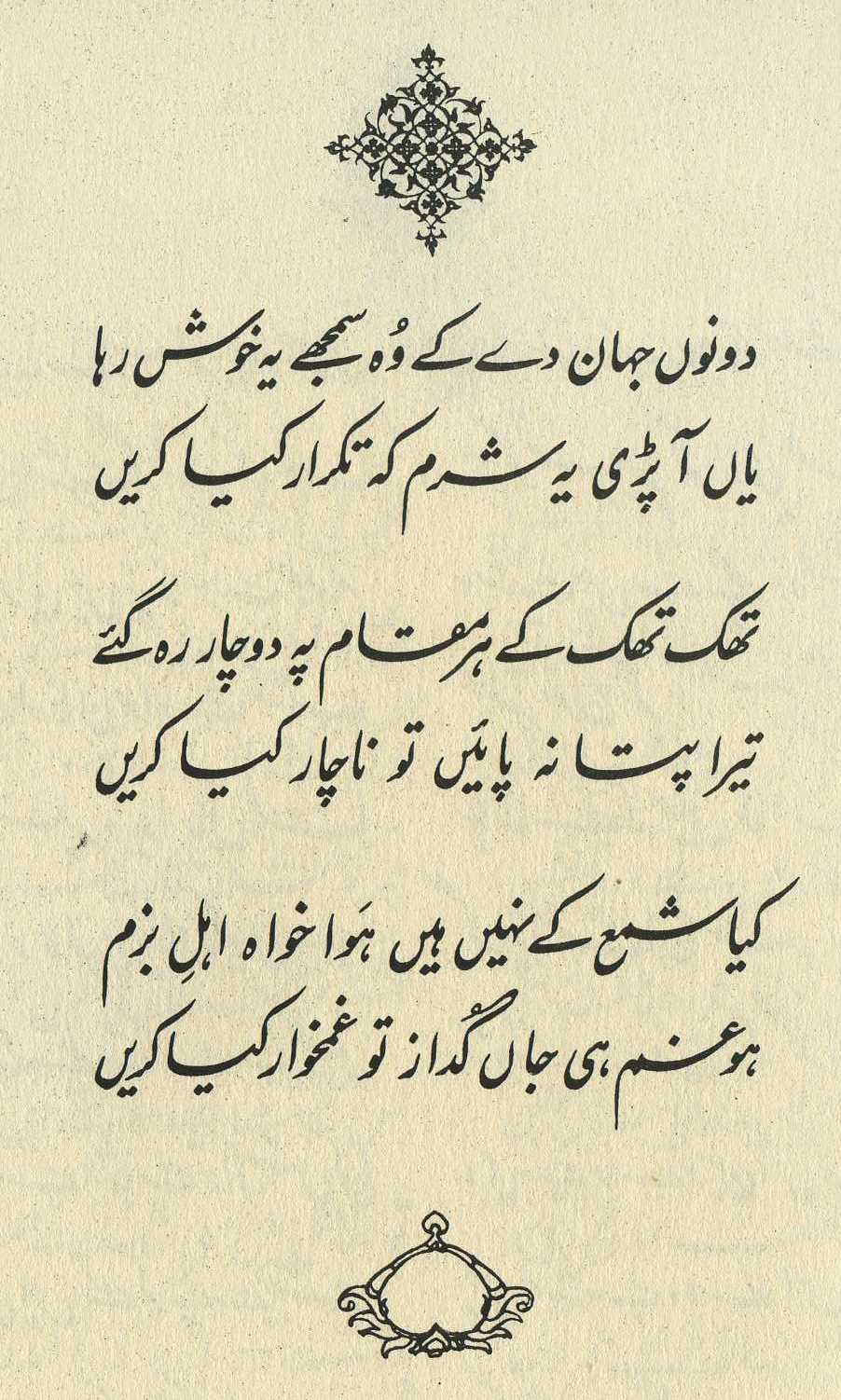
It's an expression of the loftiness of his spirits and, with that, his refinement of temperament. That is to say, if I took both worlds and remained silent, the reason is not that I am content with them; rather, I felt shame at asking for more and insisting, so I chose silence.
==Urdu text: Yadgar-e Ghalib , p. 150
That is, having bestowed on us this world and the world to come, He thought that we were content. We said, how would we insist/object? Otherwise, our sole claim was that we should not be separated from Him, and would not want all the rest of this. (109)
== Nazm page 109

God gave Man two worlds and thought His munificence made Man content. Man's powers actually demanded many more worlds to conquer, but Man remained quiet in order not to embarrass God.
== Naim 1970, p. 36
cannot apply to God, unless it's assumed that Ghalib wrote contrary to the idiom [because in Urdu usage only the proper name of God can be used with a plural verb, while when used for God requires a singular].... [Also, the usual reading of the first line is a slur on God's omniscience, since it attributes to him an incorrect judgment.]....
The beloved too possesses two worlds, the outer (that is, her body) and the inner (that is, her heart). The beloved bestowed everything, outer and inner, and considered that I would be content. But I was not content; I only remained silent because, how would I do (meaning 'disputation', or meaning 'repetition')?-- to be more greedy is contrary to courtesy []. Now the question is, beyond the outer and inner, what can there be that I was in search of? The answer is, the lover in reality was in search of the beloved's essential self []; that is, he wanted to lose himself in the beloved's existence, not have control or use of her....
If it be supposed that refers to some praiseworthy person-- for example, that he is in the service of some venerable elder or pir-- then too the interpretation can be established. The phrase 'both worlds' can also now refer to this world and the next, or can also be taken as 'an uncommon gift or endowment'. There's a famous story that one time Khvajah Bakhtyar Kaki, overcome by some uncommon spiritual mood, said to those present in the gathering, 'Whatever you want, ask it of me'. Somebody asked for paradise, somebody for mystic knowledge, somebody for the world. But Baba Farid said, 'I ask only for you'. It's possible that at the time of composing the verse a dim effect of this event, or some such event, may have been in Ghalib's mind.
== (1989: 148-50) 2006: 170-72
I was initially surprised by Faruqi's contention that the 'he' can't be God, because I'd taken it that way without the slightest hesitation, just as the commentators had. I haven't given Faruqi's detailed account of the idiomatic examples that support his claim; his full commentary is (in this case as in so many others) well worth reading in the original.
In any case, to me the more fascinating line is the second. From the first line we get an impression of lavishness, grandiloquence, a donor highly content with his/her generosity-- a one-sided social transaction to which the response should be an overjoyed gratitude. When a highly-placed, well-meaning benefactor, whether human or divine, gives what s/he quite plausibly thinks is a lavish gift-- well, isn't it only proper that a courteous, well-bred recipient should accept it gratefully, rather than vulgarly, greedily arguing about the nature of the gift, or demanding more?
But then in the second line we learn that the well-meaning benefactor has unknowingly given a clumsy, inadequate, quite unsuitable gift-- one that we'd never have considered sufficient in any case, and perhaps one that (as Nazm claims) we didn't even want at all. Thus we are forced to show grace under pressure-- we must act pleased and grateful, while suppressing all signs of our disappointment and pain. Our frustration is all the greater because courtesy requires us, now that we've received such an ostensibly lavish gift, to make no further requests.
Thus we are the ones who are the real benefactors. To avoid hurting the donor's feelings, to avoid a shameful appearance of vulgarity and greed, we suppress our true feelings and accept forever, irrevocably, an inadequate gift that we don't want, knowing that it precludes forever any chance of our even asking for-- much less receiving-- a gift (if any) that we really do want. We are the gracious ones, and the giver is the one receiving our grace.
How deftly, economically, and inconspicuously the second line turns the first one on its head! And how proper, too, for a classic mushairah verse like this one.
On as 'to consider', see 90,3 .
For an even more wonderfully extravagant verse that definitely does apply to God, see 4,8x .
Note for grammar fans: On the translation of as 'would remain', see 35,9 .
graphics/twoworlds.jpg