Verse 31852aarkyaa kare;N
G3
1
are the people of the gathering not friends/lovers of the candle?
2
if/when only/emphatically grief would be life-melting, then what would/can sympathizers/'grief-eaters' do?
'Desirous of vanities; vain; ambitious; fond of pleasure; —a vain, or an ambitious, man; one who is fond of pleasure; —a well-wisher, friend; lover'.
| References | |
|---|---|
| Arshi, Imtiyaz Ali | Ghazal# 113 |
| Raza, Kalidas Gupta | 425 |
| Hamid Ali Khan | Open Image |
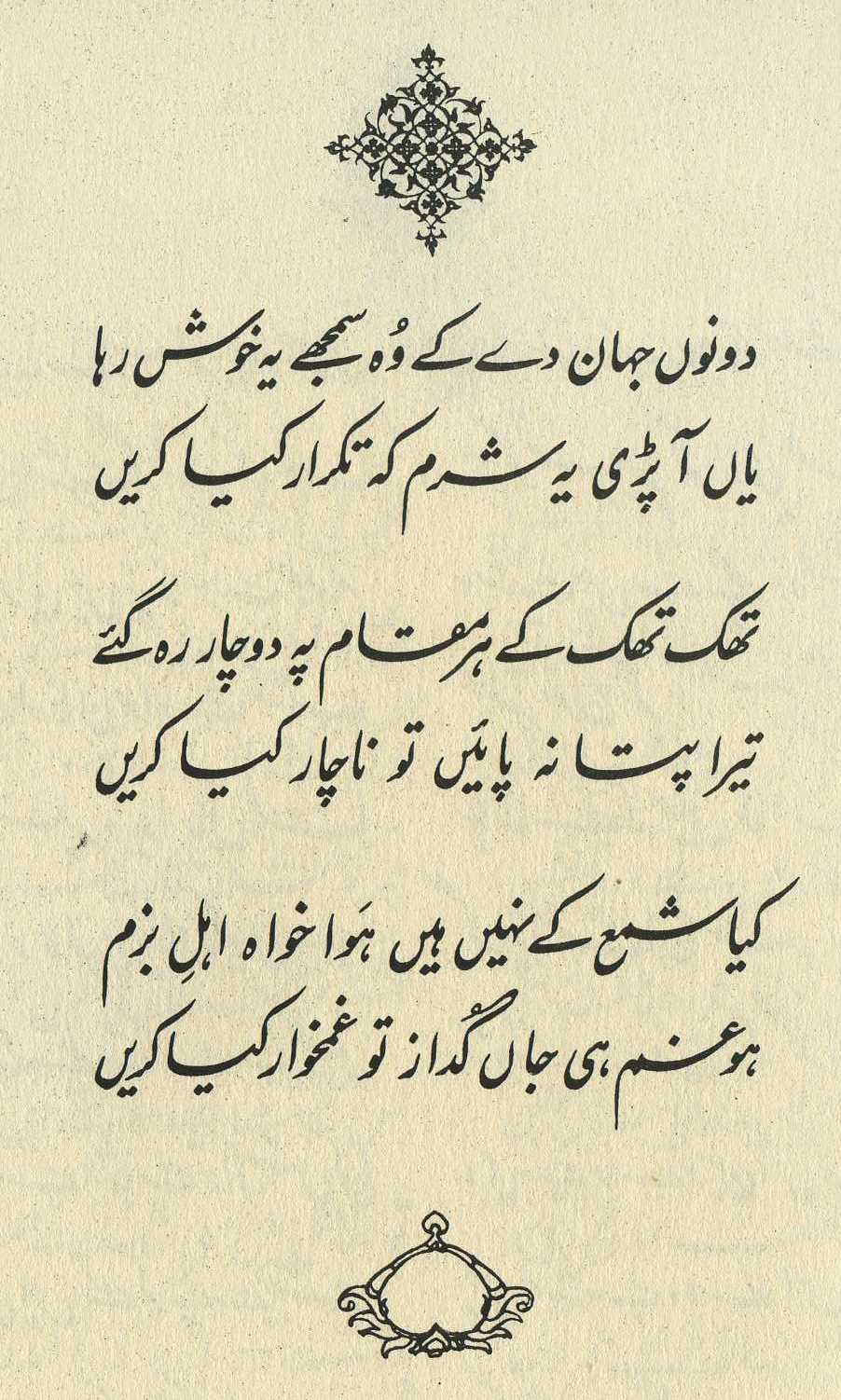
The mention of the candle is only an allegory ; the intention has to do with his own situation. (109)
== Nazm page 109

The people of the gathering sympathize with the candle, but they are helpless-- the candle's grief itself is such that it can't be cured by anyone. That is, what fate decides for anybody, that very thing happens. An allegory of this should be considered: if there's some invalid who's the life of the home and family, and is burning with fever. Not only the family members, but even others, want the sick person to be cured. But no one can do a thing, nothing can be accomplished. Here, the candle has been mentioned as an allegory. Otherwise, the intention is to reveal his own situation. (210-11)
(1) The first line could be the allegory , and the second the exposition [].... [Thus, as in the common interpretation, the verse would move from the particular to the general.]
(2) The candle keeps burning and melting all night; thus its grief has been described as life-burning. But there's an easy cure for its burning and melting: that it should be extinguished-- that is, that its life should be ended. As the night draws to a close, it will have to burn down and die anyway, so why is it obliged to endure pain and suffering all night?.... [This introduces the whole question of 'euthanasia' and 'mercy killing'.].... Ghalib has elucidated this problem with very great excellence.
(3) If the candle's head is cut off, then its suffering will be over. The candle's being extinguished will be very much in its own interest. But when the candle is extinguished, it will be dark. Then the people of the gathering, who claim to be well-wishers of the candle, will remain in darkness. The people of the gathering want light; to accomplish their purposes they keep the candle lit all night. Otherwise, with one gesture of theirs the candle can be saved from this long bath of fire. Thus the people of the gathering are not, in reality, well-wishers of the candle-- rather, they are its selfish enemies.
(4) Grief is so life-melting that its result can only be death. But this very death is the cure for this grief. That is, the cure is worse than the disease. Mankind's destiny is so ill-omened that he must either endure unimaginable grief, or accept the terrifying ministrations of the physician of Death.
(5) The first line is not a negative rhetorical question, only a question. Seeing the candle's bad state, somebody asks, 'Are the people of the gathering not its well-wishers, that they see it in such trouble but don't do anything?' [The second line answers the question.]
(6) For 'candle', 'life-melting' [] is very fine. The gesture toward meaning 'breeze/air' is fine. If the breeze is sharp, then the candle will be blown out, and will be freed from burning. But if there's no 'air', then too the candle can't burn, because oxygen is necessary for burning. Thus in [literally in one sense, 'air-desirer'] Ghalib's special paradox is present as well. It's a brilliant verse.
== (1989: 151-53) 2006: 173-75
What an elegant tribute to the powers of speech-- both lines contain parallel questions that, in both cases, may or may not be rhetorical. As Faruqi has rightly pointed out, it's not necessarily obvious that the people of the gathering are friends of the candle (they deliberately keep it alive in its suffering so that they can exploit it for light). Nor is it obvious that they can do nothing for the candle-- Faruqi describes this question as encapsulating the various sides of the question of euthanasia.
Faruqi also points out the wordplay involving -- does it mean 'well-wisher', or do its overtones of frivolity and selfishness ('air'-wisher, or 'lust/desire'-wisher, as in the definition above) loom equally large? There's a similar wordplay in the second line as well. When 'grief' [] itself is 'life-melting', then what can a 'grief-eater' [] do? Just as in English 'sym-pathy' literally means 'feeling-with', in Urdu a sympathizer is a 'grief-eater' who takes in a share of someone's sorrow. But when the grief is so mortal, can even the most dedicated 'grief-eater' really ingest it?
The question echoes the larger question of whether the people of the gathering really are, or aren't, well-wishers of the candle; and what sympathizers can, or can't, do for the candle in its mortal agony. All these questions, unanswered and starkly unanswerable, hover around the verse, and there's no way to lay them to rest.
When it comes to candles, compare the powerful simplicity of Mir 's M 23,1 .
graphics/candle.jpg