Verse 11816aarapnaa
G2
1
Asad , we are such a madness-moving wretched/'head-and-foot-less' beggar
2
that the comb of the deer's eyelashes is our back-scratcher
'Wandering up and down, wandering about; moving or springing from side to side... moving round ... coursing; ... Fetters, irons'.
'A hand made of ivory (to scratch the back with)'.
'A claw or scraper of ivory, or wood, &c. (shaped like the human hand) with a long handle, to scratch the back'.
| References | |
|---|---|
| Arshi, Imtiyaz Ali | Ghazal# 32 |
| Raza, Kalidas Gupta | 147-148 |
| Asi, Abdul Bari | 58-59 |
| Gyan Chand | 82-84 |
| Hamid Ali Khan | Open Image |
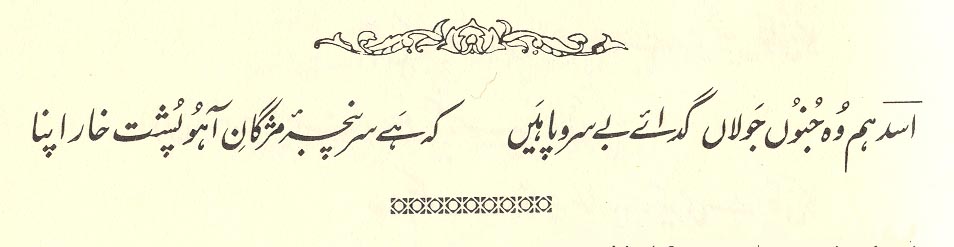
The juxtaposition of [literally, 'lion'] and deer is apparent. Through being 'madly-moving' he has implied that the deer remains behind me and with its 'back-scratcher' rubs against me from behind. The word ['beggar'; also, 'pillow, back-cushion'] is for its affinity with 'back-scratcher'. By saying 'limbless' [literally, 'without head and foot'] he means that I have not even a back-scratcher; if I have any at all, it is the deer's eyelashes. The grounds for similitude between 'comb' and 'eyelashes' and 'back-scratcher' are apparent; that is, all three have something like the same form. First he has used 'comb' as a simile for 'eyelashes', then 'back-scratcher' as a simile for 'comb'. (24)
== Nazm page 24

Urdu text: Vajid 1902 {23}
Oh Asad, we are a limbless beggar, and our display of madness and wildness is famous even in remote places, for we have achieved supremacy even over Majnun . (It is said that a deer always used to come to Majnun, and Majnun used to use its eyes as a simile for the eyes of Laila .) Mirza Sahib displays his own state of madness as more perfect than Majnun's. And he says that the comb of the deer's eyelashes is his back-scratcher. That is, in the state of madness/wildness I leave behind even a wild creature like the deer; even he cannot outdo me. (49)
All these words-- madness, moving, beggar, helpless [ , lit. 'without head and foot'], comb [ , lit. 'head-claws'] of the deer's eyelashes, back-scratcher-- have an affinity among themselves. (58)
This verse too should be considered a ['a labyrinth or maze....any complicated or puzzling plaything, or machine, &c'. (Platts p.924)].... How can one get hold of these elaboratenesses? (84)
One excellence of this is that in the state of madness, while wandering in the desert he is moving so fast that even the deer, which is famous for bounding along, remains behind him. For this reason its eyelashes act as a back-scratcher. (99)
In this verse there is neither attractiveness nor movingness, neither poeticness nor meaningfulness; he's only put together an enchantment [] of words.... the theme of the verse has become 'the story of Hamzah ' [as in 22,7 ]. (326)
This verse is founded on verbal elaboration [], in which layers of wordp lay have created a novel glory. The harmony too is very dignified and suited to the theme. [Nazm] Tabataba'i has alluded to the subtle wordplay between and . In addition to this, -- all these are strung together by layer upon layer of wordplay. Between and there's also a double wordplay, and in this verse Ghalib's beloved art of paradox , too, shows itself with full effect.
The apparent interpretation of the verse is that 'I am such a helpless beggar that I don't even have a back-scratcher, and my state of madness is such that I have outrun even the deer, and the deer's comb-shaped eyelashes do the work of a back-scratcher for me. In this one paradox is that on the one hand he shows such swiftness in 'madness-moving' that he's emerged ahead even of the deer, and on the other hand such destitution that he doesn't even have 'head and foot'. It's clear that when he has no head and foot, then how can he run?
The other aspect of the paradox is that when head and foot are not present, then he doesn't exist. And when he doesn't exist, then that deer too is imaginary, whose eyelashes he uses as a back-scratcher. Then, there's the further pleasure in that when he has no [head], the [lit. 'head-claws'] of the deer's eyelashes is present. The affinity of with 'back'-scratcher is also worthy of notice.
Consider some other affinities : (meaning 'lion') and [with meaning 'claws']; also means 'shackles', so we can suppose madness to be shackles as well, in which we are confined and are being dragged around.
In this verse affinity arises among several words by virtue of , a figure involving words that have a mutual connection among themselves, but in which that connection gives no evidence about the meaning of the utterance. For example, -- here there is an affinity among ( ), , and . But this affinity does not establish/prove the real meaning. Since the use of a creates in poetry a new kind of tension, it always proves to be a means for creating beauty and pleasure/subtlety in poetry. For example, between and there's the connection of a , because a lion too has claws.
== (1989: 42-43) 2006: 52-53
The poet chose to present this in the divan as an individual verse [], not part of a ghazal (as it originally was). The first line is an in-your-face paradox: 'We are such a (with as a vigorously colloquial replacement for something like ) madly swift-moving, wretched-- literally, 'headless and footless'-- beggar'. The oral poetics of mushairah presentation then provide a delay, and surely a repetition of that wild first line.
When (after suspense and curiosity have built up) the second line finally resolves the situation, even the knower of ghazal convention must stop and think a minute before both sides of the coin become properly unified. The speaker is so madly fast a runner that he outruns even the deer, who races along behind him, breathing down his neck but unable to overtake him; thus the speaker feels the deer's eyelashes on his back. At the same time, he is so helpless, so hapless, so headless-and-footless a beggar that he is like the famous Majnun in the wilderness: the animals sympathize with him in his solitude and suffering. Since he is too weak to move, the deer comforts him by coming up to him and rubbing its nose on his body, and scratching his aching back with its eyelashes.
The impossibility of both these conditions existing at once, and the flagrant delight in the paradox of asserting that they do, is part of the exuberance and metaphysical wit of the Ghalibian ghazal. It is also an evocative representation of the heights and depths of passion. To be a lover is to be both hyperactive and helpless, both omnipotent and undone. The verse 'proves' its point with a perfect claim that works both ways.
It's also a brilliant mesh of interlocking wordplay. The commentators among them have done a good job of bringing it out, so I won't bother repeating it all.
Here's my long-ago attempt at a translation (1985) .
Compare the equally extravagant but less successful 69,4x , in which the lover's eyelashes are used to comb out the forelock of Speech; in 104,4x , the hoopoe uses his crest as a comb.
Compare Mir's equally baroque use of the : M 321,4 .
graphics/deer.jpg
graphics/backscratcher.jpg