Verse 31862aan((aziiz
G11
In this meter the first long syllable may be replaced by a short; and the next-to-last long syllable may be replaced by two shorts.
1
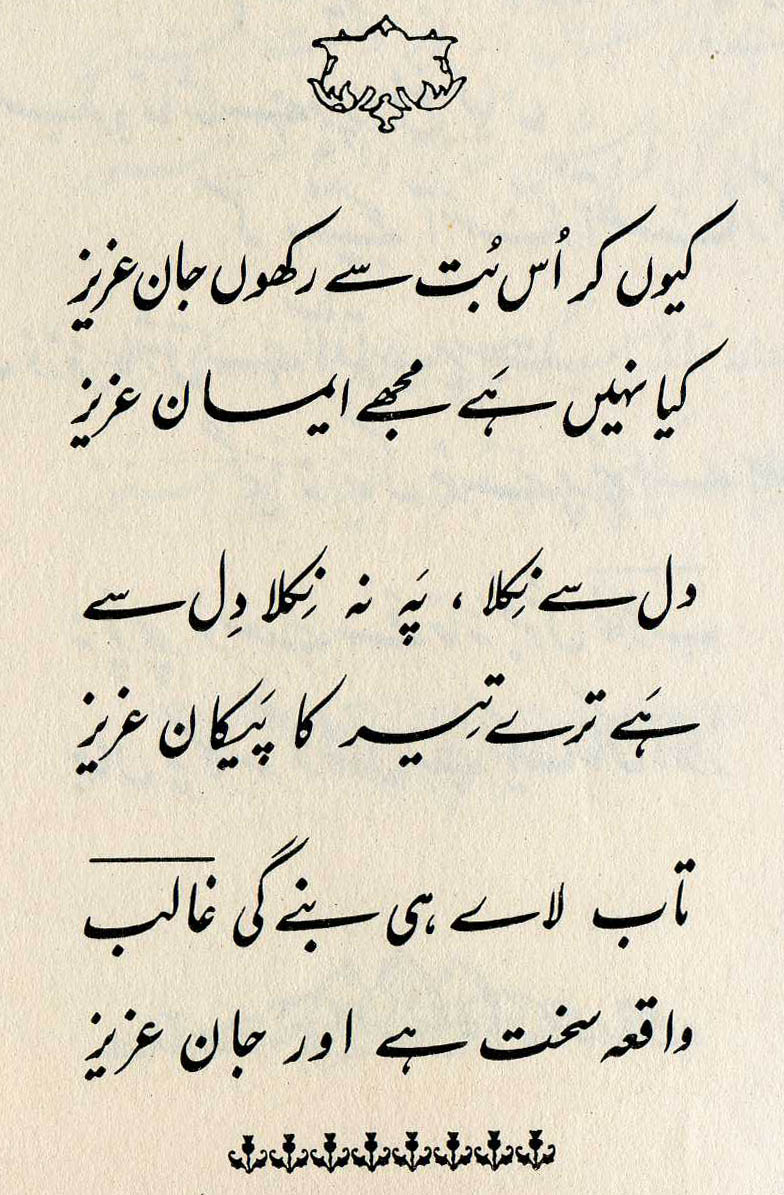
only/emphatically having mustered/'brought' strength/endurance will the thing get done, Ghalib
2
the 'event' is harsh-- and [one's] life, dear/precious
'To muster strength, endurance, or courage, &c. (for); to be able to bear'.
'Speech, language, word, saying, conversation, talk, gossip, report, discourse, news, tale, story, account; thing, affair, matter, business, concern, fact, case, circumstance, occurrence, object, particular, article, proposal, aim, cause, question, subject'.
'To be successful, prove a success, answer well; to gain credit or honour, to prosper, flourish'.
'Event, occurence, incident; --news; intelligence; --accident; misfortune; a grievous calamity; -- battle, encounter, conflict; -- casualty; death; --a dream, vision'.
| References | |
|---|---|
| Arshi, Imtiyaz Ali | Ghazal# 71 |
| Raza, Kalidas Gupta | 477 |
| Hamid Ali Khan | Open Image |
[1865, to Ala'i:] I haven't seen our brothers since; one is afraid to go out into the bazaar. Javahir the messenger [] conveys my salaam to the brothers, and their salaam to me. This I consider to be a lucky break []: {70,3}; 219,1 .
This closing-verse and opening-verse are recorded in the divan , but just now my eye fell on both verses, thus they have been written down. [For the continuation of this letter, see 216,1 .]
==Urdu text: Khaliq Anjum vol. 1, pp. 421-422
[1866, to Taftah:] Why do you renounce clothing [as an ascetic]? What do you even have to wear, that you'd remove it and fling it away? Through the renunciation of clothing the bondage of existence won't be erased. You can't live without eating and drinking. Treat harsh and easy times, sorrow and comfort, as all equal. No matter how, in this way, in any way, let things flow by: {70,3}. ==Urdu text: Khaliq Anjum vol. 1, p. 355 ==another trans.: Russell and Islam p. 334
[1866, to Taftah:] Why do you renounce clothing [as an ascetic]? What do you even have to wear, that you'd remove it and fling it away? Through the renunciation of clothing the bondage of existence won't be erased. You can't live without eating and drinking. Treat harsh and easy times, sorrow and comfort, as all equal. No matter how, in this way, in any way, let things flow by: {70,3}. ==Urdu text: Khaliq Anjum vol. 1, p. 355 ==another trans.: Russell and Islam p. 334
== Nazm page 70
;
Nazm page 71


Mirza Sahib's
closing-verse
too is in grief at the death of the late
Arif
.... That is, the harshness of the event says, you ought to give up your life; and life is such a dear thing that under any circumstances, a man doesn't wish to give it up. (118)
This closing-verse too is in memory of the late Arif. (145)
Apparently, its meaning is that although separation from the beloved is a very soul-destroying event, or rather incident, still, one will be forced to endure this shock. Because everyone's life is, under all circumstances, dear to him. But a reference to the occurrence of 1857 may also be intended. (456)
The feminine singular is agreeing with an invisible, omitted . For more on this idiomatic construction see 59,2 .
Bekhud Dihlavi and Josh assert quite firmly that the 'event' referred to in this verse is Arif's death. Chishti suggests, more cautiously, that the 'event' may be the Rebellion of 1857. As far as I know, there's not a shred of evidence to substantiate either claim. Ghalib's elegy for Arif, 66 , was composed in 1852, fully ten years before the present ghazal. The Rebellion of 1857 took place five years or so before this ghazal was composed.
Apart from the scholarly issue of their blandly inventing such things, one may well wonder why these commentators even want or need to do it. Why seek to attach a radically unspecific verse to only one single event, and thus rob it of much of its power? This is another result of the 'natural poetry' [] movement in Urdu poetry and criticism, which values poetry for its power to reveal the 'real life' of the poet and the 'real conditions' of his society. I have often railed against this approach to the ghazal; if you're interested, I spell it all out in Nets of Awareness . The commentary on this verse is one more small piece of evidence in favor of my case. For an even more egregious commentarial folly, see 90,3 . And for my favorite personal anecdote, see 191,8 .
This whole little ghazal shows what can be done with a 'short meter.' Simple, stark, unaffected lines can be created that achieve powerful effects in few words-- and usually short ones, at that. It's life in general that's at issue here. We have to grit our teeth and endure: life is painful, but we want to live. How much more stark, and more true, can two lines get? By leaving the nature of the 'event' in line two absolutely unspecified, the poet invites us to fill in our own choice of calamity (including death; see the definition above), or even to take the word to mean 'news, intelligence'. This 'imagine-it-yourself' device is one that he uses often: see for example 71,2 , 191,8 , and 208,12 . But the present verse is the ultimate case of what can be done with eleven short, simple words.
Compare the second line with a well-known proverb used by Mir in M 545,1 .
graphics/endurance.jpg