Verse 2after 1847arkahe ba;Gair
G3
1
[she] says, when the strength for speech did not remain to me
2
'how would I know [the speech/idea] of anyone's heart, without [his] saying [it]?'
'Speech, language, discourse, word, words; --thing, business, affair (syn. )'.
'Speech, language, word, saying, conversation, talk, gossip, report, discourse, news, tale, story, account; thing, affair, matter, business, concern, fact, case, circumstance, occurrence, object, particular, article, proposal, aim, cause, question, subject'.
| References | |
|---|---|
| Arshi, Imtiyaz Ali | Ghazal# 64 |
| Raza, Kalidas Gupta | 398-99 |
| Hamid Ali Khan | Open Image |
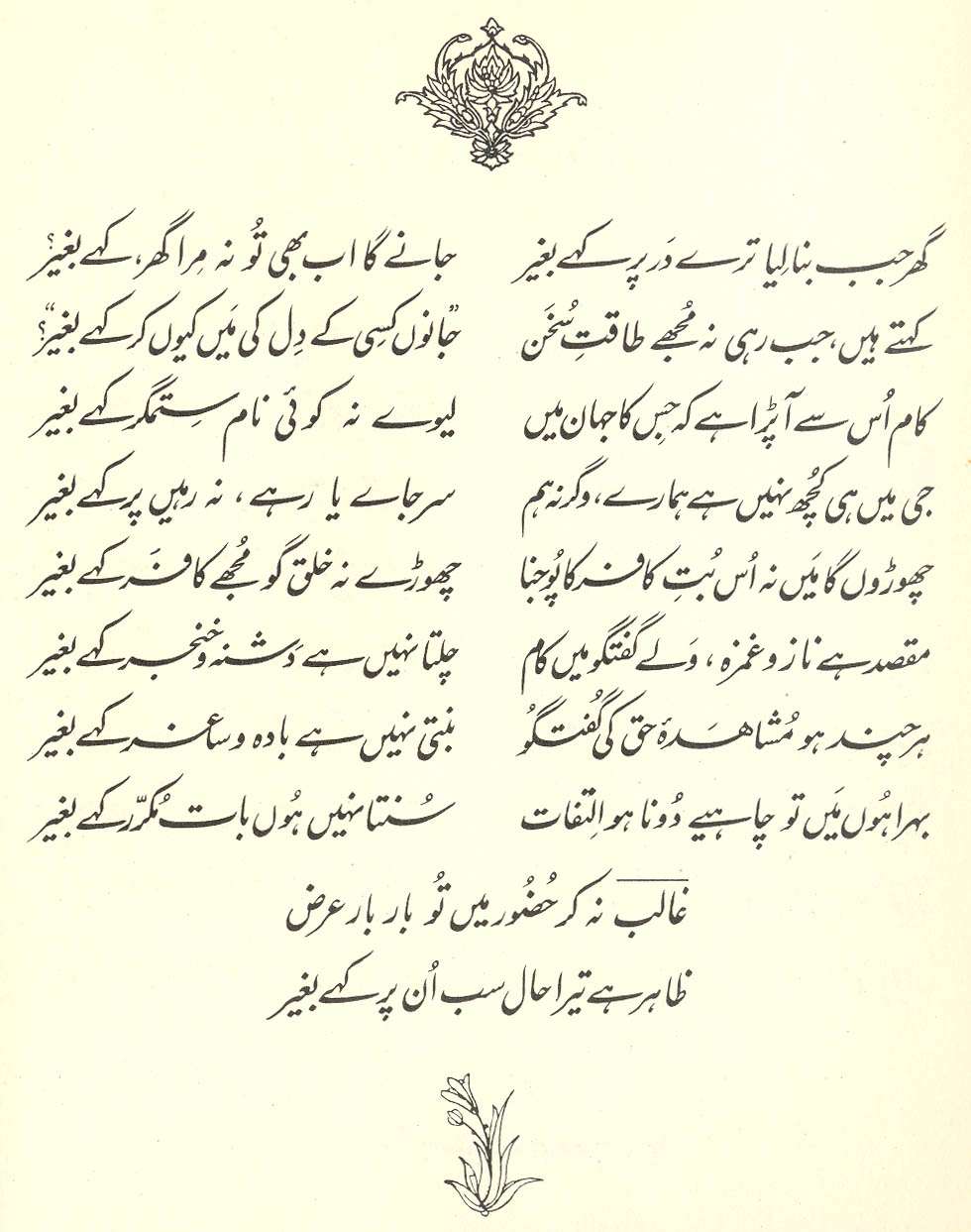
The meaning of the verse is apparent. This verse makes very clear that the poet often speaks in assumed voices. Sometimes, considering himself a creature without speech, a Nightingale , a Ring-dove , he complains of the hunter and the gardener. Sometimes, assuming himself to be a motionless blade of grass, he declares himself to be a withered branch or an autumn-wasted plant. Sometimes, considering his breath to be like that of unbreathing things, he converses with the tongue of the dust of the roadway or the wave of the spring breeze. Sometimes, becoming a lifeless dead person whose hopes have been extinguished, he claims justice for his murder.
In short, this field is very broad. In this verse the poet himself says that he has no further strength for speech, then he also complains that when I despaired of describing the state of my heart and when the power of speech was finished, then you say 'without your speaking, how would I know the state of your heart?' And this speech is in an assumed voice. (54)
== Nazm page 54

The reference of 'that one says' is to the beloved. That is, she says-- and says at the time when no strength of speech remained to me-- that I may describe the state of my heart at length and in detail, for how can she understand the intent of the heart without its being described? The meaning of the verse is that when no power of speech remained to me, then that enjoyer of tyranny, out of mischievousness, accuses me of not describing the secrets of my heart. (101-02)
This verse is a universe of poetry. It must be remembered that the poet is the translator of the world-- sometimes he tells his own experiences, and sometimes a universal story; sometimes he speaks with the voice of his situation, and sometimes with words.... Mirza has captured a picture of a situation before which the mastery of speech prostrates itself. (129-30)
ABOUT : It's fun to find Ghalib using exactly the kind of idiomatic forms that students still learn in elementary Hindi/Urdu today. The abstract and protean feminine noun (see the definition above) is so utterly, conveniently, indispensably omnipresent that people frequently don't even bother to say it. So when you encounter a sentence with a dangling feminine adjectival form, the odds are overwhelming that it's evoking a hovering, unstated, but still fully powerful-- . More examples: 15,12 ; 51,7x ; 59,7 ; 70,3 ; 111,3 ; 116,4 ; 151,1 ; 169,7 ; 215,4 . Some examples with actually present: 21,13 , an ultimate case; 109,3x ; 131,10x , twice; 163,9 , ; 231,3 , . Examples with similarly omitted masculine nouns: 66,5 , presumably ; 136,4 , presumably ; 160,3 , presumably .
For once, the beloved speaks-- but only when the lover is too weak and worn out with passion to speak in reply. And her speech is, with deliberate cruelty or casually cruel indifference, designed only to put him in the wrong, and to place him in an impossible situation. All the times he's tried to speak, longed tp speak, and maybe even spoken, wearing himself out with the effort-- none of it has registered. She alone decides what counts and what doesn't. She waits till her lover is overcome by weakness; then she talks-- only to reproach him for not talking. But he's not surprised, of course. He's just ruefully reporting, maybe even with a wry amusement, the normal vicissitudes of the lover's life.
Nazm makes the convoluted but intriguing point that the speaker in the verse is using some kind of a special meta-voice, since he tells us in the first line that the power of speech 'did not remain' [] to him. (This is another example of that skewing of the tenses between Urdu and English discussed in 38,1 , since in English we'd say 'hasn't remained'.) So if he has no power of speech, how is he speaking to us who are listening to the verse?
On the structure of , see 59,1 .
graphics/heartmouth.jpg