Verse 9after 1847arkahe ba;Gair
G3
1
Ghalib, don't make petition again and again in the Presence!
2
your whole situation is manifest to him/her, without saying [it]
zaahir>> : 'Appearing, apparent, overt, open, perceptible, visible, perceived, plain, evident, manifest, conspicuous'.
| References | |
|---|---|
| Arshi, Imtiyaz Ali | Ghazal# 64 |
| Raza, Kalidas Gupta | 398-99 |
| Hamid Ali Khan | Open Image |
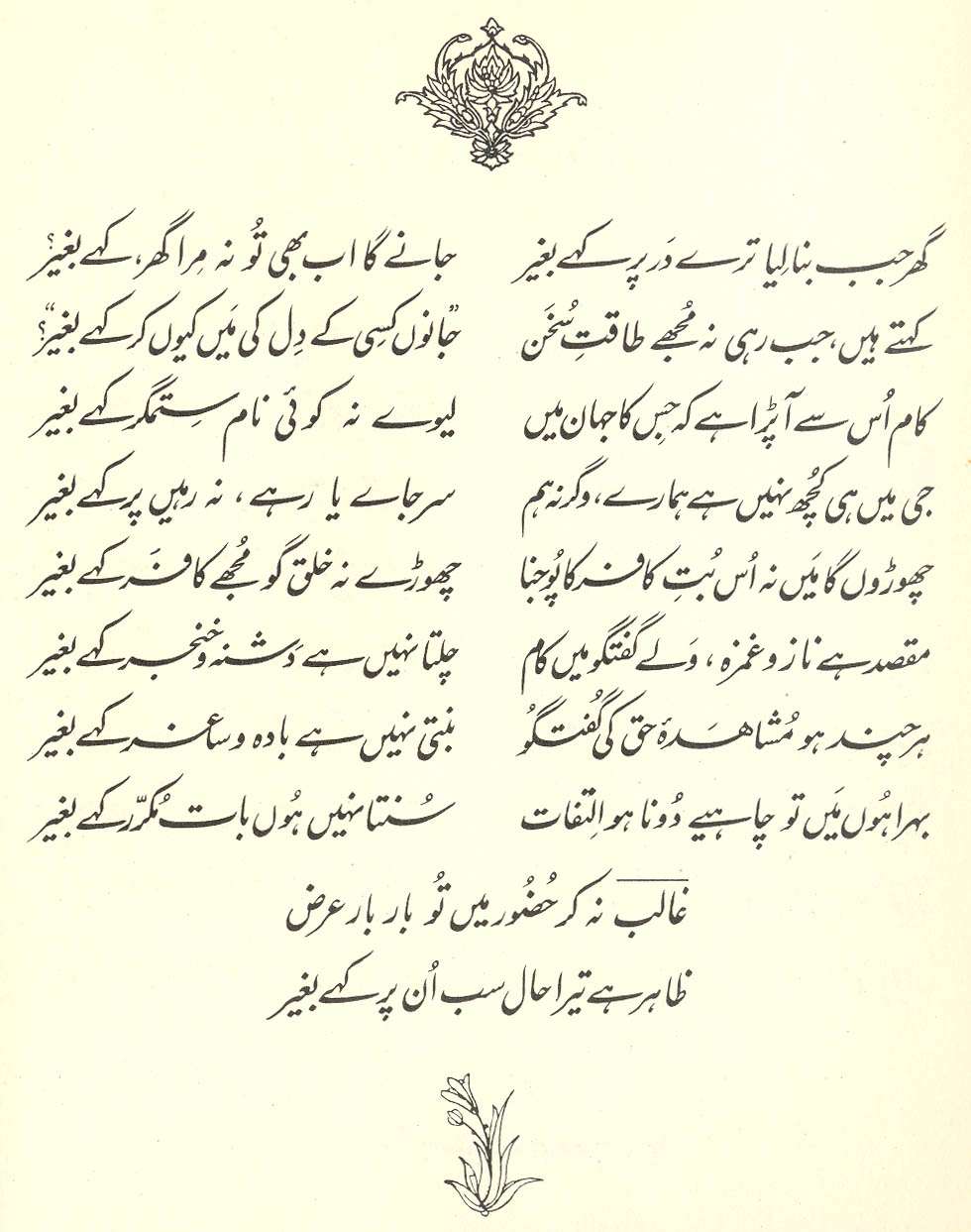
In this verse is the verbal device that he's expressed his state in such a way that it's as if he hasn't said anything. And this ought to be counted among the verbal devices of meaning []. (55)
== Nazm page 55

In addition to the verbal device of meaning [], in this closing-verse the great excellence has been created that even after presenting the petition of his case in its entirety, it is proven that it's as if he's said nothing at all. (103)
Helplessness and wretchedness are implied so logically in this theme that there's not even any need of further commentary. (139)
As Josh observes, if the lover is sufficiently wretched-looking, wasted, and visibly suffering, then what need of words to describe his plight? And as the other commentators note, he has found a rhetorically clever way to say something without saying it, by telling himself not to say it, and identifying exactly what it is that he's not to say. Or rather, not to say repeatedly [], since perhaps it would be permissible to say it once (even though it shouldn't be necessary to say it all, since it's manifest anyway).
The person to whom he's not to say it is 'His Excellency'-- literally, 'the Presence' []-- a title of great respect used for a superior in rank, who is naturally addressed in the plural of respect []. By contrast, the poet is addressed with the intimate , either because he's talking privately to himself, or else because someone else (a friend? a courtier in His Excellency's service?) is addressing him in a patronizing manner, politely but firmly requiring him to observe proper courtly etiquette.
graphics/notspeaking.jpg