Verse 4after 1847arkahe ba;Gair
G3
1
there's nothing only/emphatically within our inner-self, otherwise
2
[our] head might go or remain, but we would not remain without saying [it]
'Life, soul, self, spirit, mind; heart; courage; disposition; affection, regard; strength; health'.
| References | |
|---|---|
| Arshi, Imtiyaz Ali | Ghazal# 64 |
| Raza, Kalidas Gupta | 398-99 |
| Hamid Ali Khan | Open Image |
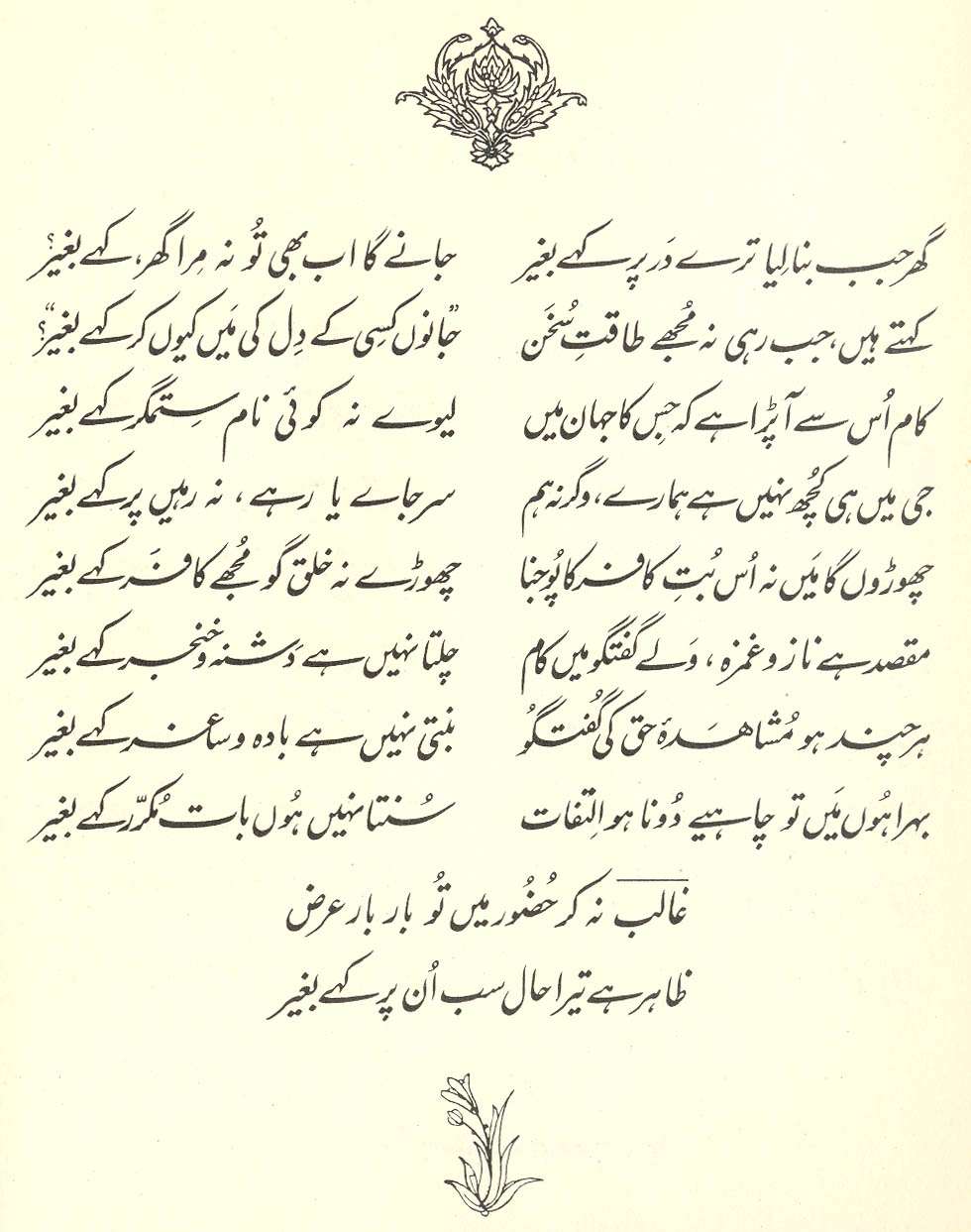
In this verse there's a moral theme . He says, my heart is the purest-- if in it there were any ill will toward anybody, I would have expressed it. Therefore whatever emerged as expression, I accept it; but I don't accept a dual temperament-- that one thing would be apparent, and another thing would be within. (55)
== Nazm page 55

The truth is that Mirza Sahib in his life was an example of fine morality. Who can cast doubt on the excellence of the verse? (102)
If we are silent, then don't think that we are silent through consideration for, or fear of, anybody. We're straight-speaking. If we had anything to say, then we wouldn't stop till we'd said it, even if it contained a secret. That is, we are absolutely uninhibited in speaking the truth. (130)
It's possible that he wants to say, we feel only love for the beloved, and have no other longing; otherwise, we would certainly have spoken out about our purpose. (167)
In Lucknow, they say [not but] . (212)
The commentators generally reduce the verse to what Nazm calls a 'moral theme'. They entirely overlook (or choose to ignore) the clever and amusing wordplay of the second line. I've said my say about their blindness to wordplay in discussing 26,7 , which is the most flagrant possible example, so I won't repeat it all here. But this is another notable instance of the same kind.
On the simplest level, look at the letters: in the second line there are no vowels except an overwhelming presence of short (fourteen), varied with a few examples of long (three), and (with the sounds of and ) (four). The sound of the line thus emerges as a riff on short , rhythmically interspersed with various consonants, especially . So many short vowels give it a somewhat incantatory quality. And when you say it aloud a few times, something else emerges suddenly from the rhythm.
Look at (the whole second line except for the refrain ). One way to say 'the head might go or might remain' is . Another common way to express the same idea, however, would be to say that the head , 'might remain, might not remain'. Here, Ghalib has virtually reproduced that phrase, in , which differs only in the nasalized plural ending (for ) of . So one might subliminally hear the line as 'the head might go or might remain or might not remain'.
Then the that ends the phrase, so strongly recalls the initial that it almost recreates it, as well as having an emphatic meaning of 'but'. In short, the closural force and well-roundedness of the phrase are powerfully present to the ear (and mind). And of course, the bouncing back and forth between the head going or staying or not staying works perfectly with the meaning of the first line-- if the whole self is so empty, can one even care whether the head goes or stays?
The primal little word , intensified and echoed by , works wonderfully here. It means so many things, and such fundamental ones, that it's almost untranslatable. One who has an empty has indeed nothing to say-- or to think, or to feel, or to live for.
In short, nobody would call out in approval-- and all the classical poets aimed at public approval in the mushairah setting-- for a verse that merely asserted the poet's moral high-mindedness. The punch comes in the second line, and it comes through a deft combination of wordplay, meaning-play, and sound effects.
On the structure of , see 59,1 .
graphics/words.jpg