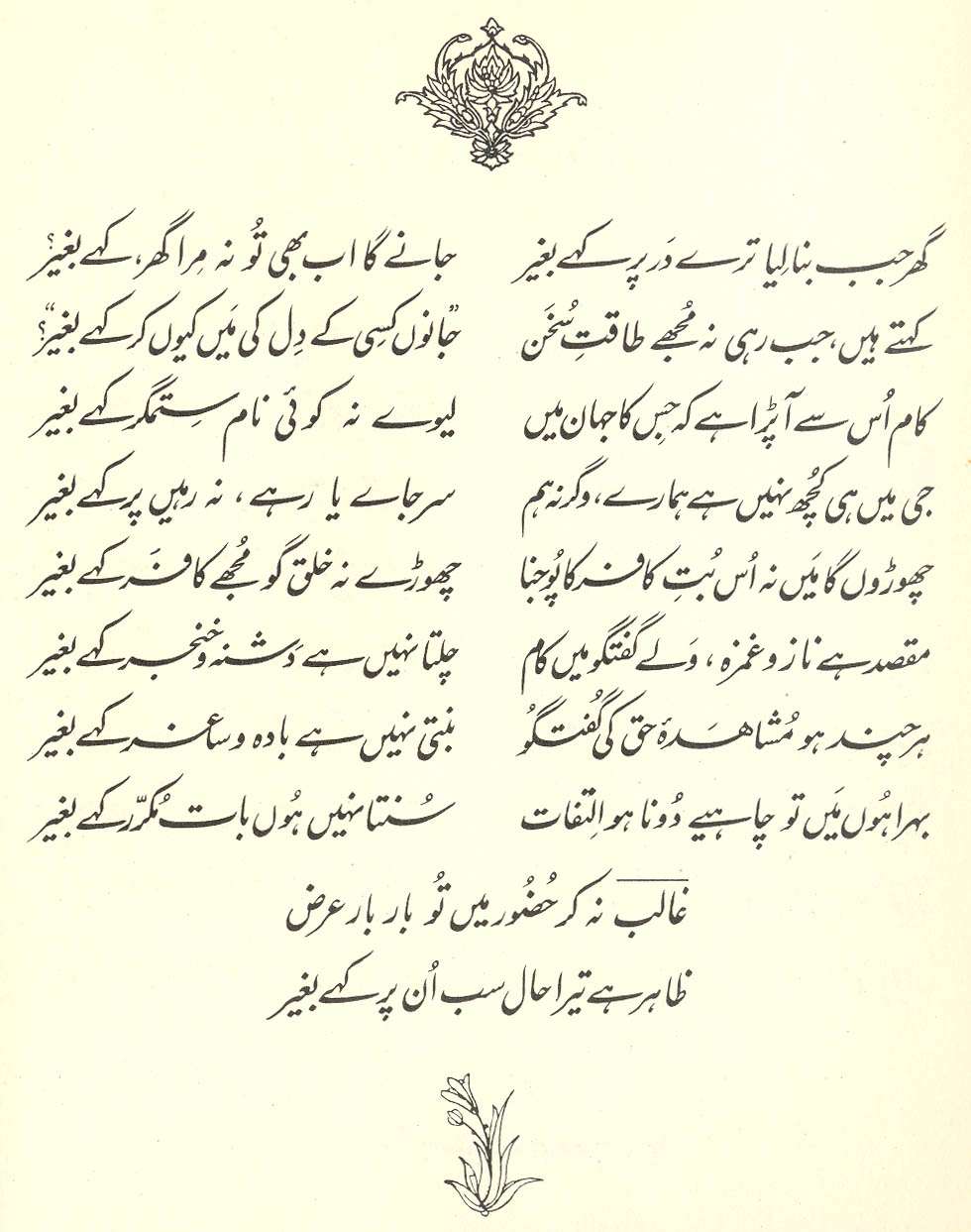
Verse 1after 1847arkahe ba;Gair
G3
1
when I built a house at your door, without [your/my] saying [anything]
2 a
will you not know my house, even/also now, without [your/my] saying [anything]?
2 b
you will not know my house, even/also now, without [your/my] saying [anything]!
'Without, exclusive (of, -), excluding; except, besides, independent (of)'. (Platts p.159
| References | |
|---|---|
| Arshi, Imtiyaz Ali | Ghazal# 64 |
| Raza, Kalidas Gupta | 398-99 |
| Hamid Ali Khan | Open Image |
In the second line there is a negative rhetorical question []. (54)
== Nazm page 54

In this opening verse Mirza has used a new style of mischievousness. He says, whenever I've complained to the beloved that she never comes to my house, out of mischievousness she says in reply, I don't know your house, otherwise I'd certainly come. Now Mirza, leaving his old house, has come and taken up residence on the beloved's doorstep. And he says to her, without your permission I've made a house on your doorstep, but even now you can't know my house without my telling you! (101)
The beloved has usually been seen as stubborn and pitiless and stony-hearted. If some poor person or lover goes to her even a thousand times, then every time she always asks, who are you, where do you live. (129)
This ground too [like that of 58 ] is very 'stony' []. In the first line means 'permission', and in the second line it means 'telling'.
ABOUT : Formally speaking, is a postposition, and its basic form should be , as in other compound postpositions (see the definition above). That usage is sometimes found, especially in modern speech and writing. But in older usage, the expected is idiomatically replaced by . As for , it's the adverbial perfect participle of , so that the expression might be short for , 'without [being in a state of] something's having been said'. The structure works similarly with other verbs: see for example in 151,7 . The same idiomatic usage often extends to nouns, as with , 'without an axe', in 3,6 ; but we also find the modern standard usage, as in 115,9 ; and use with an , as in the cleverly multivalent 79,1 .
The in the first line may refer either to the lover's not saying anything to the beloved; or, as Josh points out, to the beloved's not saying anything to him (by way of a command or prohibition). In the second line too, the same two possibilities exist: the may mean without his informing her of his new address, or else without her inquiring about his new address. In either case, the lover is observing (reproachfully? teasingly? resignedly?) that the beloved pays almost no attention to him, even if he's right underfoot.
Josh describes this set of rhyming elements too, like those of 58 , as a 'stony' ground , meaning that its long and very specific refrain , , challenges the poet's inventive powers. I'm not convinced that the use of so-called 'stony' grounds for ghazals poses as much of a problem for the ustad as Josh seems to think. Let's not forget that the 'stoniness' is alleged only by Josh, long after the fact, and not at all by Ghalib.
The second line, though not formally a question (since it lacks the prefatory ), can quite well be read as one, since the prefatory that marks a yes-or-no question can always be colloquially omitted. Nazm and other commentators in fact insist on reading it this way. But reading it as a flat statement is also appropriate to the context, and makes a simpler but equally reproachful effect of its own.
Note for translation fans: After I've inserted the parenthetical '[anything]' because 'without saying' is so unidiomatic in English. But 'without speaking' doesn't convey the right idea either, since silence is not the point so much as the specific utterance that is not said.
graphics/house.jpg