Verse 91853aa))ekyuu;N
G15
1 a
without broken-down Ghalib, which tasks are ended?
1 b
without broken-down Ghalib, which desires are constrained?
2
why do/would you weep bitterly? why do/would you lament?
'Wounded, hurt; broken; infirm; sick, sorrowful'.
'(Hindi) Action, act, deed, work, doing, handiwork, performance; work, labour, duty, task, job; business, occupation, employment, office, function; operation, undertaking, transaction, affair, matter, thing, concern, interest'.
'(Persian) Desire, wish; design, intention'.
'Fastened, tied up, bound; shut, closed, stopped, stopped up, cut off; prevented, hindered, barred, checked, restrained, suppressed; constrained, still, dull, heavy, paralyzed; contracted, straitened'.
| References | |
|---|---|
| Arshi, Imtiyaz Ali | Ghazal# 116 |
| Raza, Kalidas Gupta | 437-38 |
| Hamid Ali Khan | Open Image |
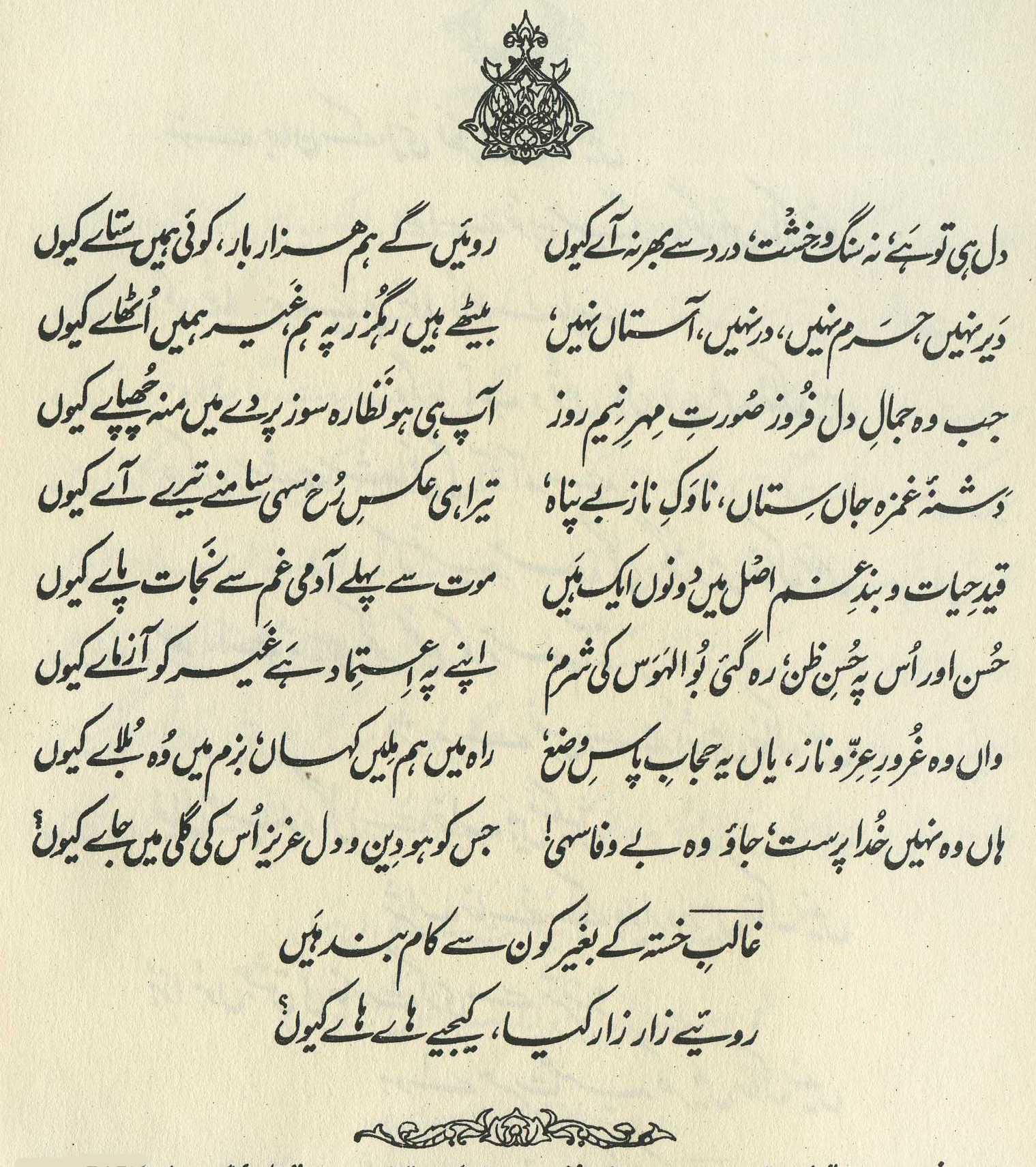
After dying, the poet comforts his companions, using the present tense. (124)
== Nazm page 124

Finding his friends grieved and sorrowful after his death, Mirza Sahib counsels them in these words to show fortitude. (176)
The deceased Ghalib, using the present tense, is comforting his companions. Why do you weep bitterly? All the tasks of the world are moving along. (234)
For general discussion of the structural qualities of this ghazal, see 115,1 .
In this verse, the dead lover speaks from beyond the grave; for other such examples, see 57,1 . And what he says, though very simple, still plays elegantly on the double meaning of as both 'work' and 'desire'; for more on this, see 22,6 . While , of course, has a wide range of relevant meanings (see the definition above) including both 'closed, shut down' and 'bound, constrained'.
On a cynical reading, Ghalib is soothing his friends with a rhetorical question: what harm have they suffered from the loss of a broken-down, useless person like him? All their projects in the world continue unaffected, all their desires can still be pursued. The implication is that people genuinely grieve only over selfish (or at least personal) losses. So why make a big show of sorrow, when they haven't sustained any? Why do you-- and/or why would you? (These abstract polite imperative verbs really concern proposed action at least as much as present action.)
And yet, the question can well be a genuine one too. The speaker could conceivably (though less effectively) be someone other than Ghalib himself. Someone-- maybe an Advisor -like someone-- notices that after Ghalib's death, his friends are grieving. He remonstrates with them: 'What have you actually lost? What cause do you really have to weep?'. It might be a kind of sneer-- since as usual the tone is left for us to decide-- but it might also be a serious question; it might invite the mourners to reflect on the answer. Having lost Ghalib, what in fact have they lost? Is there some work now forever uncompleted, some desire now forever unfulfilled? Does his loss signify or imply other losses?
A lovely companion poem for it is ' Spring and Fall ' (1880), in which Gerard Manley Hopkins interrogates a young girl's grief over a leafless autumn tree. Regardless of the outward occasion, he says, 'sorrow's springs are the same'. In the end, Margaret's grief is really for herself: 'It is the blight man was born for, / It is Margaret you mourn for'.
graphics/mourning.jpg