Verse 11853aa))ekyuu;N
G15
1
it's only/emphatically a heart after all, not stone and brick-- why wouldn't it fill up with pain?!
2
we will weep a thousand times-- why would anyone torment us?
'Just, very, exactly, indeed, truly, only, alone, merely, solely, altogether, outright'.
'Why? wherefore? how? what? well?'.
| References | |
|---|---|
| Arshi, Imtiyaz Ali | Ghazal# 116 |
| Raza, Kalidas Gupta | 437-38 |
| Hamid Ali Khan | Open Image |
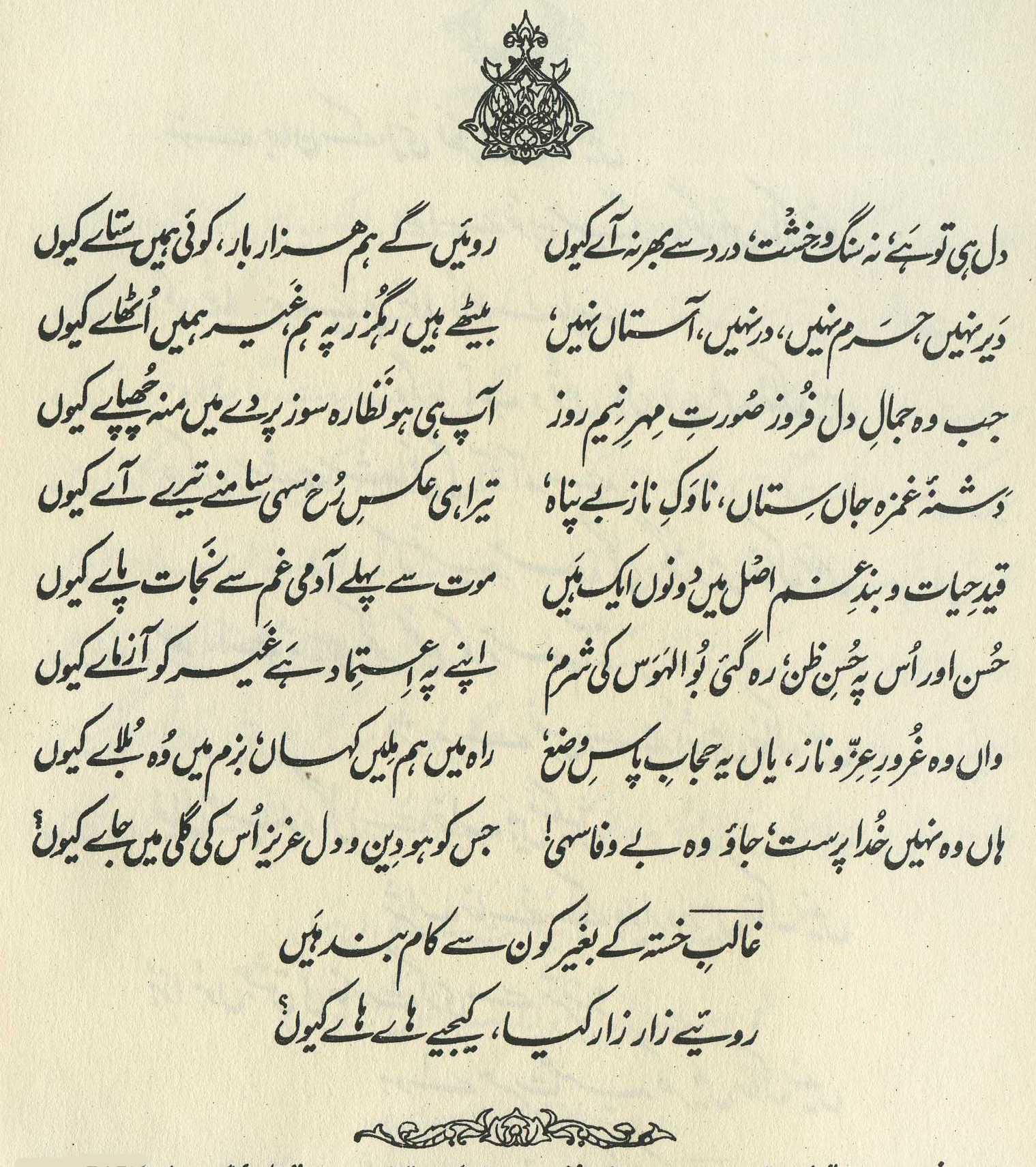
[1861, to Junun Barelvi:] This city [of Delhi] is very much devastated. Neither people remain, nor buildings. I will tell the booksellers, and if they find any portion [] from my poetry or prose, it will be bought and presented before Your Excellency. -- a friend has in his possession some remnants of my poetry that have survived from the devastation. I will get him to write out this ghazal, and will send it in the morning.
==Urdu text: Khaliq Anjum vol. 4, p. 1498
It's as if there's some tyranny-oppressed one, and the beloved says to him, 'If we practice tyranny, then don't moan and groan!' [and this is his reply]. And the word 'anyone' proves that in anger, he doesn't consider her worthy of being directly addressed. (123)
== Nazm page 123

When you address somebody directly and scold him, he dislikes it more. And if you say it in an oblique way, then in addition to his understanding that he is the one addressed, it doesn't seem as bad to him. This too is a secret of human nature. (232)
And this [indirection] is completely in accord with colloquial speech. In such situations, that's exactly how people always do talk. (218)
This ghazal was published in the 'Delhi Urdu Akhbar', volume 15 number 7, February 13, 1853 ... with this introduction: A by Janab Sahib-e Alam Murshidzadah Bahadur Mirza Nur ul-Din with the pen-name 'Shahi', of whom the noble qualities have been recorded in previous newspapers: Inquiry has brought word that at the command of the servants of His Majesty, Janab Najm ul-Daulah Asadullah Khan 'Ghalib' of enchanting speech had written a ghazal this week. And that ghazal had been composed for the sake of ' joining lines ', which here would be difficult, or rather impossible. The esteemed Sahib-e Alam Bahadur, with very slight reflection or hesitation, with extreme speed, prepared the and recited it. His Majesty caused the to be read five times, and was very much delighted. (240-41)
This is one of only a handful of ghazals from which Faruqi has selected every single divan verse as superior.
It's such a swingy, bouncy ghazal! You can easily hear, and feel, and see, how in this meter the lines break both rhythmically and (usually) semantically right down the middle. Most of the lines in this ghazal do so; the only exceptions are (5b) and (9a). This meter is unusually long, and is the 'foot A / foot B // foot A / foot B' kind; both these qualities incline it to fall easily into two halves. Thus it lends itself very well to internal rhyme, including the fancy triple kind found in 115,3 . Another ghazal in this same meter is the following one, 116 .
Note for meter fans: This is one of those meters made of two symmetrical halves with a kind of quasi-caesura in the middle, in which an extra short 'cheat-syllable' (as I call it) is permitted at the end of the first half. In the present verse, this cheat-syllable occurs in both lines. Other such cheat-syllables occur in both lines of 115,3 , the first line of 115,7 , both lines of 115,8 , and the first line of 115,9 .
The refrain of this ghazal, , usually means just a plain 'why?'. But it has a penumbra of other interrogative possibilities: see the definition above. These are particularly invoked in 115,4 , 115,5 , and 115,7 .
With regard to the present verse, the commentators are determined to bring the beloved in, and that's undoubtedly a perfectly good way to read the verse. It can be the middle part of a quarrel; it can be direct address (to the beloved) posing as indirect address. It can be the kind of thing you mutter to yourself-- but loudly enough for the other party to hear you.
But of course, it can be a lot of other things too, since there's no reference to any such context (or any context at all) in the verse itself. The first line begins by offering the ambiguities of . It might be a a dismissive ('after all, it's nothing but a heart!'); but it could equally well be an insistent or even cautionary ('after all, it's most emphatically a heart '). Naturally, there's no way of telling. Here are two readings that result (here the is something like 'after all'):
=After all, it's only a heart!-- It's something weak and helpless, not strong and durable like stone and brick. Naturally it would fill up with pain, being the pathetic, vulnerable, passion-wracked thing that it is. (For another such use of the phrase, see 151,2 .)
=After all, it's a ! -- something uniquely intense and mystically attuned, not dull and soulless like stone and brick. Naturally it would experience the travails of passion; what else is the meaning of its special destiny, its power to be sensitive and empathic []?
Then when we consider the two halves of the second line, another two possibilities open up:
=(first half, then second half): We're already planning to weep a thousand times-- why would anybody bother to torment us? There's no need for anybody even to take the trouble, since the same result is already guaranteed anyway.
=(second half, then first half): Why would anybody torment us? For if they do, they'll be sorry! We'll weep a thousandfold, we'll weep up such a storm that they'll rue the day they tormented us! (In this regard, consider 111,16 .)
Naturally (since this is Ghalib), either reading of the first line works excellently with either reading of the second line. We are free-- or else, depending on your point of view, obliged-- to mix and match them on our own.
The anecdote Arshi cites from the 'Delhi Urdu Akhbar' is about how this ghazal was used as a sort of skeleton for the addition of extra words to create a , a longer poem in five-line stanzas. The story seems to imply that the ghazal was composed especially to make this sort of transformation difficult; but since the main point of the story is to glorify a royal relative, that claim can be taken with a salt-dish full of salt.
graphics/stoneheart.jpg