Verse 31853aa))ekyuu;N
G15
1
when that heart-{illumining/inflaming} beauty, {like / with the aspect/face of} the mid-day sun
2
would only/emphatically itself be sight-melting, why would s/he hide her/his face in a veil?
'Illumining, enlightening, kindling, inflaming'.
'Form, fashion, figure, shape, semblance, guise; appearance, aspect; face, countenance; prospect, probability; sign, indication; external state (of a thing); state, condition (of a thing), case, predicament, circumstance; effigy, image, statue, picture, portrait; plan, sketch; mental image, idea; —species; specific character, essence; —means; mode, manner, way'.
| References | |
|---|---|
| Arshi, Imtiyaz Ali | Ghazal# 116 |
| Raza, Kalidas Gupta | 437-38 |
| Hamid Ali Khan | Open Image |
This can be applied to divine and human love both.
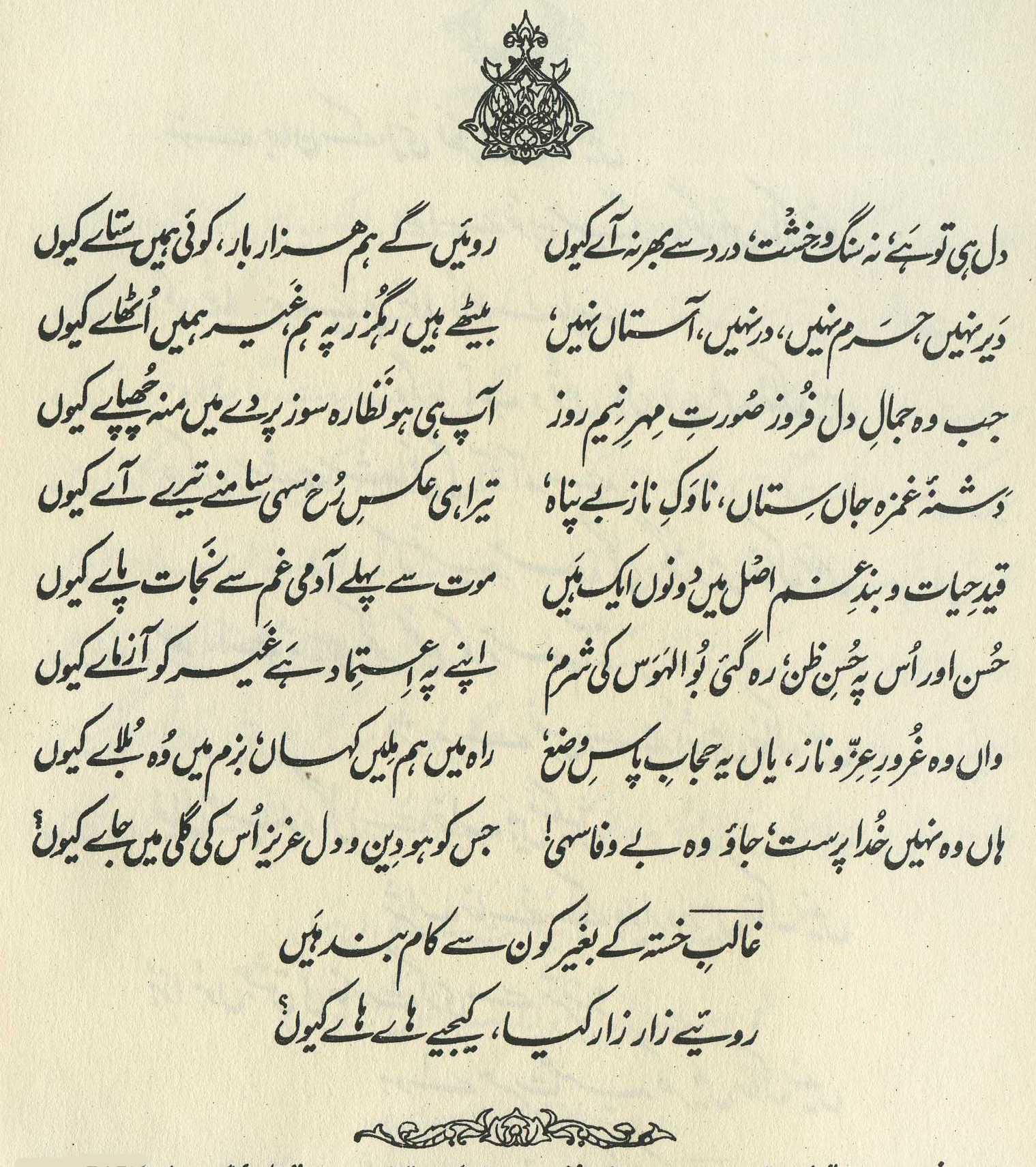
==Urdu text: Yadgar-e Ghalib , p. 152
That is, she is not hidden in pardah; rather, thought and vision cannot endure her revelation and its extremity of manifestation, the way from the sun's extremity of light, the vision is weak. (123)
== Nazm page 123

What need does the Lord have of hiding himself in pardah? Even if he should come before us, no one can endure his glory/appearance (of which the story of Mount Tur and Moses is a witness). (233)
To bring in three rhyme s other than the rhyme of the ghazal or ode , increases the rhythmic effect []. In the third verse of the ghazal, he has brought in , three rhymes other than the rhyme of the ghazal. (301)
Compare 158,7 . (307)
For general discussion of the structural qualities of this ghazal, see 115,1 .
As Shadan (alone among the commentators I've read) rightly points out, the rhythmic power of this verse is immediately apparent-- sonorous, hypnotic, building up beautifully to its concluding question. What a feat! Ghalib has created no fewer than three identical internal rhymes-- and none of them feels awkward or forced in any way, and their whole effect is both fluent and lofty.
And all these rhymes build up to that great question, in which Ghalib's trademark speech-mode is used as brilliantly as ever. In view of its innate, overpowering dazzlingness, why would the divine or human beloved hide his/her face in a veil? Here are some possible frames for the question:
=The speaker notices that the beloved is veiled, and he wonders why, since it's so unnecessary.
=The speaker notices that the beloved is unveiled, and he's not surprised, since no veil is necessary.
=The speaker can't tell whether the beloved is veiled or unveiled, and he concludes that it's hard to be sure.
The first line sets up some subtle ambiguities that help to prepare us for the great question in the second line. The adjective can meaning 'heart-illumining' (something entirely desirable) or 'heart-inflaming' (something with painful and destructive as well as desirable possibilities).
Then there's the elegant wordplay with , which is often used to mean merely that something is 'like' something. (See 53,3 for an example of this use.) That's the least-marked reading, the first time through; but of course, after we see the second line-- or finally get to hear it, under mushairah performance conditions-- we're then struck by the literal meaning of 'face', and also by the more abstract meaning of 'aspect'; both of these work to wonderful effect.
Compare Mir 's even more multivalent treatment of the theme: M 1328,4 .
graphics/sun_nolde.jpg
graphics/sun.jpg