Verse 61853aa))ekyuu;N
G15
1 a
beauty, and on top of it 'beauty of thought'-- the lecher’s honor remained
1 b
beauty and, based on it, 'beauty of thought'-- the lecher’s honor remained
1 c
beauty and, about him, 'beauty of thought'-- the lecher's honor remained
2
in herself, she has confidence-- why would she test Another ?
'Goodness, goodliness; comeliness, beauty, pleasingness'.
zann>> : 'A good opinion, a favourable judgment'.
zann>> : 'Thought, opinion, notion, idea, supposition, conjecture; suspicion, evil opinion; jealousy'.
'Father; possessor, &c. (used in comp.; —before words defined by the Arabic article , it is shortened in pronunciation to '.
'Desire, lust, concupiscence, inordinate appetite; —ambition; —curiosity'.
'Reliance, dependence, trust, confidence, faith'.
| References | |
|---|---|
| Arshi, Imtiyaz Ali | Ghazal# 116 |
| Raza, Kalidas Gupta | 437-38 |
| Hamid Ali Khan | Open Image |
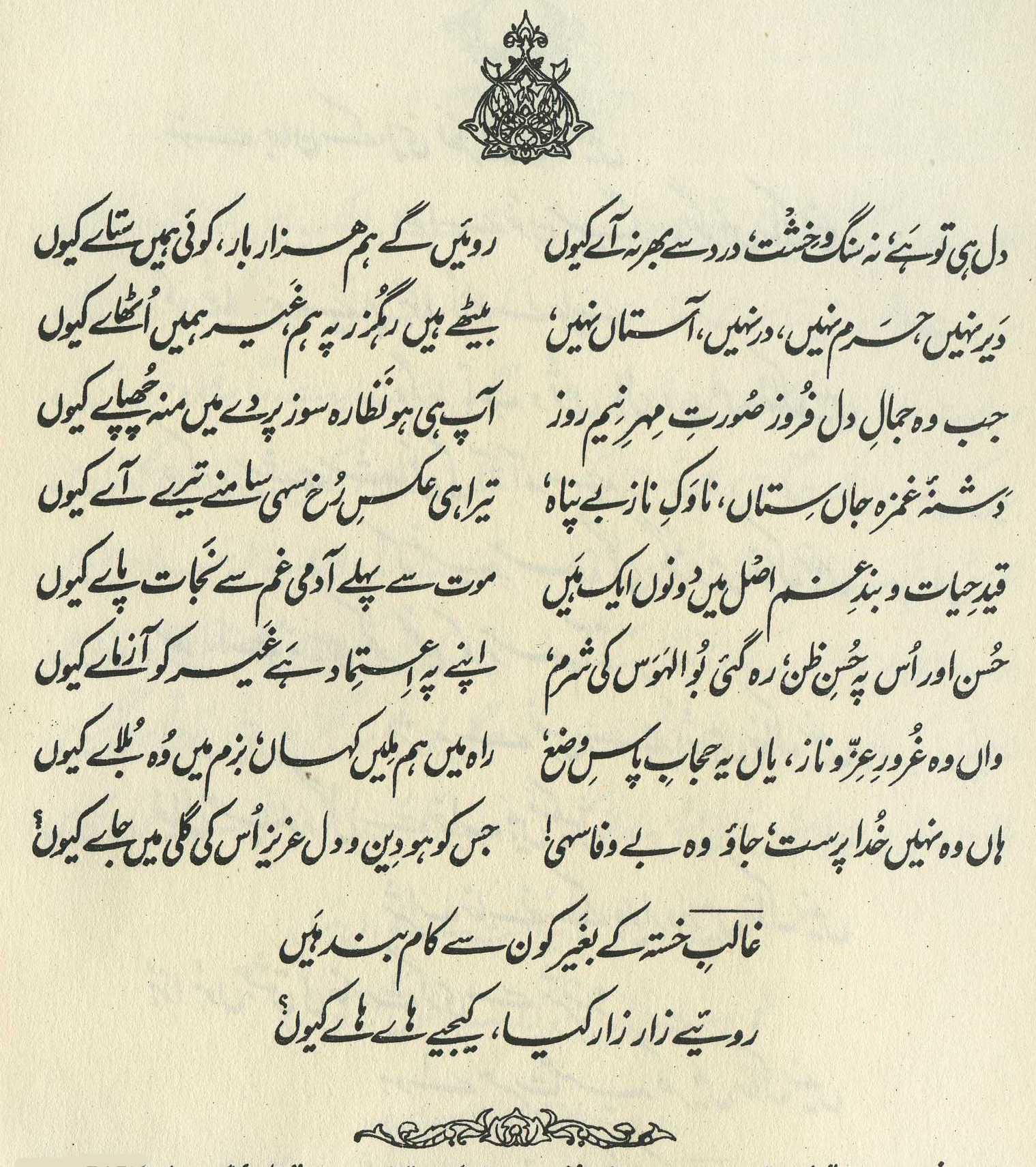
[1864, to Junun:] Maulvi Sahib, what a subtle/enjoyable [] meaning it has-- do it justice! Beauty of body and 'beauty of thought'-- both qualities are combined in the beloved. That is, her face is good [] and her thought [] is correct []; she never misses the mark []. And accordingly she thinks about herself, that 'Anyone I strike never recovers, and the arrow of my sidelong glance does not miss'. Thus when she has such trust in herself, why would she test the Rival ? And 'beauty of thought' has saved the Rival’s honor. Otherwise, for her part the beloved had been led into error []. The Rival was not a true lover, he was a lustful man. If it had come to the point of a test, then the truth would have been revealed. (Arshi 241-42)
==Urdu text: Khaliq Anjum vol. 4, p. 1514
==another trans.: Russell and Islam , p. 301
==another trans.: Daud Rahbar , p. 268
That is, when the lustful Rival expressed passion, then without testing him she believed him. Because for one thing, the Lord had given her beauty; for another, she has 'beauty of thought' as well. That is, she considers, 'Who will there be who will not desire me?'. The gist is that she has confidence in her own beauty, so why would she start testing the Rival? In this way his honor was saved. (124)
== Nazm page 124

: to consider everything good.... The Lord has made the beloved beautiful, and she also considers all others good in the way that she is. The beloved trusts in her own virtuousness; for this reason, she doesn't test the Rival's love. (234)
[See his comments on Mir's M 226,4 .]
Many editions of the divan have instead of ; as always, I follow Arshi.
For general discussion of the structural qualities of this ghazal, see 115,1 .
In the first line, there's an enjoyable doubleness to 'on that' [] which can be only somewhat captured in English. One sense is 'on top of that', in addition to that, added to that (1a). Another sense is 'based on that', resting on that, relying on that (1b). Either the beloved has 'beauty of thought' simply as an add-on to her beauty of form, because she was endowed with both qualities at birth (1a); or else she has 'beauty of thought' because of her beauty of form: her own beauty and charm cause her to display great confidence and 'beauty of thought' (1b).
Then the third sense, which we can't capture at all in English: in the first line can be taken as 'about that one', parallel to , 'in/about herself', in the second line (1c). 'About him', she has 'beauty of thought'-- because 'about herself', she has confidence.
And what exactly is this 'beauty of thought' []? To Bekhud Mohani, it's a naive Pollyanna-ish view of goodness in the world, which doesn't sound at all like the beloved as we know her. To Nazm, it seems to be an arrogant confidence in her own beauty. To Platts, it's 'a good opinion, a favourable judgment'.
Fortunately (and all too exceptionally), we have Ghalib's own explanation: 'beauty of thought' means that her thought is correct, true, right []-- so much so that she never 'errs', never 'misses the mark' []. Thus here 'beauty' becomes a general term for 'correctness, excellence'. (For an example of this sense, consider the technical literary term , literally 'beauty of cause-assignment'.)
But then, Ghalib also goes on to say that in this case she does err: she has been 'led into error' [], because she didn't test the lustful (false) lover when she should have-- and would have, if she hadn't been so (over)confident in her own beauty.
How can it be that she never errs, yet in this case she errs? Is Ghalib just explaining casually in a letter, and would otherwise qualify one or the other of the statements? (For example, perhaps 'she never errs' should be taken to mean 'normally, she never errs'.) Or perhaps Ghalib is creating one of his (in)famous paradox es?
We have all the evidence before us, and we're forced to decide for ourselves. As ghazal readers, and especially as Ghalib readers, we have to work hard for the marvels we get. We have to develop our own 'beauty of thought'.
Note for meter fans: The Arabic phrase is actually pronounced, and scanned, as bul-ha-vas, = - = .
graphics/confidence.jpg