Verse 41816aa;Nhai
G2
1
bring heart and faith as cash, if you would want to do merchandising/madness with the Cupbearer
2
for in that bazaar, the wineglass is property that is peddled/handed around
'Going from hand to hand; hawked about; --money, &c. which is obtained on loan, a loan for a short period (on a verbal promise to pay); --anything hawked about for sale'.
'Causing to revolve or go round, revolving, turning; winding; changing; inverting; converting (used as last member of compounds)'.
| References | |
|---|---|
| Arshi, Imtiyaz Ali | Ghazal# 154 |
| Raza, Kalidas Gupta | 275 |
| Nuskhah-e-Hamidiyah | 223-224,227 |
| Asi, Abdul Bari | 232 |
| Gyan Chand | 355-356,358-359 |
| Hamid Ali Khan | Open Image |
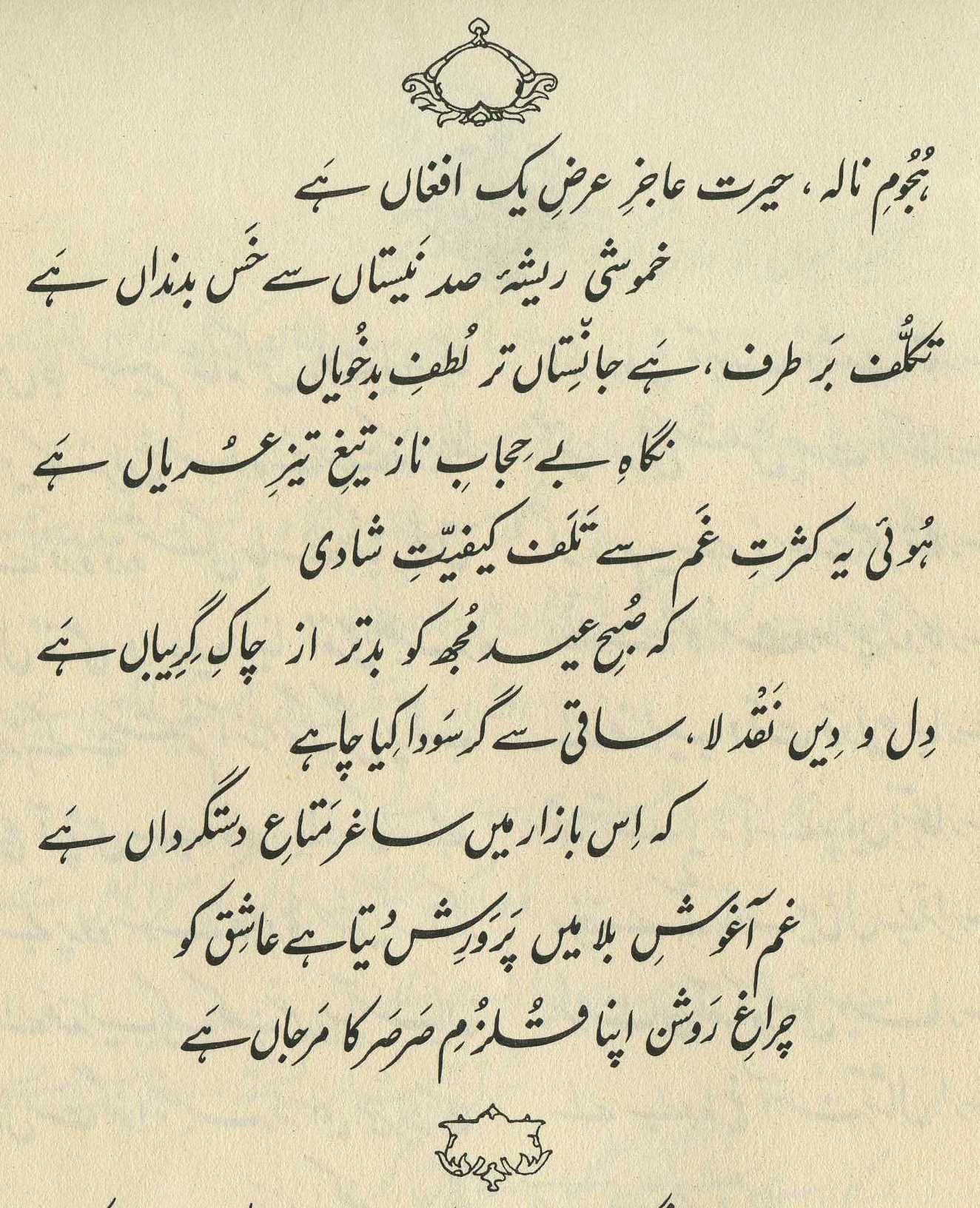
With the going-around [] of the , merchandise is always sold for a price in cash. Here, to call the wine-flask has such enjoyment/refinement [] that we ought to recognize with heart and soul our indebtedness to the author. (254)
== Nazm page 254

They call that thing that is is sold for a price in cash. He says, if you seek to purchase the wine of love from the Cupbearer of the wine-house of passion, then bring heart and faith at once and hand them over and make the deal with him. In that bazaar-- that is, in the bazaar of passion-- the price of the wineglass of passion is received in advance. (311)
By is meant something available for a price in cash. In such a situation, to say to bring the heart and faith as cash is such a fitting usage that-- praise be to God! Because it's obvious that in Islam, wine is forbidden. And in the intoxication of wine, neither the heart nor the faith remains in one's control-- nor does the mind. That is, if you intend to drink wine, you ought to wash your hands of heart and faith.
[Or:] By wineglass is meant the cup of mystical knowledge, and by Cupbearer is meant the True Beloved or the spiritual guide. (460)
In the light of these remarks [from Indo-Persian dictionaries] the wineglass of the verse under discussion, that is , is not anything very valuable and rare; rather, it's commonplace.... Now the meaning of the verse becomes, 'Friend, if you want to do business with the Cupbearer, then bring with you heart and faith as coin when you come. Indeed, if it's only a wineglass that you want, if you don't have any dealing to do with the Cupbearer, then that's a different matter. A wineglass is easily available here on credit-- and that too, in such a way that you won't to have to pay anything down in advance. You can strike a deal instantly, and take away the merchandise.'
Now the question arises of what kind of business is to be done with the Cupbearer, and what is this wineglass that comes to hand so easily. In order to answer it, please keep in mind the assumption that I presented at the start: that the Cupbearer's task is not to sell wine, but rather to cause people to drink and render them intoxicated. The sale of wine is a monetary and commercial transaction. The seller himself is self-interested; he will give you a . Now there remains the matter of the intoxication caused by wine-- that is, the matter of the true benefit obtained from wine: the Cupbearer's favorable glance, or warm glance, that would go along with the wineglass. For that, bring the wealth of heart and faith and offer it to the Cupbearer. Then perhaps he will give you, along with the wine, the intoxication of the wine-- that is, his attention, or a tiny little taste of the wine of love. This can't be obtained through riches.
== (1989: 350-51) 2006: 375-79
The cleverly multivalent idiom is what energizes the verse, as the commentators observe. The literal meaning of the idiom is 'property that is hand-going-around', which of course perfectly evokes the going-around of the wineglass and the wine-flagon, in the famous , as they are passed around among the drinkers.
The idiomatic sense of an up-front ready-cash transaction is also perfect for the situation. If we assume, with the commentators, that both lines apply to the same 'bazaar', here are some of its possible implications about the nature of 'that bazaar':
=One's heart and faith can readily be converted into, or used as, cash.
=No other form of cash is available or acceptable.
=The cash must be handed over in advance-- before any goods are received.
=There are plenty of eager buyers, so one should be prepared to cut a quick deal.
=There are plenty of other bidders, so one should be prepared to pay whatever it takes.
=The seller doesn't trust the honesty and/or credit-worthiness of the buyer.
=The seller doesn't care about the identity or circumstances of the buyer.
='That bazaar' is a regular, well-known venue for such transactions.
These were the implications that I had come up with on my own, before reading Faruqi's provocative and persuasive argument that the two lines should be read in opposition, as describing two different, contrasted situations: wineglasses are cheap and easy, but 'business' with the Cupbearer costs you everything. Doesn't Faruqi's reading suddenly open the verse up in a whole new, piquant, and enticing direction? It doesn't invalidate the other reading (of two lines, one situation), but it makes it look simple and somewhat unsubtle.
The double meaning of as 'madness' can't be missed, though nothing specific in the verse picks up on it. After all, to sell 'heart and faith' is in itself surely the result of madness, since otherwise who would part with such irreplaceable treasures? And to buy wine is also a cause of madness, since intoxication deprives one of normal awareness. So a rational bit of cash 'commerce' is also a piece of wildly crazy behavior.
Compare the even more cavalier treatment of 'heart and faith' in 115,8 .
An illustration from Id ki tahniyat, Lucknow, 1822 (New York Public Library), generously provided by Maliha Noorani (April 2013):
graphics/bazaar.jpg
graphics/wineglass.jpg