Verse 21816aa;Nhai
G2
1
{leaving aside formality / 'to tell the truth'}, the elegance/pleasure/grace of the bad-tempered ones is more life-stealing
2
the unveiled glance/gaze of coquetry is a sharp sword [that is] naked
tf>> : 'Delicacy; refinement; elegance, grace, beauty; the beauty or best (of a thing); taste; pleasantness; gratification, pleasure, enjoyment; --piquancy, point, wit; --courtesy, kindness, benignity, grace, favour, graciousness, generosity, benevolence, gentleness, amenity'.
| References | |
|---|---|
| Arshi, Imtiyaz Ali | Ghazal# 154 |
| Raza, Kalidas Gupta | 275 |
| Nuskhah-e-Hamidiyah | 223-224,227 |
| Asi, Abdul Bari | 232 |
| Gyan Chand | 355-356,358-359 |
| Hamid Ali Khan | Open Image |
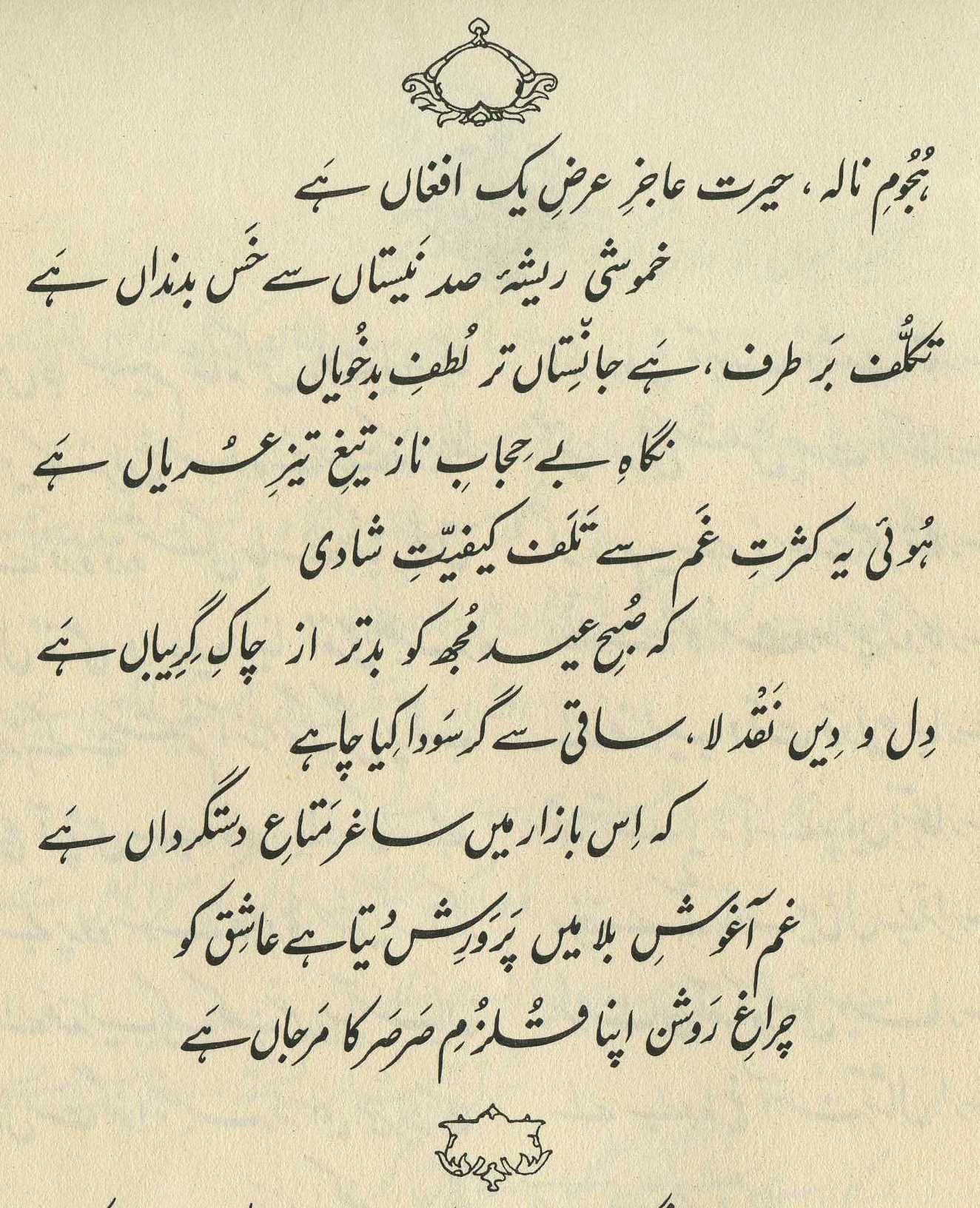
The glance is a sword, and when the glance became unveiled, the sword became naked; and her giving a 'glance of elegance/pleasure/grace' became more murderous. (254)
== Nazm page 254

He says, 'The elegance/pleasure/grace of beloveds is even more life-stealing than tyranny. As if the glance of coquetry is a well-tempered sword, and when it became unveiled, then the sword became naked.' Now, in her murdering, what veil still remains? (311)
It's true that for a bad-tempered beloved to be gracious is even more life-stealing than for her not to be gracious. Don't look, for when the glance of coquetry becomes unveiled, then it is like a sharp sword that would already have left the scabbard. That is, in her being gracious there's even more suffering. (460)
What a sharp, witty, perfectly deft contrast to the awkward 226,1 ! Now we're back to the classic Ghalib, in his usual state of remarkable verbal control.
On the 'petrified phrase' , see 65,1 . The first impression the line gives us is that of a 'claim of candor', an informal, let's-cut-to-the-chase quality. The speaker observes (to us? to a confidant? to himself?) that the of bad-tempered ones is 'more' deadly. The comparative is left unresolved-- more deadly than what? More deadly than their bad temper itself? More deadly than the of good-tempered ones?
But above all, what exactly is meant by ? The possibilities are rich (see the definition above). It might be some quality of the beloved's, like 'grace', 'kindness', or 'generosity'. It might also be something experienced by the lover, like 'gratification', 'pleasure', or 'enjoyment'. And in some of its range ('refinement', 'elegance') it resonates pleasurably with ('formality', 'ceremony').
In short, after the first line we don't know where we're heading. The best guess might be toward a contrast between bad-tempered ones and good-tempered ones, or between the times when the bad-tempered beloveds shows their true colors, versus the times when they are (absent-mindedly? instrumentally?) kind.
Then in true mushairah -verse style, the second line sweeps us off in an entirely different direction: it turns out that we are to be interested not in the beloveds at all, but in their glances. We are treated to imagery that expertly picks up on the patterns of the first line: as a counterpoint to 'formality' and 'refinement' we now have a coquetry that is 'unveiled', and, finally a sword that is sharp and-- when the line finally grants us the the slightly shocking punch-word-- 'naked'. For more examples, and discussion, of the use of , see 6,1 .
And that final 'naked' causes us to reappraise and fully appreciate that initial . The first time around, in the context of the first line, it sounded like nothing more than a petrified phrase, a claim of candor and sincerity in speech: 'To tell you the truth...'. But now we realize how radical and literal the image has become, for nothing could possibly be a greater sign of 'putting formality aside' than becoming not merely unveiled, but 'naked'. When the beloved's glance is straightforward, not sidelong and coquettish, it is linear like a sword; and because she's both bad-tempered and beautiful it's also, even in her benevolent moments (when she deigns to vouchsafe a glance), sharp like a sword. At such times the glance is stripped for action: it has cast off all literal veils and metaphoric coquetries, and plunges naked and deadly into the lover's heart. And isn't this sort of rapturous passion-death exactly what the lover dreams of? (Remember the ecstatic associations of the naked scimitar in 17,5 .)
Note for grammar fans: the latter half of the second line features a noun-adjective-adjective , which is unusual. But Arshi gives all the marks clearly; and in any case, without them we'd be in danger of creating the kind of lumpy noun-heavy effect that was so awkward in 226,1 . It's best to think of as a single compound, and then of as applying to the whole thing. The adjectives in such a sequence shouldn't be read as parallel to each other the way they tend to look in English.
graphics/sword.jpg