Verse 11816iibaa;xir
G2
1
I am oppression-accepting from advice/prudence, since beautiful ones are in love with you
2
{leaving aside formality / 'to tell the truth'}, a Rival like you will become available, finally
'A cause, means, or occasion, of good; a thing or affair conducive to good, or that is for good; a thing that is good and right; welfare; that which is best, a prudent measure, advisable thing; advisability, sound or good policy; an urgent occasion; --convenience, expedience; an expedient; fitness; --advice, counsel; --an affair, business; subject'.
'Taking (anything) upon oneself gratuitously or without being required to do it, gratuitousness; taking much pains personally (in any matter); pains, attention, industry, perseverance; trouble, inconvenience; elaborate preparation (for); profusion, extravagance; careful observance of etiquette, ceremony, formality; dissimulation, insincerity'.
taraf>> : 'Ceremony apart, waiving ceremony'.
| References | |
|---|---|
| Arshi, Imtiyaz Ali | Ghazal# 61 |
| Raza, Kalidas Gupta | 183 |
| Nuskhah-e-Hamidiyah | 107-108 |
| Asi, Abdul Bari | 118 |
| Gyan Chand | 207-208 |
| Hamid Ali Khan | Open Image |
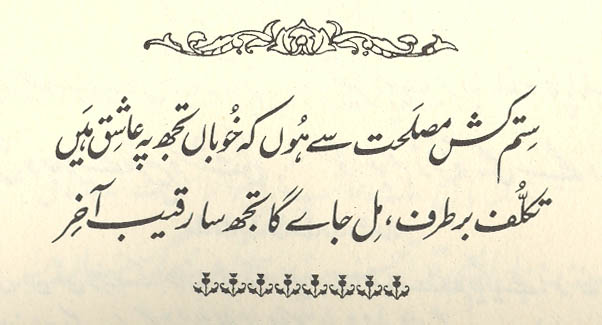
That is, among the beautiful ones who are in love with you, one or another of them will fall to my lot. With this counsel I submit to your coquetry-- that if I don't get you, then I will get some rival as beautiful as you. (65)
== Nazm page 65

You are the beloved of the beloveds of the world-- among your lovers some such Rival will turn up, who will be as beautiful as you. I will give my heart to that one. (64)
Today, you don't care about me. When I get one of the beloveds who is in love with you, then you will be doubly jealous-- first, that I've stopped loving you, and second, that I've turned a lover into a beloved. That is, you'll feel even more jealous than you're making me feel today. (146)
Those who have a proper [poetic] temperament know that in Urdu such Persian plurals as don't sound good even to the ear, when they are used like this without a connective or an . (226)
The true and plain fact is that sometime or other one of these [beautiful ones], having endured your tyranny and oppression, will become my confidant and sympathizer, and I will keep comforting my heart with the knowledge that you don't hesitate to make even the loveliest ones objects for the practice of cruelty and injustice. So why should passion become anxious?
To say that Ghalib would give his heart to one of these beautiful lovers and thus find satisfaction, is to make a complete mockery of Ghalib's poetic art []. (234)
ABOUT : For other, equally complex uses of , both as a petrified introductory 'claim of candor' phrase (see the definition above), and as adverbial ('casually, informally'), see: 132,2 , with a second as well; 165,4x ; 171,4x ; 205,6 ; 226,2 ; 226,8x // 396x,3 ; 396x,3 . In every case, this expression is placed at the beginning of a line, so that its general, introductory reading is the first one that will come to mind. Then afterwards (after the whole verse has been heard), its meaning will be enjoyably modified or enhanced by the specific semantic context of the verse. The expression works somewhat the way does: for discussion of , see 25,1 .
The verse is a sly little sweet-and-sour morsel offered to the beloved. The lover seeks both to compliment the beloved's beauty (since all the other lovely ones of the world are said to be in love with her/him) and to arouse the beloved's jealousy (since the lover will thus be surrounded by a crowd of gorgeous people, all jostling and competing for her/his attention). The implied advantage to the lover will be either that he will manage to capture one of them for himself (as most commentators say) or that he will simply have access to them as confidants and companions (as Mihr maintains, in a 'natural poetry' attempt to defend what he thinks of as Ghalib's honor as a lover).
The most amusing feature of the verse is its 'reviving' of the petrified phrase 'leaving aside formality' []. It's a commonplace introductory phrase, used the way 'to tell the truth' or 'if you want to know the truth' is used in English. So at first, we hear it as just a standard 'claim of candor' phrase for introducing the real point of the utterance. But when we are allowed (under mushairah performance conditions) to hear the second line, we recognize the pleasure of its literal sense as well.
For if it is read adverbially with , the meaning is that finally the speaker will obtain a lover like the beloved under conditions of informality, when everyone has put aside social decorum []. In the jostling, intimate, crushed-together crowd of her/his other lovers, the speaker will be in especially conducive proximity to many beautiful ones, and will eventually find intimacy with someone like the beloved. And that will show you, cruel beloved! says the lover, perhaps with a (desperate? amused? ironic?)) little sneer.
For another verse that plays with the idea of taking a new lover, see 131,2 .
The present verse also plays enjoyably with the polymorphous perversity of gender identity in the ghazal. We know that the lover is an adult male. We know that the beloved may be a woman, or a beautiful boy (for examples of this latter case see 9,2 ). In this verse, no matter how we slice and dice the relationships, same-sex cases appear. Here are the main possibilities:
=The beloved is a woman, her lovers are other women; the (male) speaker hopes to get one of them.
=The beloved is an adolescent boy, his lovers are other adolescent boys; the (male) speaker hopes to get one of them.
=The beloved is a woman, her lovers are adolescent boys; the (male) speaker hopes to get one of them.
=The beloved is an adolescent boy, his lovers are women; the (male) speaker hopes to get one of them.
In short, anybody hoping to confine Ghalib's poetic world to heterosexuality is completely out of luck, as this verse demonstrates very clearly. In the great majority of verses, it's impossible to tell the gender of the beloved, and basically it doesn't matter; the beloved may also in most cases-- though not always (see 20,3 for examples)-- be God.
The main reasons that I've adopted a feminine persona for the beloved in this commentary are (1) because it makes it much easier to show clearly who's who with pronouns, if one is male and the other is female; and (2) because in English poetry the female beloved is 'least marked' to such a degree that to show a male beloved as normative would make the poetry look markedly gay-oriented in a way that it's not. (As Owen Cornwall has pointed out, the three famous pairs of lovers in the ghazal world-- Majnun-Laila, Shirin-Farhad, Yusuf-Zulaikha-- are all heterosexual.)
graphics/triangle.jpg