Verse 21821uu;Nvuh bhii
G2
1
we remained displeased with that mischievous one, {somewhat / for some time}, out of formality/pretense
2 a
{leaving aside formality / 'to tell the truth'}, even/also that was a single/particular/excellent/unique style of madness
2 b
formality/pretense was put aside-- a single/particular/excellent/unique style of madness, even/also that
'Afflicted (by, -), sad, dispirited, sorrowful; vexed (with, - ), displeased, dissatisfied; weary (of, -)'.
'Some, somewhat, a few, a little, a while'.
'Pains, attention, industry, perseverance; trouble, inconvenience; elaborate preparation (for); profusion, extravagance; careful observance of etiquette, ceremony, formality; dissimulation, insincerity; -- takalluf bar-:taraf , adv., Ceremony apart; waiving ceremony'.
| References | |
|---|---|
| Arshi, Imtiyaz Ali | Ghazal# 133 |
| Raza, Kalidas Gupta | 342-343 |
| Nuskhah-e-Hamidiyah | 182-183 |
| Asi, Abdul Bari | 217 |
| Gyan Chand | 332-333 |
| Hamid Ali Khan | Open Image |
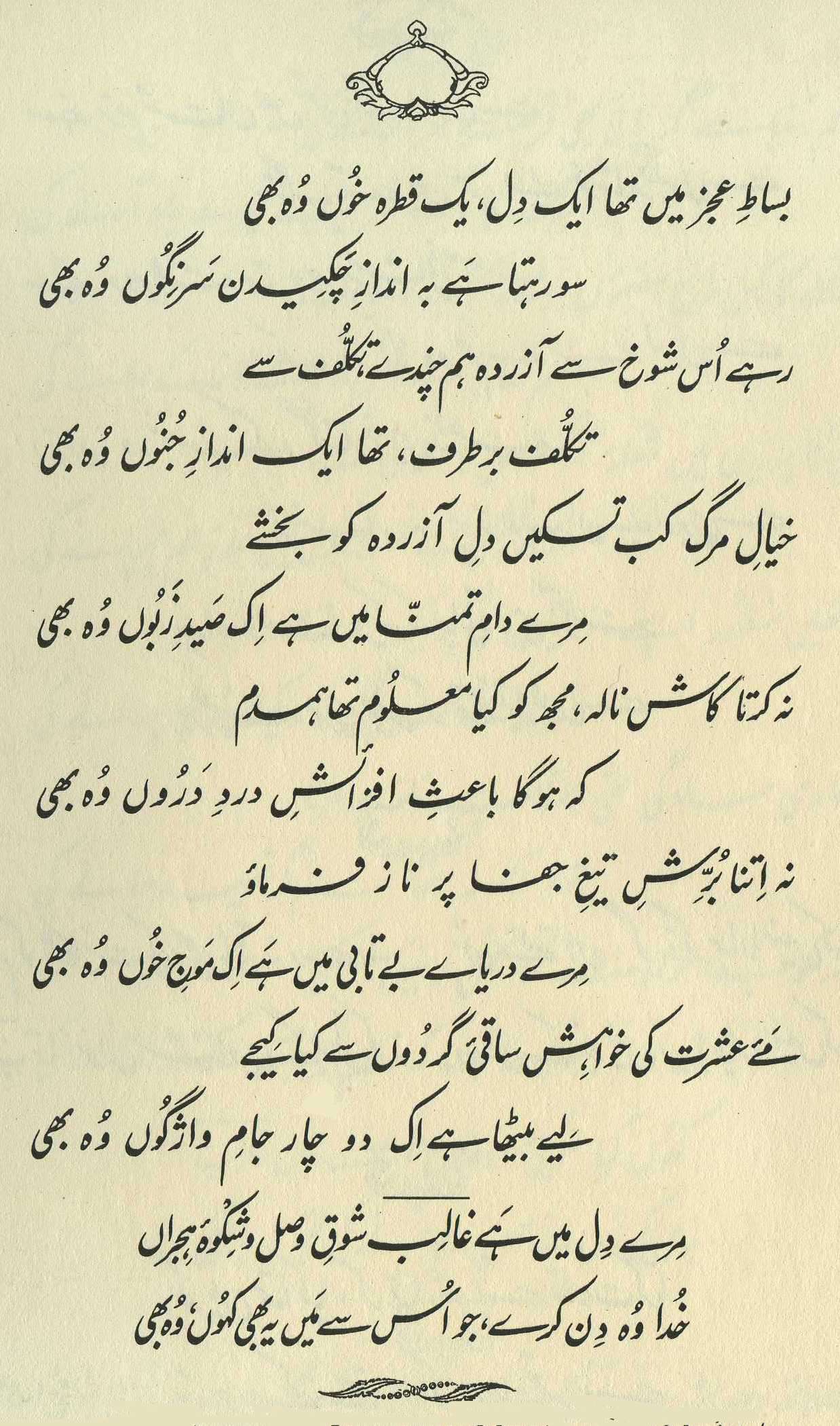
The meaning of the first is adornment and artifice, and by the second is intended that respect and concern that would not be from the heart, and would be artifice. That is, if we don't call it madness, then it's as if he himself showed for himself. (142)
== Nazm page 142

As long as we have a heart in our breast, then we can't become displeased with her. Indeed, for some days we made a show of displeasure. The truth is [] that this too was our madness. That is, what kind of can there be with a mischievous person, and what kind of displeasure? She sometimes teases, and sometimes torments us. What meaning can it have to quarrel with such a person? We've come to a truce with the beloved. Now that we've become accustomed to the pleasure of laughing and enjoyment with her, what a pity that we spent so much time in displeasure! This too was our madness. (264)
The deliberately chosen adoption of displeasure has been called a style of madness because it's a device-- i.e., that we would, for some time, pretend to be displeased-- that madness itself had taught us. If we were in our right mind, then we wouldn't have been able to do such a major task (mischievousness, short-sightedness, the trouble and pain of keeping the beloved herself at a distance). There are a hundred kinds of dangers in being angry with the beloved; no sensible person in his right mind would incur them....
The question remains, why commit such a folly?.... The answer to this question is in fact contained in the word 'mischievous one' []. The beloved considered us foolish and trivial, and mocked us. She treated us in such a way that it was clearly apparent that she didn't intend to humiliate us; rather, she considers it a form of sarcasm and teasing. This behavior of hers embarrassed us. Our madness taught us [this strategy]. But in some [] days we realized that ceasing to visit the beloved is worse, it's better to again present oneself humbly in her court....
To prove (which is a thing of responsibility) to be madness (which is a thing of irresponsibility and agitation) is a wonder even for a poet like Ghalib, not to speak of the ordinary run of poets. And on top of this, the axis of the verse has been placed in a common word like . And all this at the age of twenty-four! Ghalib put it well when he said that if poetry were a religion, then his divan would be the scripture of that religion.
== (1989: 250-51) 2006: 271-73
Faruqi has done a lovely job, and I'd only like to add some further thoughts about the first phrase in the second line, . Literally it means 'leaving aside formality', and of course it's a stock introductory phrase like 'to tell you the truth' or 'if you want to know the truth'. For discussion of this phrase and more examples, see 65,1 . These examples, like the present verse, place the phrase right at the beginning of the line, just where such a phrase might be expected in real speech: the speaker says something, then decides to add something else that will be (presented as) particularly candid. The fact that occurs twice in the verse, in ways both similar and different, makes its importance particularly clear.
In the present verse, the commentators have concentrated on discussing (2a), the 'claim of candor' sense, in which the 'even/also that' refers to the show of displeasure described in the first line. I agree that that's the more prominent reading. But I love the prospect of adding (2b), in which 'even/also that' refers to the act of 'putting aside formality' itself. The thus becomes a 'midpoint' verb that can be read with either the phrase after it (2a) or the phrase before it (2b). On the (2b) reading, the 'for some time' in the first line receives full weight. The verse becomes an inventory of tactics: 'For some time I pretended to be mad at her; then the pretense was put aside-- and that too was a style of madness.'
No matter how the lover treated the beloved, in short, it was a 'style' of madness. Either it was a deliberately planned device, cunningly suggested by madness; and/or it was a result, a symptom, a function of madness. The very fact that the second line is so contrived as to yield both (2a) and (2b), with the in just the right 'swing' position, and the that emphasizes the possibility of other styles of madness-- truly, the man was a genius. Who could possibly get more mileage out of fifteen or twenty words?
graphics/quarrel.jpg