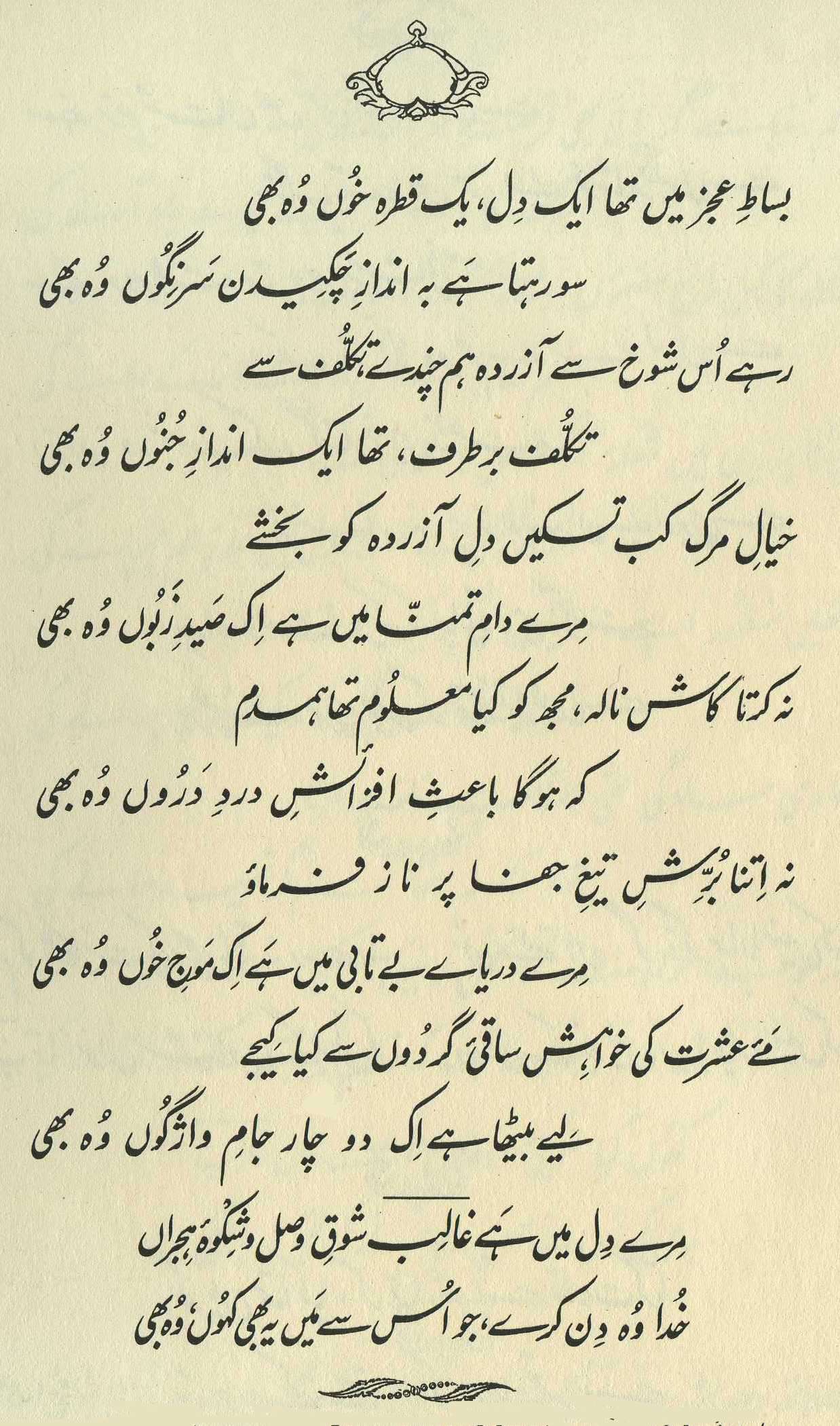
Verse 11821uu;Nvuh bhii
G2
1
in the spread/expanse of weakness there was a single/particular/unique/excellent heart; one drop of blood-- even/also that
2
so remains, in the style/manner of dripping, head-lowered-- even/also that
t>> : 'Anything that is spread out; surface, expanse, expansion; carpet; bedding;... goods, wares, &c.'.
'Powerlessness, impotence, weakness, helplessness, submission, wretchedness'.
'Shedding (or raining) blood; generally spoken of the eyes of a lover'.
'To suppress (one's) feelings, to restrain (one's) emotions, or anger, or grief, &c. -- to consume (one's own) lifeblood; to vex or worry (oneself) to death --to work (oneself) to death'.
'A murder to be committed; to be murdered; --to be wasted, be squandered'.
'Hanging down the head, abashed, ashamed; downcast, dejected; depressed; mean, abject, vile'.
| References | |
|---|---|
| Arshi, Imtiyaz Ali | Ghazal# 133 |
| Raza, Kalidas Gupta | 342-343 |
| Nuskhah-e-Hamidiyah | 182-183 |
| Asi, Abdul Bari | 217 |
| Gyan Chand | 332-333 |
| Hamid Ali Khan | Open Image |
The Urdu language will not bear the word to be brought into it. But Persianness [] was dominant [] over the author. For this reason, he didn't consider it foreign/strange. (142)
== Nazm page 142

He says, in the spread/expanse of weakness there was one heart, and that too was only a drop of blood-- its actuality was really nothing more than that. But in the style of dripping, that wretch too remains head-bowed; no telling when it might fall. In man's chest, the heart is hanging by means of a sinew, and its state is just the same as that of a drop of blood when it falls. The meaning is that the whole wealth/property that my passion possessed consisted of one heart. Now, from constantly enduring grief and sorrow, it is in the same state as a drop of blood that is constantly ready to fall. (197-98)
We are weak and oppressed; we had only one heart, the condition of which was really no more than that of a drop of blood. But alas, even that one is now in such a state that like a drop of water, it has its head lowered for dripping. That is, can we do anything? Our capacity [] is this: that our heart has the shape of a cypress, and seems to have its head lowered.
[And in reply to Nazm's objection:] If ['time of departing'] is a phrase that can be said, so can this one. [An example of this usage from Zauq .] (263)
In 3,7x and 13,5 the word seemed to be more like a carpet, and in 15,6 and 33,7 more like a meadow. Yet to come is the lovely 169,6 , in which it seems to be a luxurious pleasure-spread, . This last example is perhaps the closest, with its 'desire of the heart', for in the present verse too the is linked to the heart-- but how differently! Here, the context is so stark, so deprived, that it's hard to tell what's going on. Here seems to mean something like 'goods, wares' on the concrete side, or 'scope, capacity' on the abstract side.
When weakness spreads out its wares, or reveals the extent of its capacity, its inventory turns out to consist of 'a single/particular/unique/excellent heart'. And that heart too (or perhaps 'even that heart'), upon examination, is nothing but 'one drop of blood'. Here we are at the heart (sorry, sorry!) of one of the ghazal world's great central image clusters. In ghazal physiology, the liver makes fresh blood, which it sends to the heart. The heart bleeds some of it away through countless unstanchable wounds, and pumps some of it up to the eyes, which pour out streams and rivers of bloody tears. There are a host of idiomatic expressions related to this series of events; see the definitions above for some examples.
Thus if the whole heart now consists of a single drop of blood, the reason is that it has worn away, melted away, bled away in the course of proper lover-like suffering and grief, leaving the lover in a condition of 'weakness'. This weakness is obviously terminal, because the remaining single drop of blood remains 'head-lowered', trembling on the verge of dripping away entirely and thus finishing the lover off. How perfectly the imagery works! It's beautifully 'over-determined'.
For the 'downhearted' lover himself is always inclined to sit with lowered head (as in 32,2 ), because of weakness, grief, and/or humility (see the definition above). His heart is thus frequently 'down'-- and now that his heart has been reduced by weakness and grief to a single drop of blood, that drop of blood too duly sits with its head lowered. It thus both dutifully reproduces the lover's own attitude, and assumes the position of a drop about to fall. Everything about the lover's life and death, love and loss, is perfectly, matter-of-factly, unsentimentally summed up in the image of that one last drop of blood.
On the contrast between (the single but perhaps expansively glorious heart) and (the one mere drop of blood), see 78,6 .
graphics/blooddrop.jpg