Verse 61821arhote tak
G5
In this meter the first long syllable may be replaced by a short; and the next-to-last long syllable may be replaced by two shorts.
1
not more than a single glance/look is the leisure of existence, heedless one!
2
the warmth of the gathering is as long as the existence of the single/particular/unique/excellent dance of a spark
'One; a, an'.
'A time, opportunity, occasion; freedom (from), leisure; convenience; relief, recovery; respite, reprieve; rest, ease; (local) leave'.
'Unmindful, forgetful, neglectful, negligent, heedless, inadvertent, inattentive, remiss, thoughtless, careless; indolent; imprudent; senseless, unconscious'.
'One, single, sole, alone, only, a, an; the same, identical; only one; a certain one; single of its kind, unique, singular, preëminent, excellent'.
| References | |
|---|---|
| Arshi, Imtiyaz Ali | Ghazal# 78 |
| Raza, Kalidas Gupta | 334 |
| Nuskhah-e-Hamidiyah | 128-129 |
| Asi, Abdul Bari | 145 |
| Gyan Chand | 238 |
| Hamid Ali Khan | Open Image |
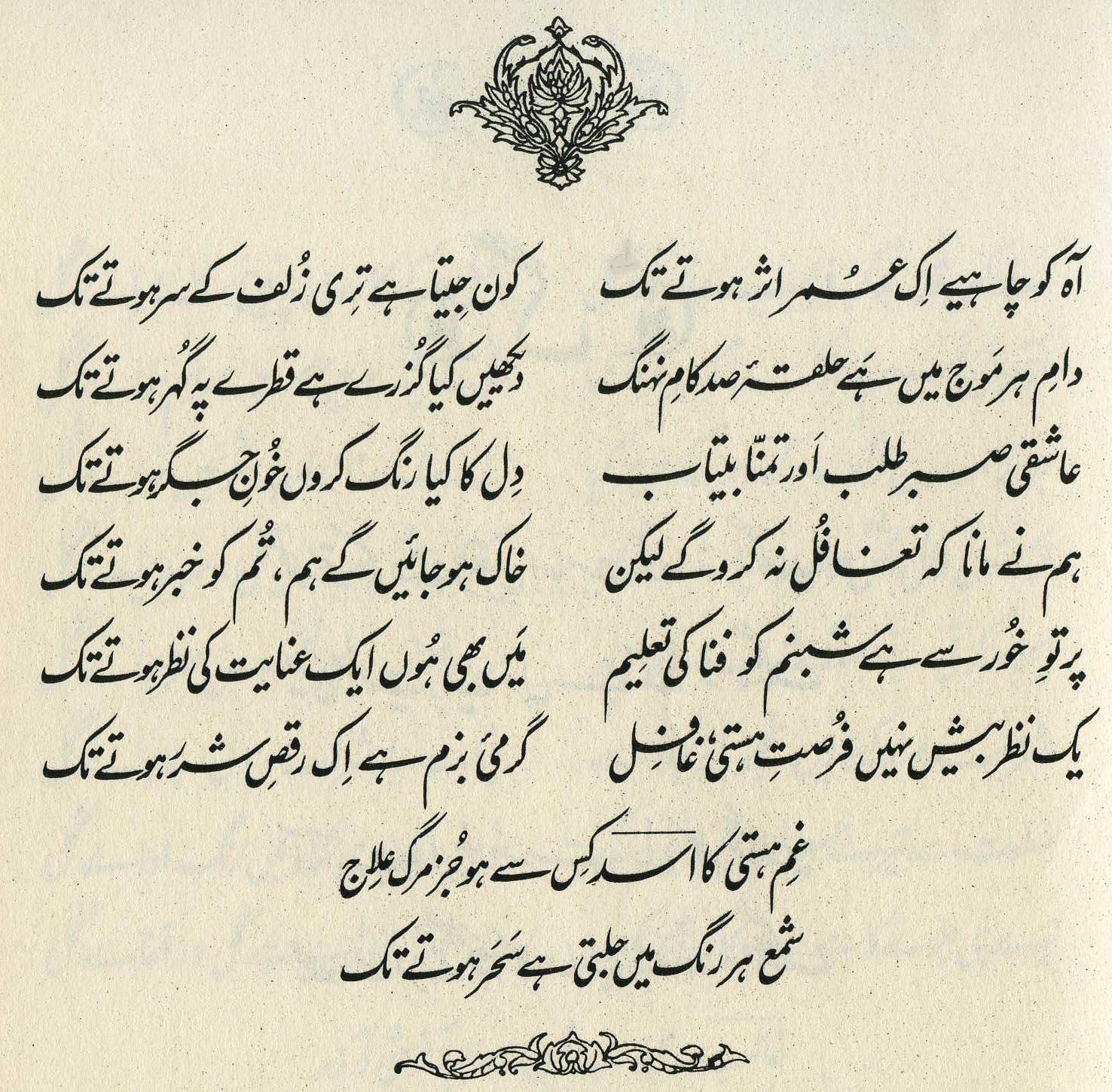
The meaning is that your duration is to look at the world for not longer than a single glance, the way a spark cannot remain established longer than to look at the gathering with a single glance. (80)
== Nazm page 80

Zauq :
[what trust in unsteady existence?
is it the wink of a lightning-bolt, or the smile of a spark?]. (72)
He says, oh heedless humankind! The interval of life is not longer than a glance, and I give as an example the 'warmth' of a gathering-- that is, the liveliness of the gathering of life is is as long as the dance of a spark. The way a spark glitters and then is extinguished, in the same way a human being has an existence that is destined to be obliterated after the space of a breath. (127)
That is, there's time enough only to cast a glance on the world, not time enough to understand its mysteries. (165)
ABOUT and : The glance is 'single' through the Persian-derived word , which basically means 'one'. By contrast, the measure for the dance of the spark is , a metrically shortened form of the Sanskrit-derived with all its wide range of possibilities (see the definitions above). In the metrical environment of this particular verse, Ghalib could have chosen to use either word in either situation. So surely we're entitled to notice that it's the mere human 'glance' that gets the narrower, more limited word, while it's the whole 'dance of a spark' of this world that gets the conspicuously protean word. Although it's impossible to prove that Ghalib uses with a deliberate intent to invoke all its multivalent possibilities, this verse certainly offers some good circumstantial evidence. In the divan , most occurrences of have this minimizing emphasis. Of course, the hyphenated compounds are a different story; on them see 11,1 . Another verse that contains-- and similarly contrasts-- both forms: 132,1 . A verse by Mir that also does so: M 85,3 .
A classic treatment of a classic theme : our little life is as brief as the flare of a spark in the darkness of the time before and after it. Our life is as brief as a glance, as brief as the spark's dance. Zauq's verse too is so appropriate that once Hasrat has cited it, several other commentators mention it favorably as well. It's good to be reminded that Ghalib was surrounded by all kinds of highly talented contemporaries.
The power of the verse lies in its measuring-rods, one in each line. In the first line, 'no longer than a single glance' [] is an unremarkable way to measure something extremely brief. And yet the glance is not only the measuring-rod, but also, in effect, the thing that's measured. For what do (and should) we do with our tiny, brief lives except devour the world with our eyes, try to take it in and savor it?
Similarly in the second line, the life-span of a spark is an unremarkable measuring-rod for momentariness. And yet, the spark's dance is not only the measuring-rod, but also what is measured, for the 'warmth' [] of the gathering, both literally and metaphorically, depends on the tiny, sometimes sputtering flames of candle and lamp-wick.
It's important too that the spark is imagined as 'dancing', not as repining, and the listener is rebuked as a 'heedless one' [], one who is negligent or inattentive. Isn't the listener being urged to pay attention, to be even more open-eyed and watchful? And isn't the 'dance' of the spark, in the 'warmth' of the gathering, exactly what there is to watch? Think of 48,9 -- the eye should, no matter what, be open. In that verse it's the glory of the rose that gives the eye relish for a spectacle. In this one, it's only (?) the dance of a tiny spark.
graphics/sparks.jpg