Verse 31821arhote tak
G5
In this meter the first long syllable may be replaced by a short; and the next-to-last long syllable may be replaced by two shorts.
1
lover-ship is endurance-seeking, and longing is restless
2
what color/mood should I make of the heart, until the liver is killed off?
'Making love, amorousness, love, courtship; gallantry; the being in love, the state or condition of a lover'.
'Patience, self-restraint, endurance, patient suffering, resignation'.
'Wish, desire, longing, inclination... ; reqnest, prayer, supplication, petition'.
'Faint, powerless; agitated, restless, uneasy impatient... ; devoid of splendour, lustreless'.
'Colour, colouring matter, pigment, paint, dye; colour, tint, hue, complexion; beauty, bloom; expression, countenance, appearance, aspect; fashion, style; character, nature; mood, mode, manner, method; kind, sort; state, condition; ... dancing; singing; acting; sport, entertainment, amusement, merriment, pleasure, enjoyment'.
'A murder to be committed; to be murdered; — to be wasted, be squandered'.
| References | |
|---|---|
| Arshi, Imtiyaz Ali | Ghazal# 78 |
| Raza, Kalidas Gupta | 334 |
| Nuskhah-e-Hamidiyah | 128-129 |
| Asi, Abdul Bari | 145 |
| Gyan Chand | 238 |
| Hamid Ali Khan | Open Image |
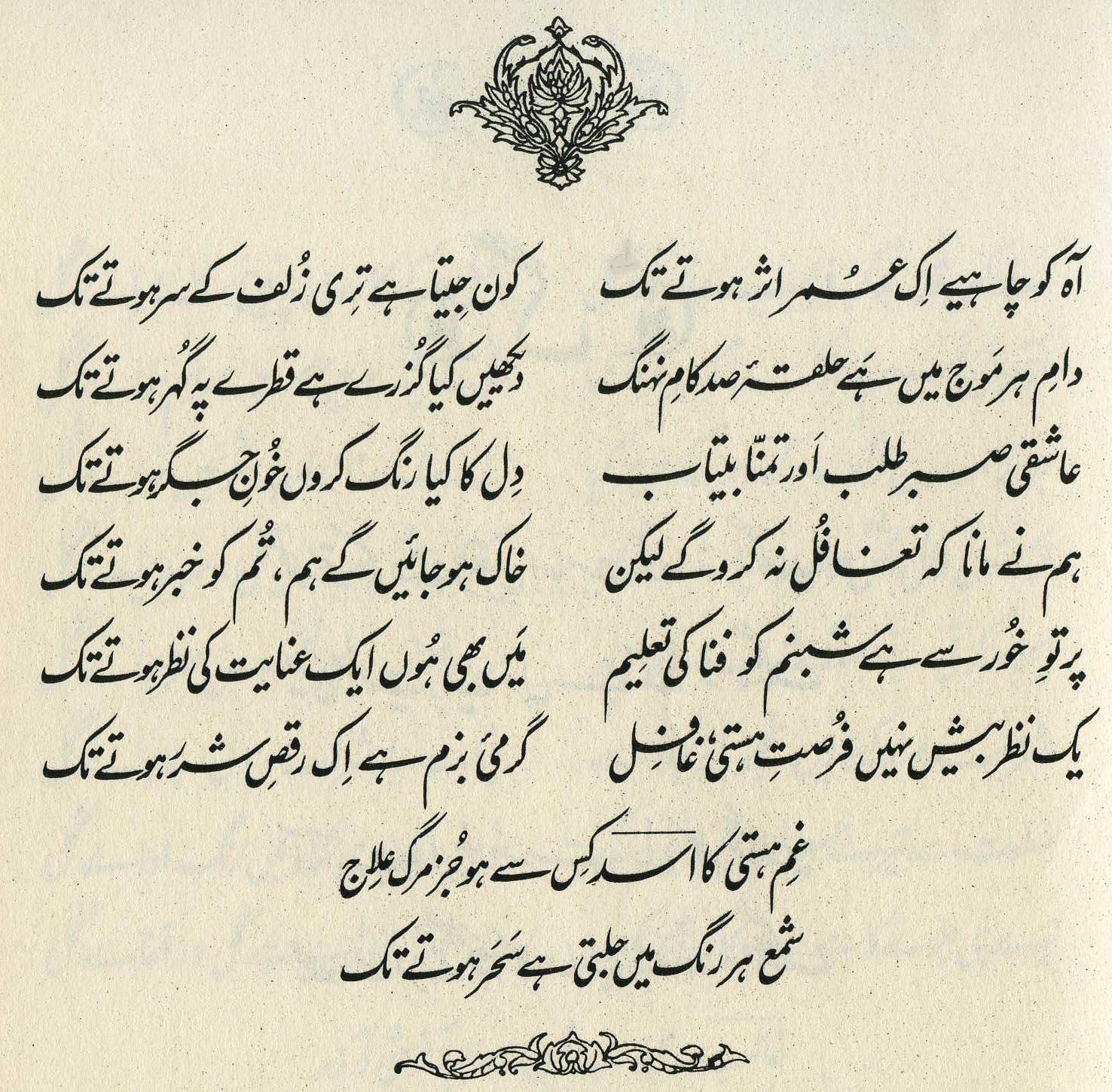
That is, the affairs of passion are such that they can't be accomplished quickly, and longing is restless and is in a hurry. In short, until the liver would be turned to blood [] and would be finished off, it's very difficult to control the heart. (80)
== Nazm page 80

He says, being a lover is a patience-demanding task, and longing is in a hurry to obtain success as quickly as possible. How would I be able to give patience to my heart and restrain my liver? The meaning is that when the liver will be turned to blood, at that time there will be effect in the sigh, and the aspect of success will be visible. (126)
In such a condition, until the liver turns to blood, and stability and effect would be created in passion-- until that time, how would I manage my heart, how would I control it? (208)
The commentators basically agree on the lover's paradoxical dilemma, and they agree that when the 'liver turns to blood' the dilemma will be resolved. They disagree on how it will be resolved. To Nazm, the resolution will be the liver's death, and thus apparently the lover's death, so that all his troubles will be over. Bekhud Dihlavi and Baqir seem to feel that the liver's turning to blood will create 'effect' [] in the lover's sighs, and will thus bring him at least some form of success.
In the second line, can mean either the liver's 'turning to blood', or else the liver's 'being murdered' (see the definition above). But in any case, the multivalence of is the key to the verse. Perhaps the second line asks a question: what would or could or should the lover do with the heart, how can he manage it, until the death of the liver finally ends the problem? Or perhaps the line is exclamatory: since the lover's longing is so restless, it will uncontrollably turn the heart into wondrously strange 'colors' and 'styles' during the brief interval before the liver finally turns into blood. I am grateful to Zahra Sabri for her help (May 2021) in construing this verse.
As everybody in the ghazal world knows (on this see 30,2 ), the liver is the emblem of fortitude precisely because it makes fresh blood; it then sends this blood along to the heart, which rapidly uses it up through wounds, bloody tears, etc. For more occurrences of , see: 16,1 ; 62,6 ; 114,1 ; 149,10x .
There's an enjoyable kind of 'catch-22' in the first line: to be a lover, you have to have endurance and patience; but the emotions of a lover make it impossible to have endurance and patience. It always makes me think of this verse of Momin 's:
[there's no recourse for the heart apart from endurance
apart from you, that doesn't [habitually] exist]
For another take on the lover's paradoxical plight, see the next verse, 78,4 . And on the 'list'-like structure of the first line, see 4,4 .
Faiz used this verse in one of his nazms, . I used this particular as an example in an article on translation. This article is now available online .
graphics/heart.jpg