Verse 11821arhote tak
G5
In this meter the first long syllable may be replaced by a short; and the next-to-last long syllable may be replaced by two shorts.
1
a sigh needs a single/particular/unique/excellent lifetime until the appearance of an effect
2
who lives until the subduing of your curls?
| References | |
|---|---|
| Arshi, Imtiyaz Ali | Ghazal# 78 |
| Raza, Kalidas Gupta | 334 |
| Nuskhah-e-Hamidiyah | 128-129 |
| Asi, Abdul Bari | 145 |
| Gyan Chand | 238 |
| Hamid Ali Khan | Open Image |
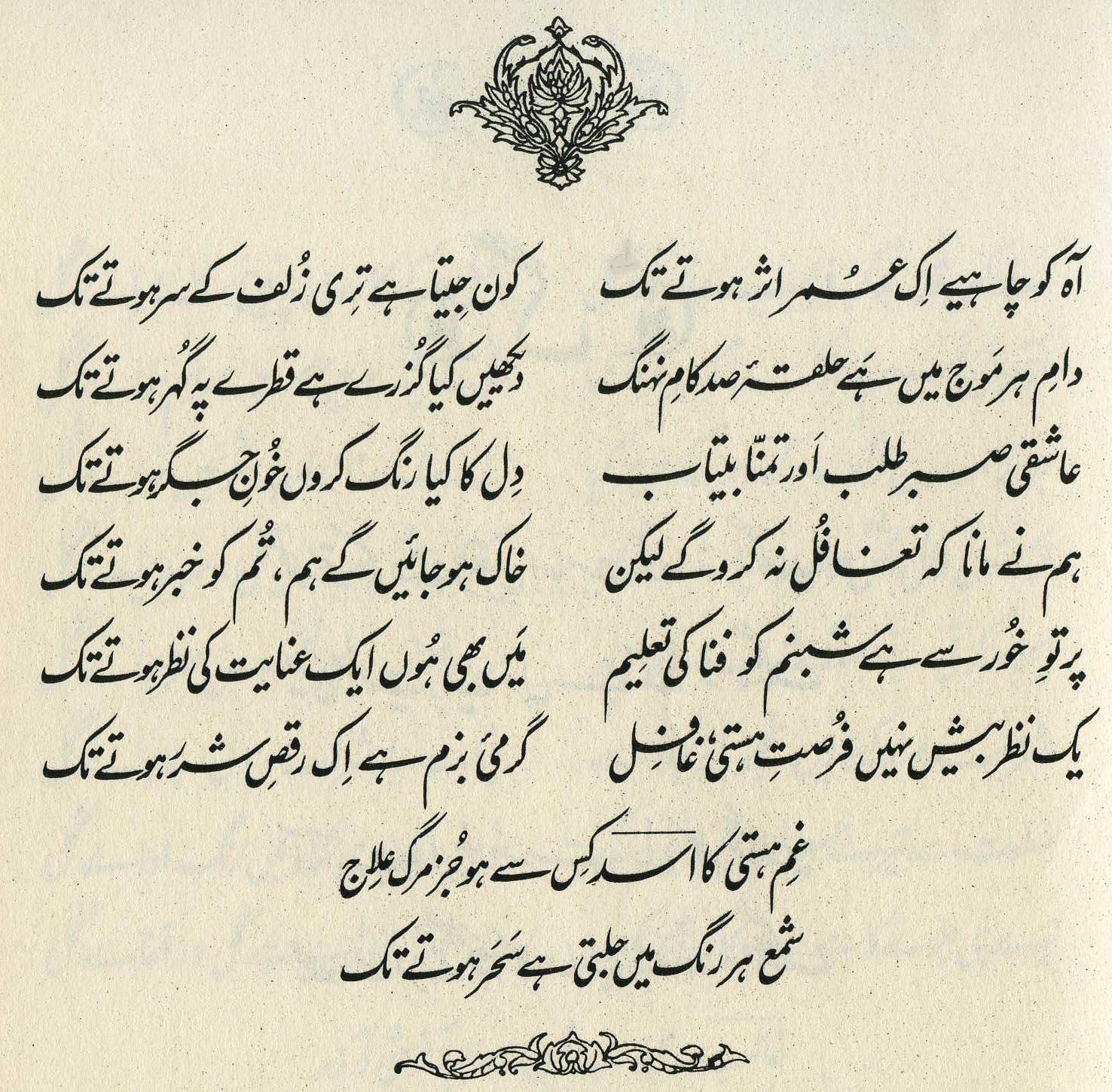
It's an idiom that -- that is, we've understood it. That is, by the time your curls would become aware of my condition, I'll be finished off. (79)
== Nazm page 79

He says, a sigh needs a lifetime to create an effect, and by the time the effect will have been made and your curls will become aware of our anxious/tangled [] condition-- how will we be be able to remain alive till that time? (126)
= [to be tamed, subdued].... A sigh will create an effect in a lifetime. And by the time your arrogant/'high-headed' [] curls would be , or tamed [], our life will be over. That is, we won't live long enough for you to become kind. (164)
[There are some difficulties in this verse.] I don't have any other commentary in my possession except these two [Hasrat and Nazm] that I mention. I hear that ten or fifteen commentaries have already been printed. If I had another, then I'd look into it. I don't want to buy one. I haven't managed to borrow any yet. The search continues. (243)
: The meanings of this idiom are varied.... A common meaning of it is 'to subdue, to subjugate' []. (262-63)
In modern Urdu means 'to pursue someone or something, to insist on having something'. It's clear that this meaning isn't suitable here. [Many other dictionary meanings are also unhelpful; some commentators give meanings that seem quite unattested and aren't relevant at all.]....
In the world of war and combat, is a well-known idiom that means 'to be victorious, to win a victory, to attain, to succeed, to complete something'. [Examples are given.] Thus for to mean 'to be vouchsafed victory over the curls, for the curls to fall into our hands' is absolutely suitable and appropriate. In this meaning there's also the pleasure/subtlety that the talk is about 'curls falling into our hands', and to express it the idiom has been used. It's a peerless verse.
== 2006: 119-20
Some editors modernize the refrain of this ghazal into . (The construction contains an archaic form of the infinitive; for another such archaic form, see 174,5 .) As always, I go with Arshi.
This is one of only a handful of ghazals from which Faruqi has selected every single divan verse as superior.
As against Nazm's reading, Bekhud Mohani, supported by Faruqi, is surely correct: if we take to mean 'to be subdued, tamed', we end up with richer and more interesting interpretive possibilities. Faruqi thinks that in the second line the lover is wistfully contemplating the (im)possibility of his ever 'subduing' her curls by getting his hands on them, running his hands through them, and so on. That is possible of course, and works well. And it highlights the wordplay of as 'head' (augmented by the sound effect contained within ).
But it's also possible that the lover's lifetime is being compared to the time it would take for the beloved herself to comb out and 'subdue' her own long, dark, tangledcurls. For this reading the perfect illustration is 71,2 . In that verse, the long, dark, tangled curls of the beloved are implicitly (and only implicitly) likened to the long, dark, tangled thoughts of the lover. She sits obliviously adorning her hair, he sits thinking. We imagine that he is probably watching her, but we can't prove it.
In the present verse, similarly, she sits combing her long, thick, hard-to-subdue curls. He sits sighing, or else thinking about sighing, and regretting her (physical? emotional?) inaccessibility, her unsubdueableness. He realizes that it will take as long for his attentive concentration and his 'sigh' to have an effect on her, as it will for her attentive concentration to subdue her unruly curls. Or rather, almost as long: it will take a lifetime for his sigh to have an effect, but more than a lifetime (who can live that long?) for her curls to be subdued.
Alternatively, she may be so fatally irresistible that the lover's lifetime will be extremely short-- merely the time it takes her to comb her hair is already longer than he, ravaged by passion, will be able to survive. Perhaps he won't live as long as it takes her to complete her morning toilette.
But there remains a kind of radical undecideability-- it's a classic 'A,B' verse, after all-- about the relationship of the two lines. They simply don't give us much traction. What, after all, is the connection between them? Are the two processes similar in slowness (the slow process of a sigh's having any effect is like the slow process of her combing out her tangled curls)? Or are they similar in impossibility (a sigh that takes a lifetime to have any effect is basically a hopeless effort, and likewise the combing-out of her curls will never be ended)? Or are they being contrasted (a sigh will take effect in merely a lifetime, while her combing out of her curls will go on much longer)? Or is the relationship of the two lines of some other, more subtle kind? Both lines are so evocative, so mysterious, so arbitrary in their juxtaposition, that they invite the mind to play with them freely.
This ghazal, and above all this verse in particular, is very famous; it is often recited and sung. In both this verse and 71,2 , the two lines suggest two very different emotional and physical worlds, even if both these worlds may be located in the same room. Isn't there a particularly 'modern', distant, remote quality about these two verses? A sort of 'so near and yet so far' effect. The verses seem so simple, but then somehow there's no end to them. This feels, ultimately, like a brilliant verse of mood .
graphics/comb.jpg