Verse 41821arhote tak
G5
In this meter the first long syllable may be replaced by a short; and the next-to-last long syllable may be replaced by two shorts.
1
we conceded/agreed that you won't show negligence/heedlessness, but
2
we'll become dust, by the time of the news reaching you
'To admit, allow, acknowledge, confess, own; to permit; to acknowledge the superiority of, to submit, yield; to agree to, assent to; to consent; to accept, receive; to take, assume, suppose; to take for granted, to grant'.
'Unmindfulness, heedlessness, forgetfulness, neglect, negligence, inattention, inadvertence, indifference, listlessness'.
| References | |
|---|---|
| Arshi, Imtiyaz Ali | Ghazal# 78 |
| Raza, Kalidas Gupta | 334 |
| Nuskhah-e-Hamidiyah | 128-129 |
| Asi, Abdul Bari | 145 |
| Gyan Chand | 238 |
| Hamid Ali Khan | Open Image |
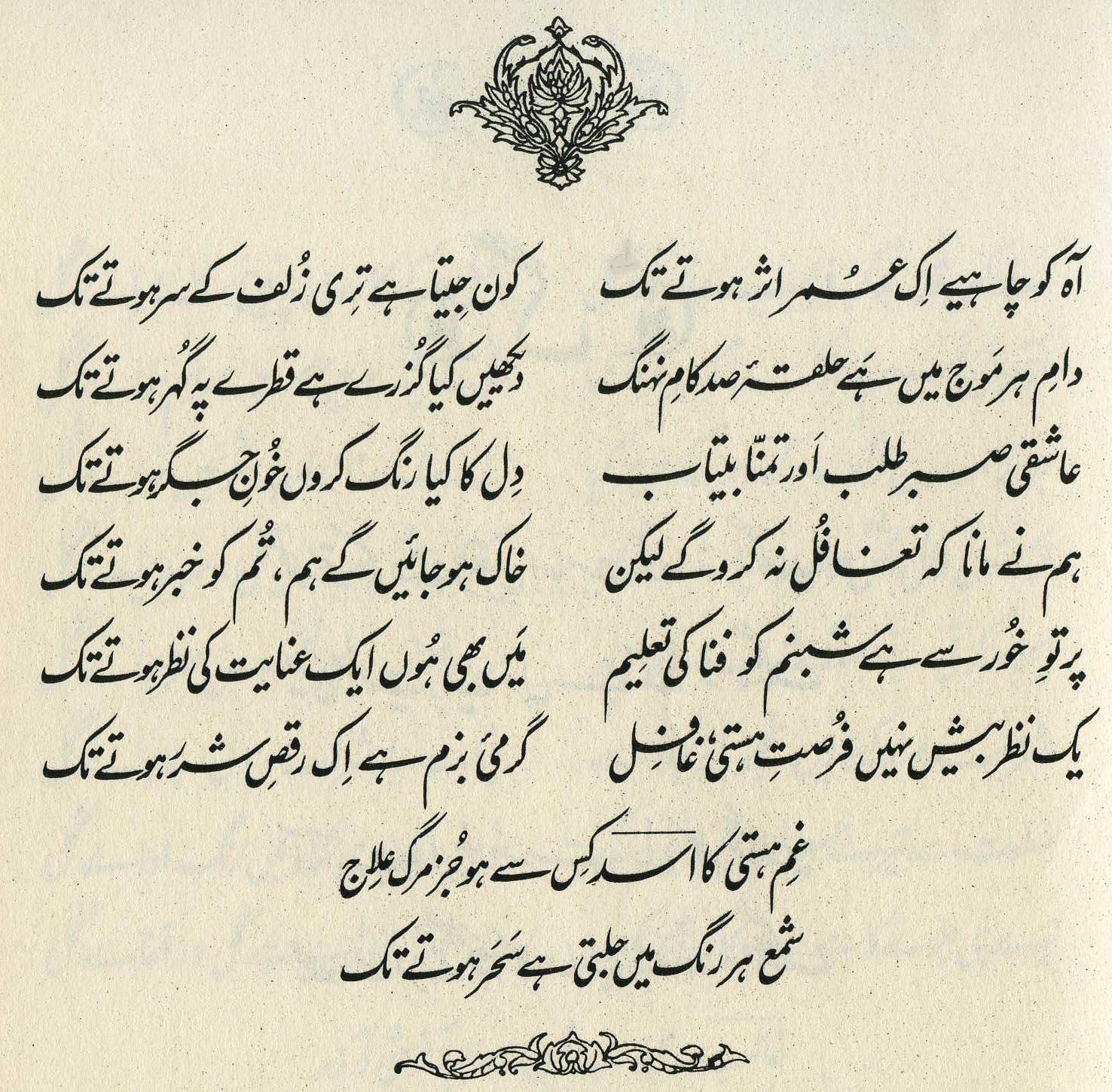
The meaning is that when the news reaches you, you will take heed, but while the news is on its way to you-- here, we are finished off. (80)
== Nazm page 80

To pull out from this ground such a clear and unexampled verse-- this was a task for an accomplished master like Mirza. He says, 'We're persuaded that you won't engage in neglect, and will come quickly. But while news is in the process of reaching you, we will turn to dust, so what's the cure for that?' (127)
It's a very clear and well-worked-out [] theme . That is, 'I'm persuaded that you will give up negligence and will return quickly. But the state we are in in your absence will finish us off, and by the time news of our bad state reaches you, we will already have been done for.' (164)
If the lover doesn't accept her pledge not to neglect or ignore him, he'll offend her-- and thus he'll never get any favors from her. Yet if he does accept it, and thus earns her good will, he'll never live long enough to get any favors from her anyway. (For he'll of course be in such bad shape, and/or she'll be so remote, that he'll be dead before she even learns of it.) So no matter what he does, he's doomed.
Yet the tone of the verse is surely wry, dry, rueful, even amused. The lover is quite aware of the peculiar quality of a non-negligence that has exactly the same effect as negligence: the non-negligence that will be brought to bear only after the non-neglected person is dead.
In fact, this almost paradoxical quality reminds me of 17,8 -- oh, the repentance of that 'quick-repenter'! First she kills the lover, then she swears off murder. In the present verse, first the lover will die without her awareness, then she will show her non-neglect! For a more inward perspective on the problem, compare the previous verse, 78,3 .
Why will it take so long for word to reach her? Perhaps because she's always so far away, so inaccessible, so basically indifferent, that even a Messenger traveling at full speed would take ages to reach her. Or perhaps because the lover's condition without her will be so dire that he won't last any longer than a candle in the wind, so that even a fast channel of communication will prove too slow. Or perhaps because she will use slowness of communication as an excuse-- oh, I would have come, but alas, the message only reached me too late. (Or, of course, since these possibilities aren't mutually exclusive, all of them at once.)
And then, what is the 'news' that will reach her too late? One possibility of course is the news of the lover's generally dire condition and imminent death. But another quite plausible possibility is the 'news' that the lover has conceded, and has claimed to be persuaded, that she won't show negligence. Perhaps the two had had a quarrel, and he accused her of being negligent. She denied it, and stormed out in anger. Later, upon reflection, he decided to concede the point, maybe as a gesture of reconciliation. But of course, his concession is useless, because he'll be dead before she learns of it.
What can a poor lover do but at least tease her, at least enjoy the irony? That much he's doing. The verse, after all, is addressed directly and familiarly [] to her.
Note for grammar fans: Here's one more case in which the tenses don't align perfectly between Urdu and English. In colloquial English we'd be much more likely to use the present perfect ('we've conceded'). For more on this topic, see 38,1 .
graphics/jaisalmercenotaphs.jpg