Verse 51821arhote tak
G5
In this meter the first long syllable may be replaced by a short; and the next-to-last long syllable may be replaced by two shorts.
1
from the ray of sun is, for the dew, an education in oblivion
2
even/also I exist/am until the appearance of a single/particular/unique/excellent glance of favor
'Vanishing, passing away, being ended and finished; being old, frail; annihilation, mortality; frailty, transientness, fleetingness'. (Steingass p.939)
'Favour, bounty; gift, present; countenance, aid, support'.
| References | |
|---|---|
| Arshi, Imtiyaz Ali | Ghazal# 78 |
| Raza, Kalidas Gupta | 334 |
| Nuskhah-e-Hamidiyah | 128-129 |
| Asi, Abdul Bari | 145 |
| Gyan Chand | 238 |
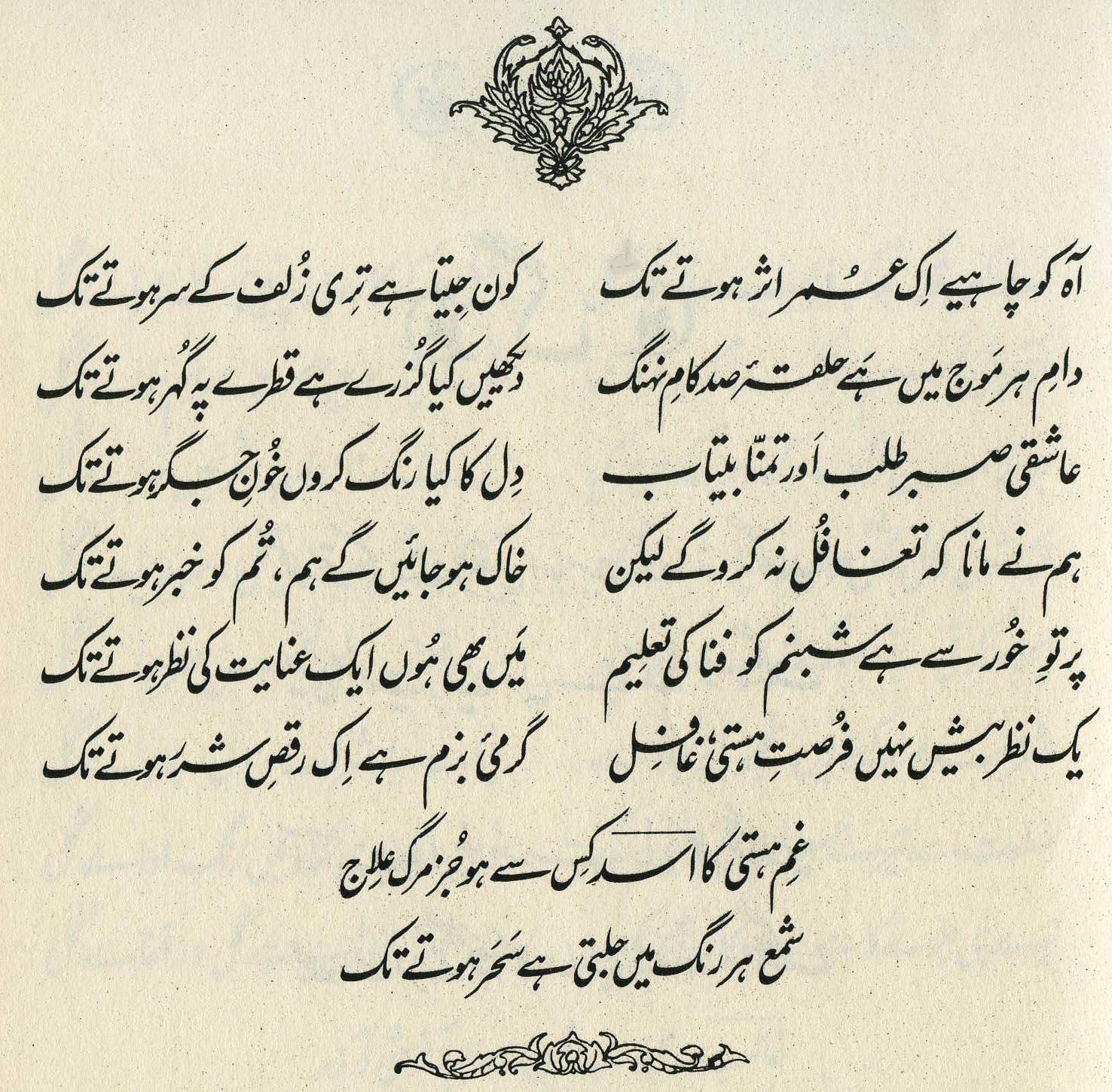
| Hamid Ali Khan | Open Image |
That is, my existence is like that of dew, and your glance is a ray of sunlight. With one single glance from you, I can no longer have any stability or foundation, the way dew is obliterated by a ray of sunlight. (80)
== Nazm page 80

He says, the way the dew evaporates and flies up from the heat of the sun, in the same way I too will be obliterated by a glance of favor from you. The meaning is that my existence has no more substance than that of the dew, nor can I have any more stability or foundation than it does. (127)
[He might be speaking to the True Beloved.]
[Or:] It's possible that he might have said 'glance of favor' out of sarcasm-- that is, the day your eye falls on me, I'll be finished off.
[Or:] When you become kind to me, my life is over, [as in] 126,8 . (165)
This word doesn't seem like a very good one. [Here's an improved version of the first line:][the ray of sun is the cause of the oblivion of the dew]. (244)
The little , 'even' or 'also, too', confirms for us that the comparison is between the lover and the drop of dew, and that they share at least one important trait. The relevant trait is obviously that of being instantly evaporated, receiving an 'education in oblivion'-- from the first ray of the sun or the first 'warm' glance of the beloved. The double possibilities of as 'even' (that the speaker is an extreme or unique or extraordinary case), or as 'also, too' (that the speaker is only one more in a series of similar experiencers), generate two possible readings of the comparison between the lover and the dew.
The Sufi-inflected term suggests that the lover might feel about that glance the rapturous delight that a mystic would feel about absorption in the Divine. There might also be a bit of trembling involved, as we saw when the lover literally depicted himself as a drop of dew in the desert in 61,1 .
If we take the beloved's 'kindly' glance as one benevolently intended, there's a suggestive parallel to the situation in 9,7 , in which the lover is so weak that Jesus's attempt to revive him by breathing on him kills him instead. Perhaps the beloved looks with kind intentions-- and then regrets that her glance has caused the lover to vanish in a puff of vapor?
Equally possible is Bekhud Mohani's notion that the lover is speaking sarcastically-- 'Thanks for your 'kind' glance-- it's bound to vaporize me!'. Bekhud Mohani also suggests that she might do it on purpose: in 126,8 , the verse he cites, the second line is, 'the person whose friend you are, why should the sky be his enemy?' (Or, as we'd put it in English, 'with friends like you, who needs enemies?')
Of course in the previous verse, 78,4 , we learned that the beloved's neglect will kill the lover; now we learn that her glance of favor too will do him in. What's a poor beloved to do? Or a poor lover? The lover's journey is a predestined route to death (and beyond it); he knows this, and chooses it even as it chooses him. It's the anticipatory part of his 'education in oblivion'-- an education which, as we learn from 61,3 , has been going on for some ages now.
graphics/sundew.jpg