Verse 11821aa;Npar
G2
1
my heart trembles at the trouble taken by the shining sun
2
I am that drop of dew/'night-moisture' that would be on a desert thorn
'Disquietude, indisposition (of body or mind); pain, affliction, trouble, sickness'.
| References | |
|---|---|
| Arshi, Imtiyaz Ali | Ghazal# 59 |
| Raza, Kalidas Gupta | 331 |
| Nuskhah-e-Hamidiyah | 105 |
| Gyan Chand | 203-204 |
| Hamid Ali Khan | Open Image |
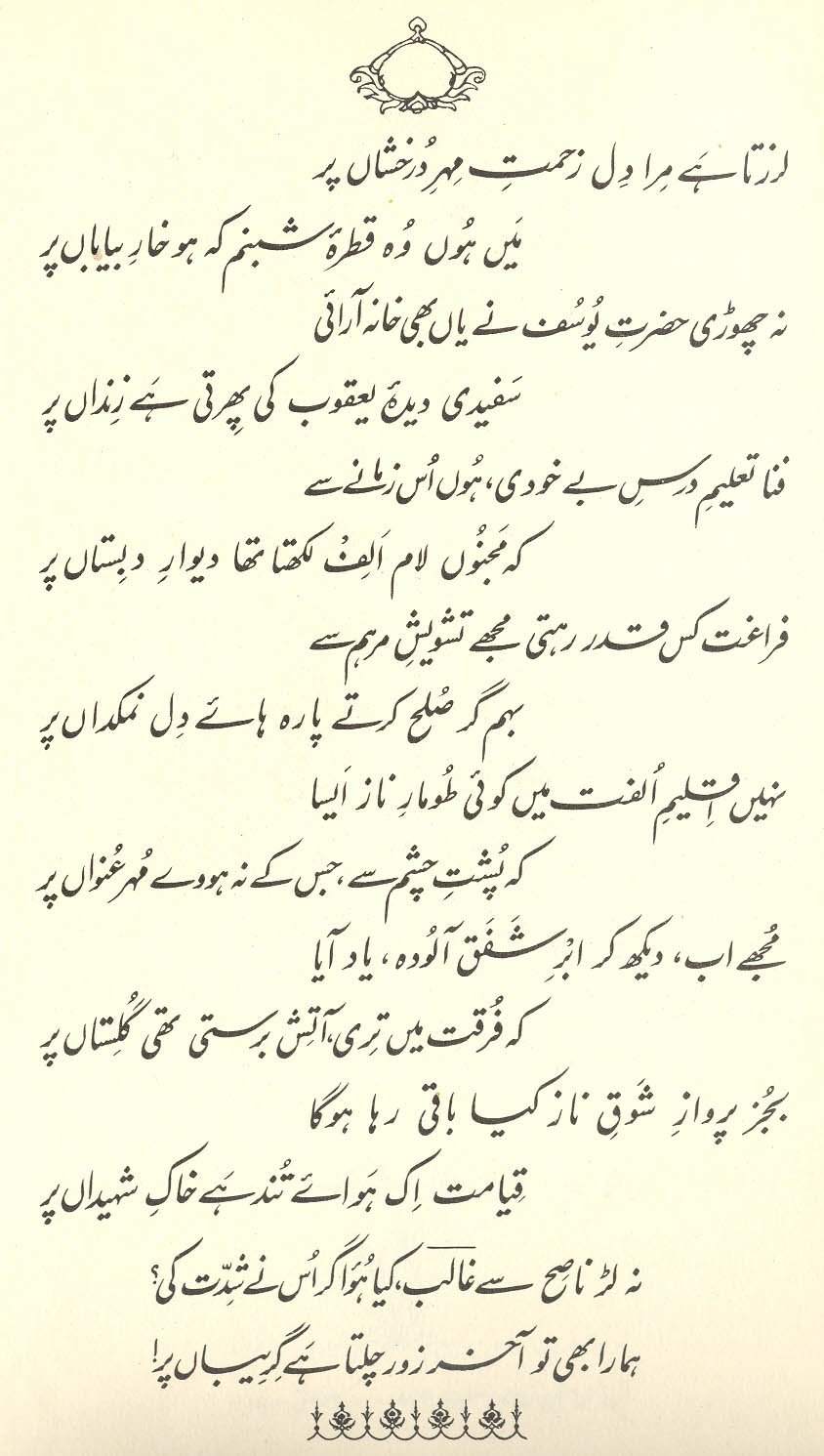
That is, the thirsty tongue of the thorn will itself swallow me up-- what need is there for the sun to take the trouble of devouring me? In this verse, the trembling of the heart has been used as a simile for the glistening of the dewdrop in the sun, and the basis for the likeness is the trembling. (60)
== Nazm page 60

He says, In swallowing up a worthless drop, the sun is showing such enthusiasm [lit., 'hot-headedness'] that my heart trembles to see it. A drop-- and that too a drop that has paused on the tip of a thorn-- has a very insecure hold on existence. (106-07)
That is, in order to erase me, is the thirst of the thorn itself not sufficient? That is, I myself will attain oblivion. What need is there for [the sun] to take the trouble? [It could also be read with a sarcastic meaning.] (136)
As Bekhud Dihlavi observes, a drop of dew on the tip of a desert thorn 'has a very insecure hold on existence'. It must have formed during the night, and it's doomed to die with the first shafts of sunlight. And what will it be able to look back on? A brief life of futility and sterility on the tip of a thorn, as a drop unable even to provide moisture to a single blade of grass. Really, as the commentators point out, the drop is so unworthy a thing that it trembles at the thought of the great and shining sun deigning to take the trouble of vaporizing it. (Of course, this could also be said in a wonderfully sarcastic tone.)
Moreover, what Nazm calls a simile could also be a form of ' elegance in assigning a cause '. We see that dewdrops quiver, and now we know why: they tremble with shame (and Sufistic rapture?).
While the first line has a firm present habitual verb [], the second line modulates from another clear present tense [] into a mere subjunctive []. This subjunctive represents a clear choice, since the poet could have used another present tense [] in the same place without the least difficulty. But the contingent-sounding , with its quality of hesitation and uncertainty, adds to the mood of the verse. It seems to call into question not only the continued survival of the drop, but even its very existence.
The wordplay that opposes dew ('night-moisture') to desert (literally, 'waterless-place'), also opposes night to day, and the softness and limpidity of a drop both to the harshness and darkness of a thorn, and to the fiery radiance of the sun. The lover imagines himself as in a state of absolute helplessness and imminent death, his existence already tentative and contingent. Far from doing anything as aggressive as indulging in despair, he simply waits, with a trembling heart, for his fate. But might his heart not also be trembling with celebratory joy? Think of 78,5 , in which a similarly placed dewdrop awaits a mystical 'education of/for oblivion'.
graphics/desertthorn.jpg