Verse 71821aa;Npar
G2
1
{except for / apart from} the flying/flight of the ardor of/for coquetry, what will have remained?!
2 a
Doomsday is a mere/particular/unique brisk breeze, on the dust of the martyrs
2 b
a mere/single brisk breeze is Doomsday, on the dust of the martyrs!
'Remaining, lasting, enduring, permanent, existing, extant; eternal, everlasting; left in arrears, still due; --remaining portion, remainder, residue, remnant'.
'Quick, swift, rapid, fast, fleet; brisk, active; hot, sharp, acrid'.
| References | |
|---|---|
| Arshi, Imtiyaz Ali | Ghazal# 59 |
| Raza, Kalidas Gupta | 331 |
| Nuskhah-e-Hamidiyah | 105 |
| Gyan Chand | 203-204 |
| Hamid Ali Khan | Open Image |
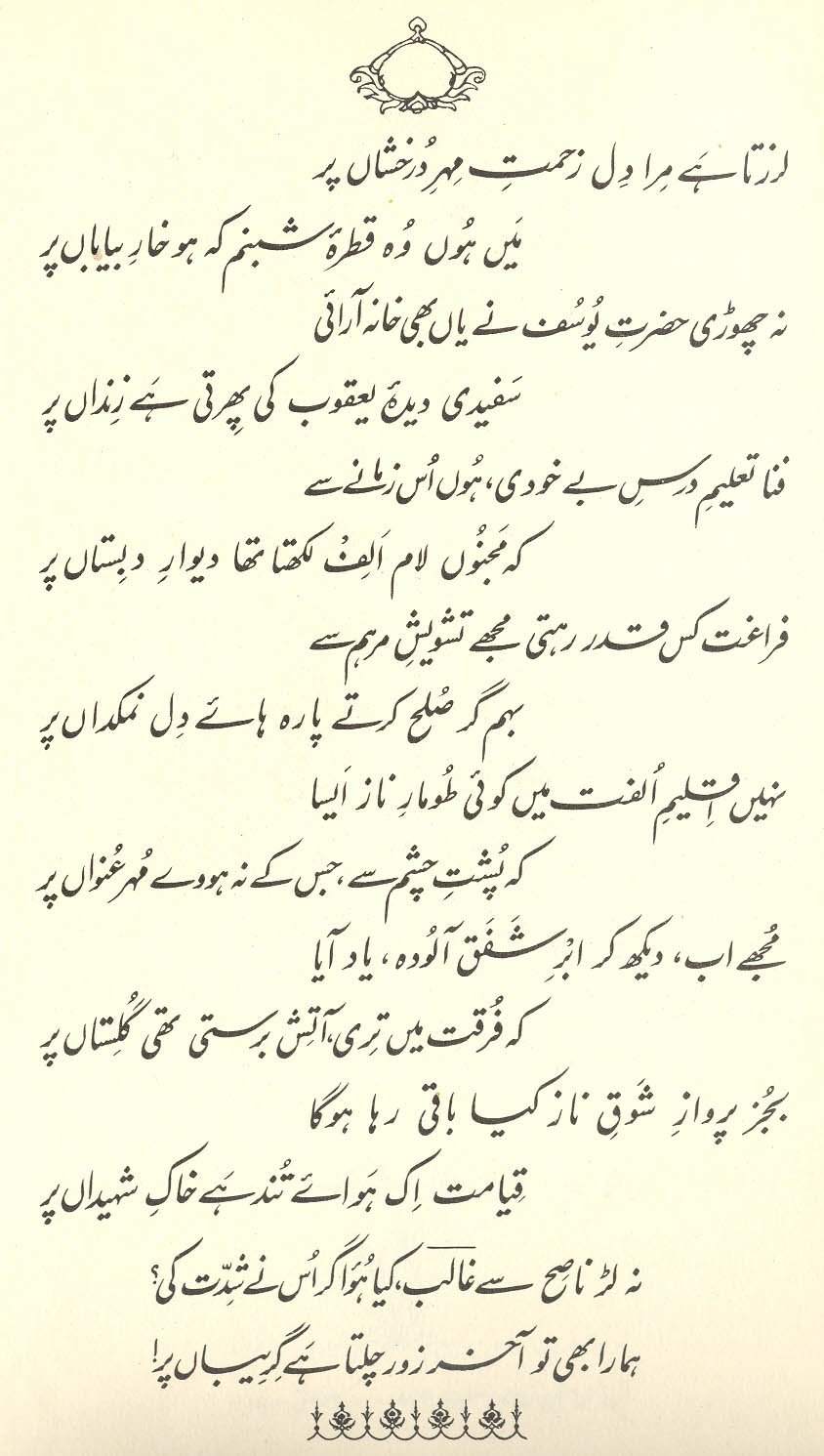
That is, what of the martyrs of the longing for sight now remains for Doomsday to cause to rise up? Indeed, in ardor for the appearance/glory of the entirely coquettish one their dust is flying around, such that for them, the tumult of Doomsday is a swift breeze. That is, in their flight this breeze too will be a helper. And if you take its mirror image, then the meaning is that when a swift breeze came, it did the work of Doomsday-- that is, their dust began to fly in the ardor for sight. (62)
== Nazm page 62

He says, Doomsday has already come a hundred times to the heap of dust of those martyred by your coquetry. That is, when a brisk wind blew, their dust has flown up and become scattered. Even if Doomsday comes at the appointed time, how will it be able to raise up those martyred by your coquetry? Where is there any dust of theirs left-- it's already been carried off by the wind. (108)
I have already alluded to this ghazal's harmony of sound. It's my view that out of all Ghalib's ghazals, this one ought to receive a special rank for its sound effects alone. [On this see 61,6 .] ....
One uncommon interpretation of the present verse is that the lover, having burned up or wandered off, has already turned to dust. When a brisk breeze blew, then it carried this dust away. That is, it created a scattering like Doomsday on the dust. In this dust what would even have been left, except the flight of an ardor for coquetry? What did the brisk breeze even gain by scattering it? Another meaning can be that the lover's dust, having turned to flecks and grains, flew off with a brisk breeze; now, except for the flight of an ardor for coquetry, what will have remained? Formerly there was dust as well, but the breeze dispersed the dust in all directions. Now the token of the martyrs is only the flight of an ardor for coquetry, which is an intangible thing.
But some problems still remain. In the second line, what is the subject? Is it 'Doomsday', or 'a swift breeze'? [A discussion of how either is possible.]
Still, the question arises of how 'flight of the ardor of coquetry' is to be understood. This construction can be interpreted in at least two ways: 1) flight of the ardor of coquetry; and 2) flight in the ardor of coquetry.
In the first case, it is taken to imply that the lover's ardor for coquetry (that is, an ardor to experience coquetry) remains always inclined to flight; that is, it is limitless and incalculable, and this ardor to experience coquetry remains established even after his death. He himself will turn to dust, but the ardor for coquetry remains.
In the second case, a situation that accords with temperament is the outcome: the lover has ardor for coquetry to such an extent that he himself keept taking flight-- that is, in order to fulfill his ardor he keeps making earth and sky into one. The lover's limbs have turned to dust, but he himself has not turned to dust; rather, he's flying like the wind. In such a case his becoming dust, or his dust being scattered, has no reality. If he's a true lover, then in any case the trace of him can only be found in the flying around of dust, in the ardor of coquetry; accordingly, the universal destructiveness of Doomsday cannot affect him.
A third case can also be that the emotion of the flight of the ardor of coquetry is so intense that the way after the lovers' deaths their dust keeps flying around-- in truth, that too is an expression of this same emotion. Although Doomsday restores everything to life and brings it back into its original body, Doomsday cannot obtain control of that ardor. Its situation before the lover's dust is only that of a swift breeze.
If the verse under discussion is read together with this [Persian] verse of his, then its pleasure is doubled:
[I am just a handful of dust, there's nothing of me there to arise
Doomsday is no more than a blast of cold wind for the {humble / dust-essenced} ones].
== 1989: 73-75) 2006: 90-91
Classic Ghalib, and one of the brilliant verses of the divan . The interrogative first line is and also presumptive, so it's doubly removed from the world of fact. And it has two constructions, so its multivalence is at least triply assured.
Then the seemingly simple second line provides two answers to the question in the first line-- if it is in fact a question and not an exclamation. Both answers are indirect, and are informative only through implication : through what I call 'symmetry', the line can meaningfully be read either as 'A is B', or as 'B is A', a common enough feature in Ghalib's poetry. But in this particular verse, what meanings! Both of them are complex and devastatingly effective, and both of them ultimately return us to the subtleties of the first line. In the ghazal world, dead lovers are 'martyrs' [] if they die true to their 'faith' of passion; this is not a parody of the religious use of the term, but an extension of it-- and perhaps a justifiable extension, since the beloved may (almost) always be God.
According to (2a), Doomsday is, thanks to the beautifully exploited multivalence of , a mere, or particular, or unique, swift breeze on the dust of the martyrs: the dust of the dead lovers has been so utterly consumed by the fires of passion that even the turmoil of Doomsday will be, by comparison, nothing more than a swift breeze. The martyrs will hardly even notice it, much less pay it any special attention. After all, what's even left of them that the day of 'rising' can summon, or can cause to arise?
And according to (2b), even a mere swift breeze is Doomsday on the dust of the martyrs: the dust of the dead lovers is so light, so easily agitated, so ethereal and unmoored that even a swift breeze would swirl their dust around as if it were the turmoil of Doomsday. (And of course 'Doomsday' is really the day of 'standing, rising', a sort of resurrection day, which enhances the pleasure still further.)
There's also the question, as Faruqi points out, of how the flight 'of' the ardor 'of' (or 'for') coquetry [], with its two constructions, to be understood. Is it a flight that is in ardor, by means of ardor, or pertaining to ardor? Is there any remaining dust of the lovers at all, such that it can take flight? Or has the lovers' dust vanished completely, so that the flight of the dust is replaced by an inexhaustible 'flight of ardor' instead? And is the coquetry that of the beloved, for which the lover is endlessly ardent, or that of the lover himself, flaunting his fine martyrdom?
The possibilities multiply, but somehow, in this verse they're all mysterious, all moving and beautiful. The internal rhyme of , which aligns itself beautifully with the metrical feet, feels fluent and uncontrived. The verse soars, and creates around itself a refined, bright, eternal flight of passion.
For a more melancholy vision of the flight of the dead lover's dust, see 114,2 . But for a structural parallel, see 222,1 , which is similar to the present verse and almost (though not quite) equally powerful.
On the possibilities of , see 101,1 .
Compare Mir's equally brilliant vision of what happens to the dust of dead lovers: M 144,7 .
graphics/dustdevil.jpg
