Verse 51821aa;Npar
G2
1
in the clime/region of love/affection there's no account-book of coquetry such
2
that there would not be a seal/stamp of/from the 'back of the eye' on its title page
'Clime, climate; region, country; zone, belt of country'.
tuumaar>> : ''A paper, &c. folded or rolled up,' a roll, scroll; a volume, book; an account-book'.
is an alternative form of the future subjunctive ( GRAMMAR )
'To look at with coquetry, with feigned or real disdain, with pride'. (Steingass p.251)
'Superscription, title, or title-page (of a book, &c.); preface'.
| References | |
|---|---|
| Arshi, Imtiyaz Ali | Ghazal# 59 |
| Raza, Kalidas Gupta | 331 |
| Nuskhah-e-Hamidiyah | 105 |
| Gyan Chand | 203-204 |
| Hamid Ali Khan | Open Image |
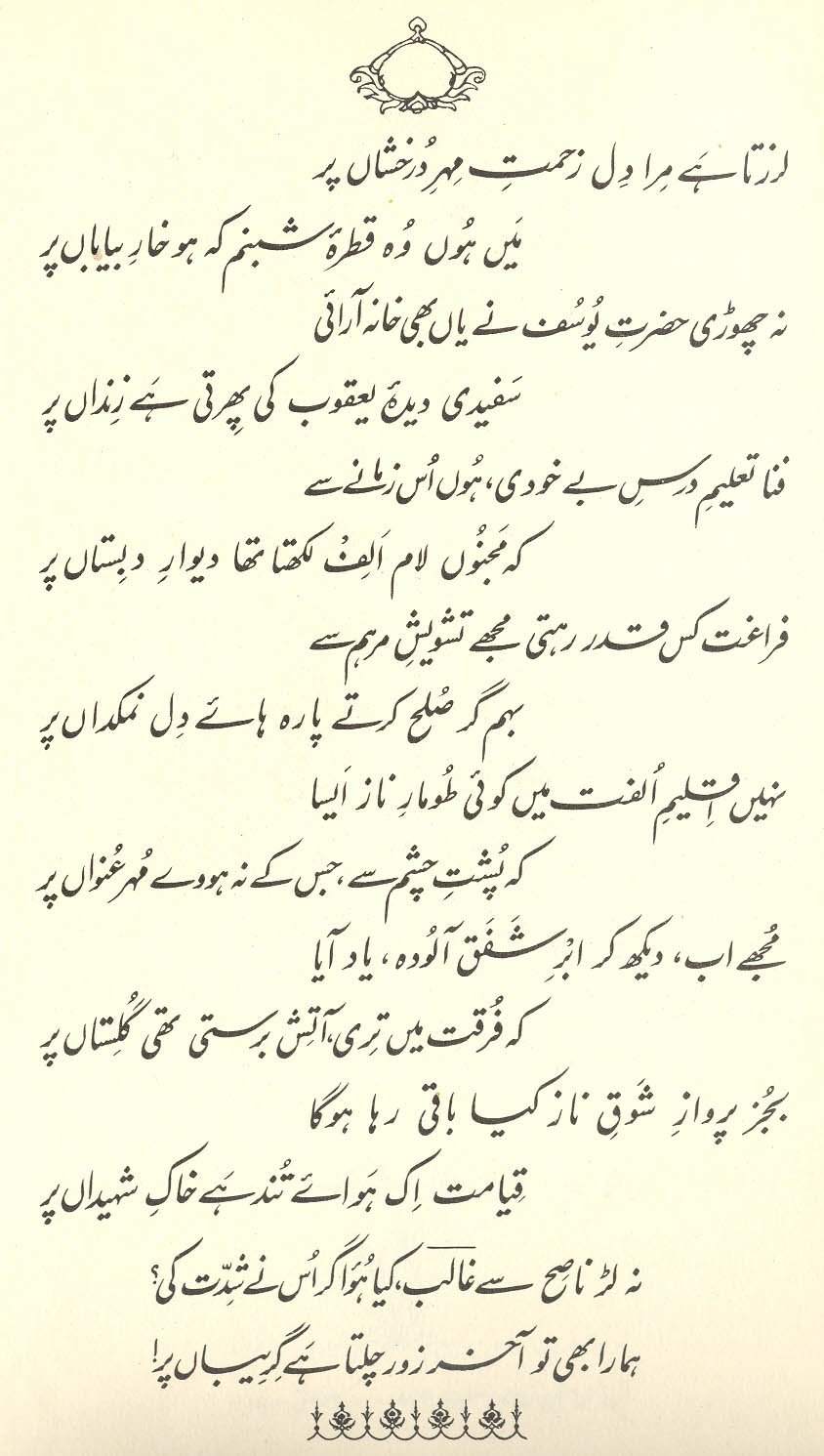
The author's meaning is that in the office of beauty there's no account-book of coquetry that doesn't have on its title page the seal of the back of the beloved's eye. (And for there to be a 'seal of the back of the eye' gestures toward the beloved's averting her eyes, and turning her gaze away, and giving sidelong glances.) And between a seal and an eye, the cause for similitude is blackness. The result is that just as it's necessary for every account-book to have a seal on the title page, in the same way it's necessary for coquetry to show averting of eyes, and looking sideways.
In this verse the author has envisioned the clime of love only through the account-book and the seal. And if we consider it in this respect, then for account-book and seal, rather than 'clime' the word ' divan ' has more affinity . But [the author rightly preferred the virtue that] the moment the seal has made an impression on the title-page, it at once turns its 'back' [as it is removed], and the moment their eyes have met, the beloved at once turns her eyes away from the lover, which is a simile of eloquence [], and the basis of the similitude is movement-- and that too, movement which is extremely beloved. (61)
== Nazm page 60 ; Nazm page 61


In these two lines Mirza Sahib has expressed a very important theme , compared to the breadth of which the largest record book is nothing. He says, in the clime of passion no record book is devoid of the airs and graces and coquetry of beloveds, and the coquetry of the beloved has always had dominion over the lover.... Mirza's claim is that the true lover is always unsuccessful and unachieving. No lover has been born in the world whose beloved has not used coquetry and refusals, and has not put the seal on the refusal with the back of the eye. (107-08)
When someone receives a royal decree, he first places it on his head, and presses it to his eyes; after that, he reads it. (138)
This verse too is an example of convolutedness of expression []. (144)
ABOUT : To 'give someone the back of the eye' is a Persian idiom for viewing with coquettish arrogance or disdain; see the definition above ( is a variant of ). It always reminds me of a somewhat similar English expression of contempt or rejection: 'She gave him the back of her hand' (meaning a slap). Other 'back of the eye' verses: 155,4x ; 155,5x . An example from Mir: M 183,14 .
ABOUT SEALS and SIGNET-RINGS: Scroll down.
The second line is indeed a bit convoluted, as Josh observes, but it goes into prose order like this: .
The verse plays on bureaucratic and commercial terminology. Every reputable account-book must have the appropriate seal, carefully stamped on its title-page (and surely within it as well), as a proof of authenticity. Why shouldn't the same proper arrangements prevail in the clime or realm of love? They do, of course: all the account-books of coquetry there have a seal 'of' or 'from' [] the back of the beloved's eyes.
Nazm does a good job of explaining what this means. The beloved's black eyes resemble the black seal with its black ink (and many seals are round in shape, like an eyeball). Even more to the point, the moment the seal has made a firm imprint on the page, it is carefully withdrawn all at once, in a single movement, to prevent smearing. Which of course is just how the gaze of the coquettish beloved operates: a single powerful, impression-making glance, then instant withdrawal of the eyes.
Just as the seal 'turns its back' after its work is done, the beloved's disdainful eyes do the same. Thus the account-book of coquetry is sealed, and its authenticity guaranteed, with/by the 'back of the eyes' [] of the beloved
Nazm gets into the spirit of the thing by pointing out an alternative path of wordplay that the poet rightly chose not to take. Since there's a 'clime of love' [], it might well have a royal court or council, or a chief minister, called a (a title that would of course evoke a divan of poetry). But in this case, what Ghalib did choose was a more unusual and complex kind of wordplay, as Nazm approvingly notes.
ABOUT SEALS and SIGNET-RINGS: Seals were used to authenticate documents. In a society of less than complete literacy, they were especially valuable for conveying an assurance of genuineness. They were usually round, and had incised into them (in reverse, of course, so that the writing would be legible when stamped) the owner's name and titles, and often a date. Some examples are shown below. For other creative juxtapositions of eyes and seals, see 24,2 and 143,6 . It seems that before stamping, the paper was often moistened with a touch of the lips; for discussion of this, see 261x,1 ; more on seals and lips: 248x,3 and 267x,4 . A wound can also resemble a seal, as in 303x,4 . (However, a is a mark on the forehead made by constant prostration, as in 254x,3 .)
Smaller versions of seals took the form of signet-rings, which were more personal and portable; the inscription was carved into a jewel-- in reverse of course. The inscribed jewel, once set into a ring, was decorative as well as useful. Verses that play with the importance of signet-rings: 4,15x ; 28,3x ; 95,2 ; 113,3 // 248x,1 ; 370x,5 ; 392x,1 . Also, compare 50,2 with its evocation of a plain, ordinary ring.
The heading of a formal decree issued by Shah Alam II (r.1759-1806):
graphics/farmanshahalam.jpg
An ordinary round seal (carved with the date 1084 AH, or1673/4) from a late Mughal letter:
graphics/roundseal.jpg
With the British, from the late 1700's onward, came the use of deeply incised seals that were impressed into softened sealing-wax (which then hardened and couldn't be removed without breaking). These were used to seal letters, rather than to legitimate account-books, so probably we shouldn't think of them in the context of the present verse; still, they have a nice metaphorical appropriateness. Here's an example of a sealing-wax impression from Gwalior:
graphics/waxseal.jpg
Ghalib himself owned some square seals. These examples are both dated 1231AH (1815/6). The second one identifies him by his pen-name as well. (Source: , ed. Akbar Ali Khan Arshizadah; Rampur: Idarah-e Yadgar-e Ghalib, 1969, p. 1.) The upper one says 'Asadullah 'urf Mirza Naushah [his family nickname]' and the lower one says 'Asadullah ul-Ghalib'.
graphics/ghalibseals.jpg