Verse 9x1821aa;Npar
G2
1
the bloody-livered heart-- impatient/unenduring; and the favor/bounty of passion-- indifferent/disdainful
2
oh God -- may a 'whole Doomsdayful' Khavar/'sun' come and fall upon Badakhshan!
'Patience, self-restraint, endurance, patient suffering, resignation'.
'Overflowing, abundance, plenty; —beneficence munificence, liberality, bounty, bountiful kindness; favour, grace; charity'.
'Free from want; in a state of competence; rich, wealthy; independent; able to dispense (with), or to do without; —content, satisfied; —indifferent (to), disdainful (of); boastful, proud, lofty, haughty, supercilious'.
'The west; (but often used by poets for) the east; —the sun'.
'To befall, happen; to break loose, break forth, break in (upon, - ) , rush in, make a rush (upon), fall (upon), attack, charge, assault'.
'Name of a country, near the source of the Oxus, famous for its rubies'.
| References | |
|---|---|
| Arshi, Imtiyaz Ali | Ghazal# 59 |
| Raza, Kalidas Gupta | 331 |
| Nuskhah-e-Hamidiyah | 105 |
| Gyan Chand | 203-204 |
| Hamid Ali Khan | Open Image |
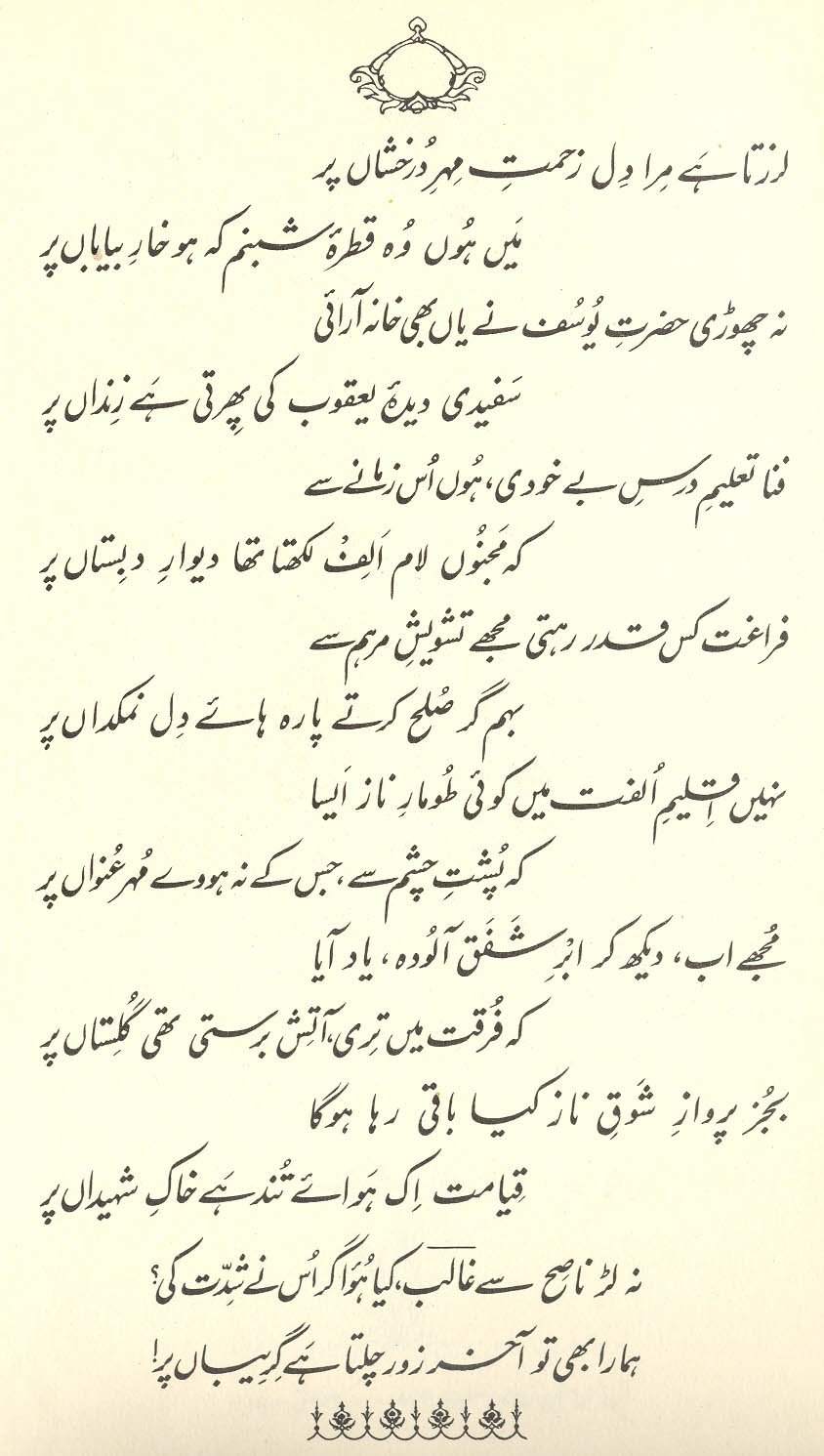
In the first line, the 'bloody-livered heart' is Badakhshan, where they say that rubies are created/born. And the 'favor of passion' is the 'east', from where the sun rises. And since this sun of the east is the sun of passion, it is a Doomsday sun; it is an evidence of Doomsday.
He prays that 'The heart is impatient and passion is indifferent-- oh Lord, remove this difficulty in such a way that passion should leave off its carelessness and indifference, and become the dawn of the sun of favor for my heart'.
== Zamin, p. 166
= a region in Khurasan; it is also called. = a region between Khurasan and Amiran; it should be kept in mind that both Khurasan and Badakhshan are famous for their rubies. In yis a quantitive expression of a 'whole Doomsday'; that is, many Khavars.
The meaning of the verse is, 'My wounded heart is impatient, and wants blood to keep flowing from within it; but the favor of passion pays no attention to it, and the drops of blood do not emerge. Drops of blood are red like rubies. If the blood does not emerge, then if only somehow rubies themselves had entered into the heart! What a miserly wrong Badakhshan did, that it bestowed no rubies on my heart! A curse upon it! If only the 'east' of Doomsday-- that is, the sun of Doomsday-- would fall upon Badakhshan!'
On Doomsday, the sun will come entirely close to the earth. To say instead of [for 'sun'] is Ghalib's innovation. It's also possible that he might have established Khavar as a mine of rubies. If only Khavar would become Doomsday and fall upon Badakhshan, so that both misers would be punished!
It's more probable that the meaning of has been taken not as a mine of rubies, but rather as the 'east'. By 'the east of Doomsday' is meant 'the sun of Doomsday'.
== Gyan Chand, p. 203-204
For background see S. R. Faruqi's choices . This verse is NOT one of his choices; I have added it myself, mostly for completeness. For more on Ghalib's unpublished verses, see the discussion in 4,8x .
Well, Ghalib certainly made the right choice when he decided to omit this verse from the divan . It's really exceptionally obscure, and not rewarding enough to be worth the trouble.
On the one hand, if the heart is 'bloody-livered', then its doom is near, because if the liver has been wounded or turned to blood, then the heart will soon exhaust its own blood supplies and be left running on empty; for more about the liver versus the heart see 30,2 . No wonder the heart is , and has no patience or steadfastness.
And on the other hand, the of passion is indifferent, disdainful, elusive. Thus the poor lover has no 'abundance, bounty, favor, grace' (see the definition above). The beloved's favor is of course what the lover always wants; in context, it might also refer specifically to a supply of fresh blood, which might be available through his passion if the beloved were kind to him and restored his liver and heart to life.
The first line thus has the contrastive structure of two forces pulling in apparently opposite directions: 'A [is] like this, and B [is] like that'. Beyond the 'and' and the forms, there's no grammar whatsoever. For another example of this kind of open-ended first line , see 78,3 . And on its 'list'-like structure, see 4,4 .
When it comes to the second line, Gyan Chand rather than Zamin surely has hold of the right end of the stick. It seems that the speaker is invoking as some kind of mashup, some special 'whole-Doomsdayful sun' that should fall on ' Badakhshan '. But what is the connection between the lines? Badakhshan is famous as the source of rubies, and rubies resemble drops of blood, but that in itself is hardly more than wordplay (along with the extensive wordplay involving ). Gyan Chand makes the best guess he can; it's not all that compelling, but I can't think of a better one. The verse is just poorly put together; this time the obscurity is surely Ghalib's fault, not ours.
graphics/rubies.jpg