Verse 31821aa;Npar
G2
1
I have been oblivion-{instructing/instructed/writing/copying} in the lesson of self-lessness since that era/time
2
when Majnun used to write on the wall of the schoolhouse
'Informing, teaching, instructing; tuition, instruction; --copying finely, writing accurately'.
| References | |
|---|---|
| Arshi, Imtiyaz Ali | Ghazal# 59 |
| Raza, Kalidas Gupta | 331 |
| Nuskhah-e-Hamidiyah | 105 |
| Gyan Chand | 203-204 |
| Hamid Ali Khan | Open Image |
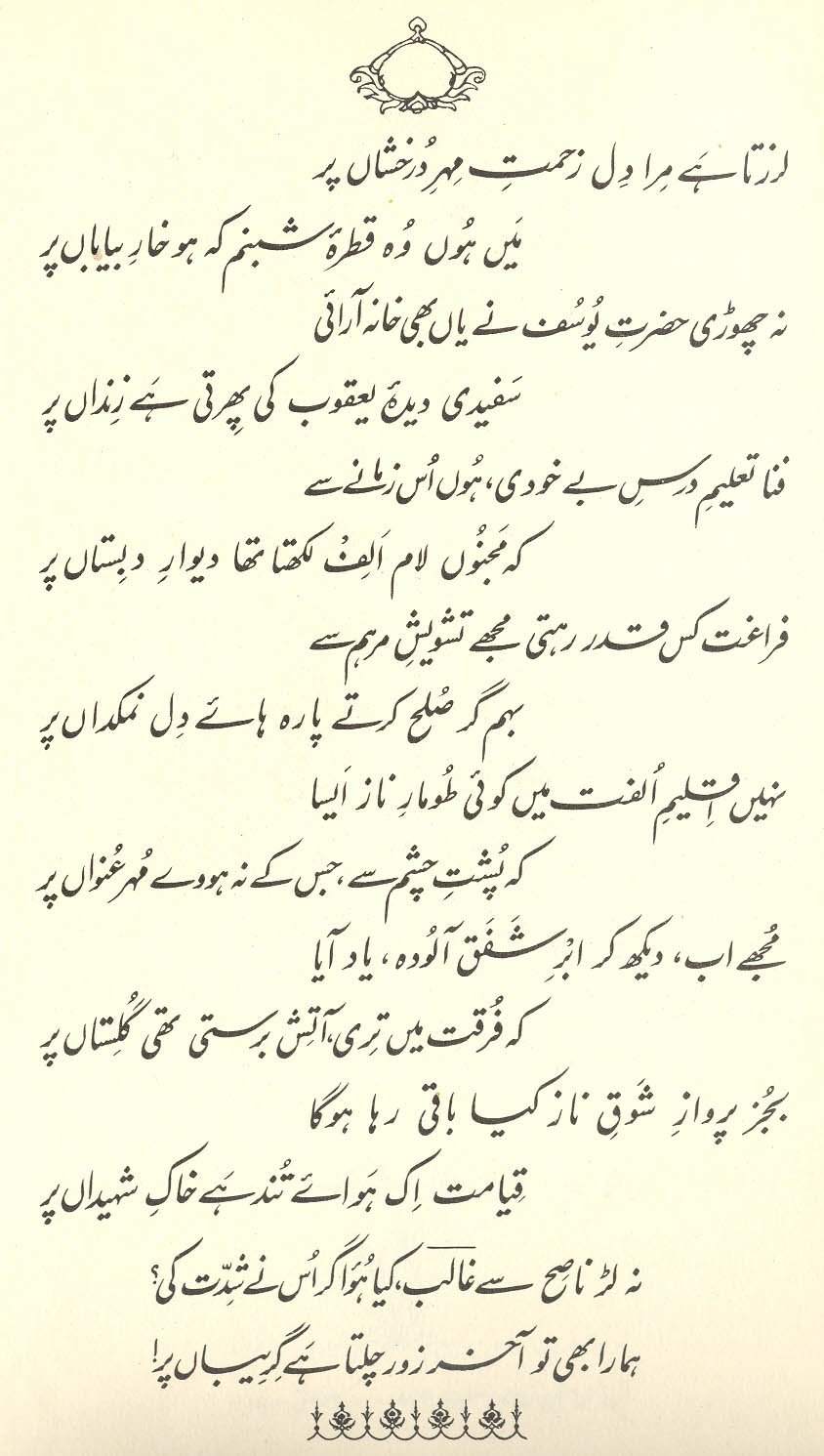
Both 'oblivion' and 'instruction' are fresh vocabulary, and the construction that joins both words is Persian-- that is, 'oblivion-instruction' has become an adjective referring to a person who has been instructed in oblivion. And this lesson which it has given is self-lessness. And the author has rejected [A,B] in favor of [L,A] because when both letters are put together they become ['without'], which has an affinity with 'oblivion'. (60)
== Nazm page 60

He says, I received instruction in oblivion at a time when Majnun was a schoolboy and drew the lines of individual letters on the schoolhouse walls as children do. When and are put together they make , and from the venerable Sufis say that the clash of negation and affirmation is generated. (107)
That is, at a time when Majnun didn't even understand that means 'oblivion', I had already been honored with the rank of 'oblivion in God'. (137)
The commentators explicate the most obvious reading: a boast of the speaker's superiority over Majnun . The speaker himself was already highly 'oblivion-instructed', or was even 'oblivion-instructing', or was finely copying or writing 'oblivion', in the lesson of 'self-lessness' (meaning not unselfishness but self-transcendence), at a time when Majnun was a mere schoolboy only beginning to learn the alphabet.
In the process of learning, Majnun used to write on the schoolhouse wall. If these two letters are joined, they become , a fundamental word: a negation meaning in Arabic 'no, not, without'. And if the two letters are taken as initiating two separate words, they stand for , the beginning of the Arabic for 'There is no God [but God]', which is not only the start of the (Sunni) Muslim profession of faith , but also, as Bekhud Dihlavi points out, a Sufi mystical phrase.
But there's another possibility as well, because 'since that era' [] can mean not only temporal sequence, but also an implied causality. It could be that what made the speaker so 'oblivion-instructed' was in fact the sight of Majnun writing on the schoolhouse wall. Was it the childish Majnun's precocious mystical wisdom-- his choice of writing 'nothing' [] instead of, say, 'a,b,c' []? Or was it the speaker's foreknowledge of Majnun's emblematic fate that made the small boy's experimental scrawl so affecting and revelatory? Either way, it was from this sight that the speaker obtained instruction in oblivion. Thus he reports this coincidence of events not as a boast of superiority over Majnun, but as a tribute to the role he played-- perhaps unknowingly-- in the speaker's own mystical education.
graphics/school.jpg