Verse 61816aarhai
G1
1
the picture/image of an eye has been drawn on the letter-'heading' so that
2
it would be revealed/'opened' to you that it has a longing for a sight/vision
'Picture; drawing; sketch; painting; portrait; an image'.
'Titles at the beginning of a letter (given to the person to whom it is addressed); address, superscription, direction of a letter; --a heading'.
is an archaic form of ( GRAMMAR )
'Sight, vision (= ); look, appearance; face, countenance, cheek; interview'.
| References | |
|---|---|
| Arshi, Imtiyaz Ali | Ghazal# 159 |
| Raza, Kalidas Gupta | 240-41 |
| Nuskhah-e-Hamidiyah | 233-234 |
| Asi, Abdul Bari | 237-238 |
| Gyan Chand | 364-366 |
| Hamid Ali Khan | Open Image |
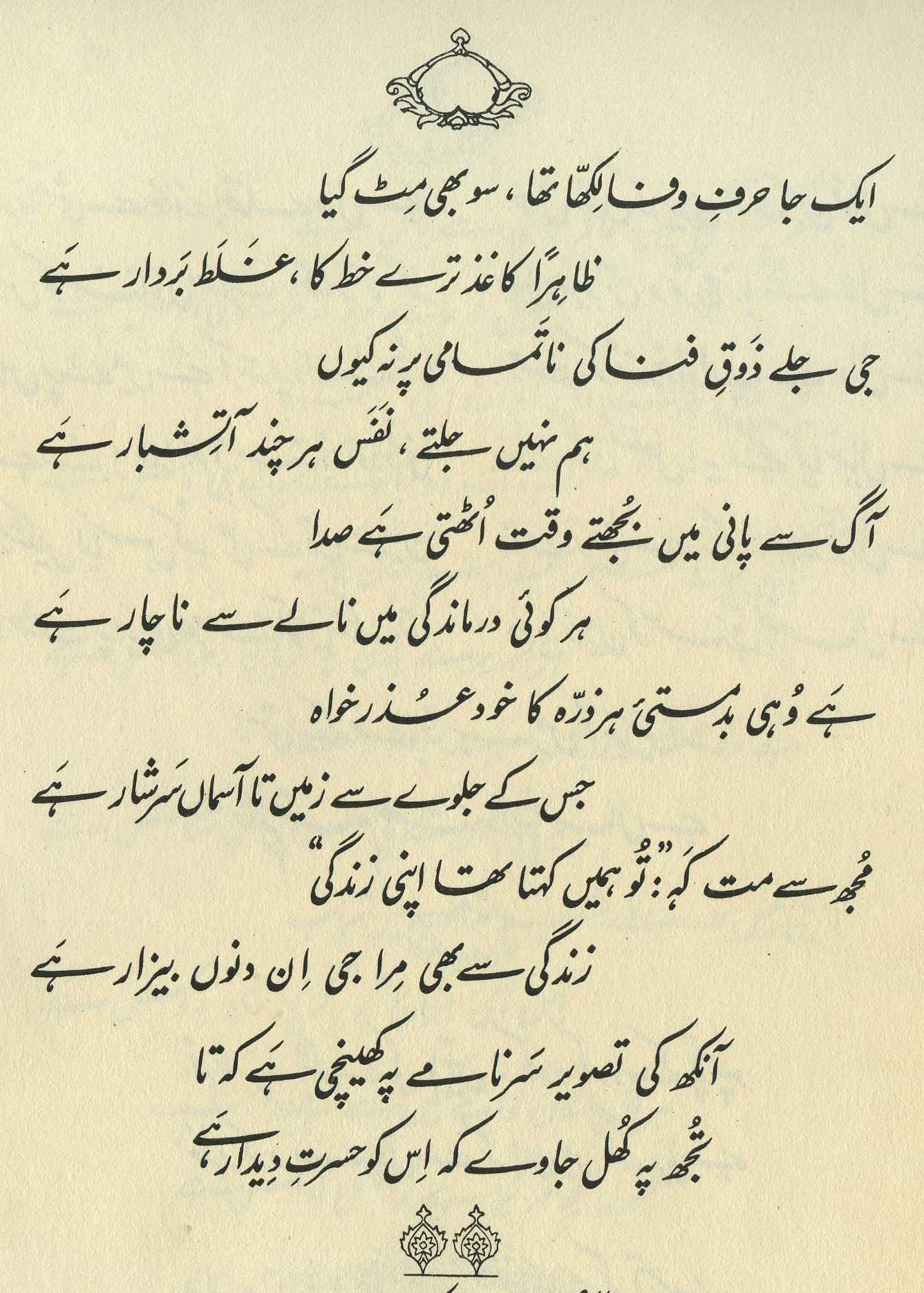
is a word of , for it has an affinity with 'address', and also an affinity with 'eye'.
== Nazm page 153

He says, instead of writing a letter, on the envelope of the letter I have drawn with a pen a picture of an eye. And what I mean by this is that it would become clear to you that the writer of the letter has an extremely great longing for sight. (211)
At the top of the letter we have drawn a picture of an eye, so that it would become clear to you that we long to see you. (280)
[See his comments on Mir's M 429,4 .]
This verse is a real jewel of wordplay. The round personal seal of the sender that often appears at the beginning of a formal letter resembles an eyeball; for illustrations, see 61,5 . Eyes read letters, eyes look at pictures, eyes behold beloveds. Eyes are in heads [], which is part of 'headings' []. Eyes become open, and through the sight of a pictured eye the writer's longing to see the beloved would be revealed or would become 'opened' [] to her. Letters too, when they are to be read, become open, so that their contents are revealed or 'opened'. (And since the beloved probably won't read the letter, at least this way its subject will be 'opened' to her.) Thus the strands of imagery are beautifully woven together, with a naturalness that makes them seem entirely obvious and unforced.
And the pictured eye would show the beloved that it has a longing for a 'sight' or 'vision'; since it is only a picture, its longing can never be fulfilled. But the writer too has a longing for a 'sight'-- meaning, of course, the sight of her. And his longing might possibly even be fulfilled-- if only his letter could be able to move her to insight and compassion.
A piquant verse for comparison is 61,5 , which also has to do with writing and eyes.
Note for grammar fans: This verse offers an elegant example of the way that grammatical subtlety can be used to add literary subtlety to a verse. There are two ways of reading the first line, and they give rise to two ways of reading the second line:
=Someone-- any colloquially-omitted subject, followed by a -- 'has drawn' [] the picture of the eye, so that she'd realize that that person, 'he' [], has a longing for the sight of her.
=The picture of the eye 'is in a state of having been drawn' []-- the past participle, with the colloquially omitted-- so that she'd realize that 'it' [], the picture itself, has a longing for the sight of her. There's no indication of who has drawn it; perhaps in its eagerness it has even somehow drawn itself?
For more on the ambiguity between the past participle and the perfect tense, see 115,2 .
graphics/eye.jpg