Verse 21816aarhai
G1
1
why wouldn't the inner-self 'burn' at the incompleteness of the relish of/for oblivion?
2
we don't 'burn'-- {although / however much} the breath is fire-shedding
'To burn; to be burnt; to be on fire; to be kindled, be lighted; to be scorched, be singed; to be inflamed, to be consumed; to be touched, moved, or affected (with pity, &c.); to feel pain, sorrow, anguish, &c.; to burn or be consumed with love, or jealousy, or envy, &c.; to take amiss, be offended, be indignant; to get into a passion, be enraged, to rage'.
'Breath, respiration;-- the voice or sound from the breast;-- a moment, an instant'.
'Although, even if, notwithstanding; --how-much-soever; howsoever; as often as'.
| References | |
|---|---|
| Arshi, Imtiyaz Ali | Ghazal# 159 |
| Raza, Kalidas Gupta | 240-41 |
| Nuskhah-e-Hamidiyah | 233-234 |
| Asi, Abdul Bari | 237-238 |
| Gyan Chand | 364-366 |
| Hamid Ali Khan | Open Image |
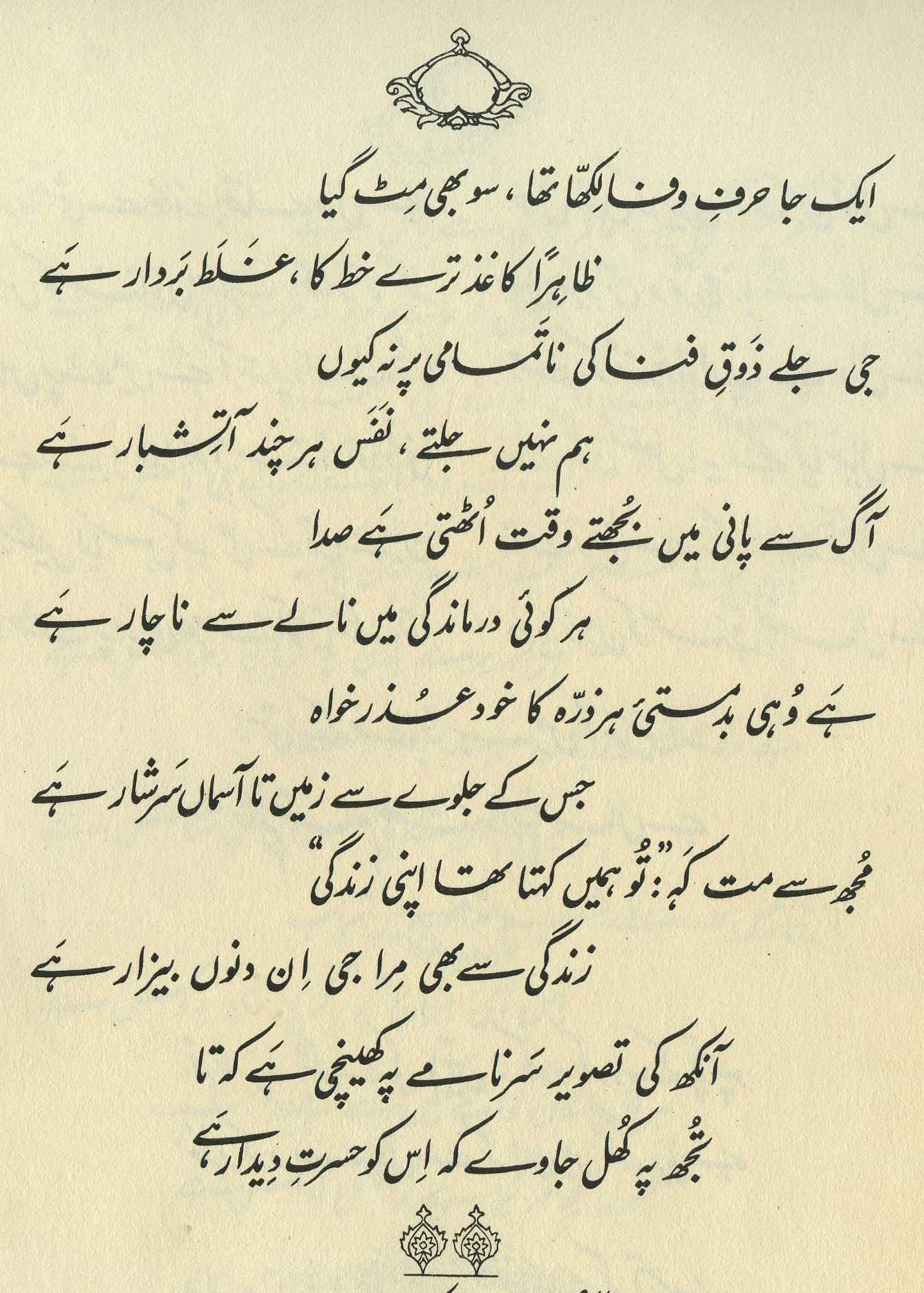
That is, every breath enters the breast and gives rise to flame, and that very flame is the cause of life. Although in every flame the wellbeing of the body and the essence of the physical frame is diminished. From this it has emerged clearly that according to temperament and to the claims of its nature, every living creature has a relish for oblivion-- because the very flame that causes oblivion is life itself. But at the incompleteness of this relish for oblivion, the self 'burns', because it does not all at once burn it up. People who are acquainted with the author's biography will be astonished: from where did he learn this problem of the circulation of the blood []? (153)
== Nazm page 153

That is, it's that very same flame which causes oblivion and bestows life. The heart 'burns' at this incompleteness of this relish for oblivion: why doesn't it burn the body up all at once? (210)
From the author's biography everyone can learn that Mirza had an extreme ardor for knowledge. Mufti Sadr ud-Din Khan Azurdah, Maulvi Fazl-e Haq Khairabadi, etc., recount that the depth of Mirza's knowledge couldn't be gauged-- whatever extremely thorny problems of philosophy, mysticism, etc. etc., were mentioned, Mirza said something that seemed as if he had just finished consulting a book about them. So why is His Excellency the Commentator [Nazm] surprised? (279)
[See his comments on Mir's M 386,2 .]
For more on , see 59,7 .
There are so many possible 'pre-poeticized' meanings of (see the definition above)-- the verse simply throws in a couple of forms of the verb itself, and then adds an extra 'fire-shedding breath' for good measure. (On the subtleties of , see 15,6 .)
In the first line, for example, the speaker somewhat petulantly asks why the self wouldn't 'burn' over its inadequate taste for oblivion. If it did burn, would it 'burn with envy' of those more successful lovers who manage to die quickly and completely, like Moths flying into a candle flame? Or would it 'burn with rage' at its own dilatory and lukewarm tendencies? Or would it 'burn with sorrow' or pity or some other emotion at the recognition of its own weakness? Or would it be so shamed by its remaining unburnt that it would just go ahead and 'burn up' and remove all cause for complaint?
Similarly, in the second line, 'we don't burn'-- but in what sense? Is the second line to be read as a sort of paraphrase of the first, with both describing the same situation? If so, 'burn' would surely be read the same way in both cases. But if the two lines are to be read separately-- and of course Ghalib gives us no hint about their possible relationship-- then the second 'burn' could be quite different from the first one. How about 'We don't catch fire, although the breath is constantly flinging out sparks.' Or: 'We're not jealous of the breath, even though it's so fiery and spark-shedding and we're not'. Or: 'Something's wrong with that inept breath-- it keeps uselessly shedding sparks, but nothing happens!'
No matter how the meanings are pieced together, I'm unable to find anything very interesting in them. This verse feels like a casual spinoff from 76,2 and 137,2 , which make much more compelling use of the same kind of material.
graphics/firebreathing.jpg