Verse 9x1816aarhai
G1
1
households trodden underfoot by the boldness/insolence of the claim/assertion, Asad --
2
the shadow/shade of the wall is the flood of door and wall
'House and home, household furniture, everything belonging to the house; household'.
'Trodden under foot, crushed, ruined, destroyed'.
'Playfulness, fun, mischief; pertness, sauciness; coquetry, wantonness; forwardness, boldness, insolence, &c.
'Pretension, claim; demand, ... contention, assertion'.
| References | |
|---|---|
| Arshi, Imtiyaz Ali | Ghazal# 159 |
| Raza, Kalidas Gupta | 240-41 |
| Nuskhah-e-Hamidiyah | 233-234 |
| Asi, Abdul Bari | 237-238 |
| Gyan Chand | 364-366 |
| Hamid Ali Khan | Open Image |
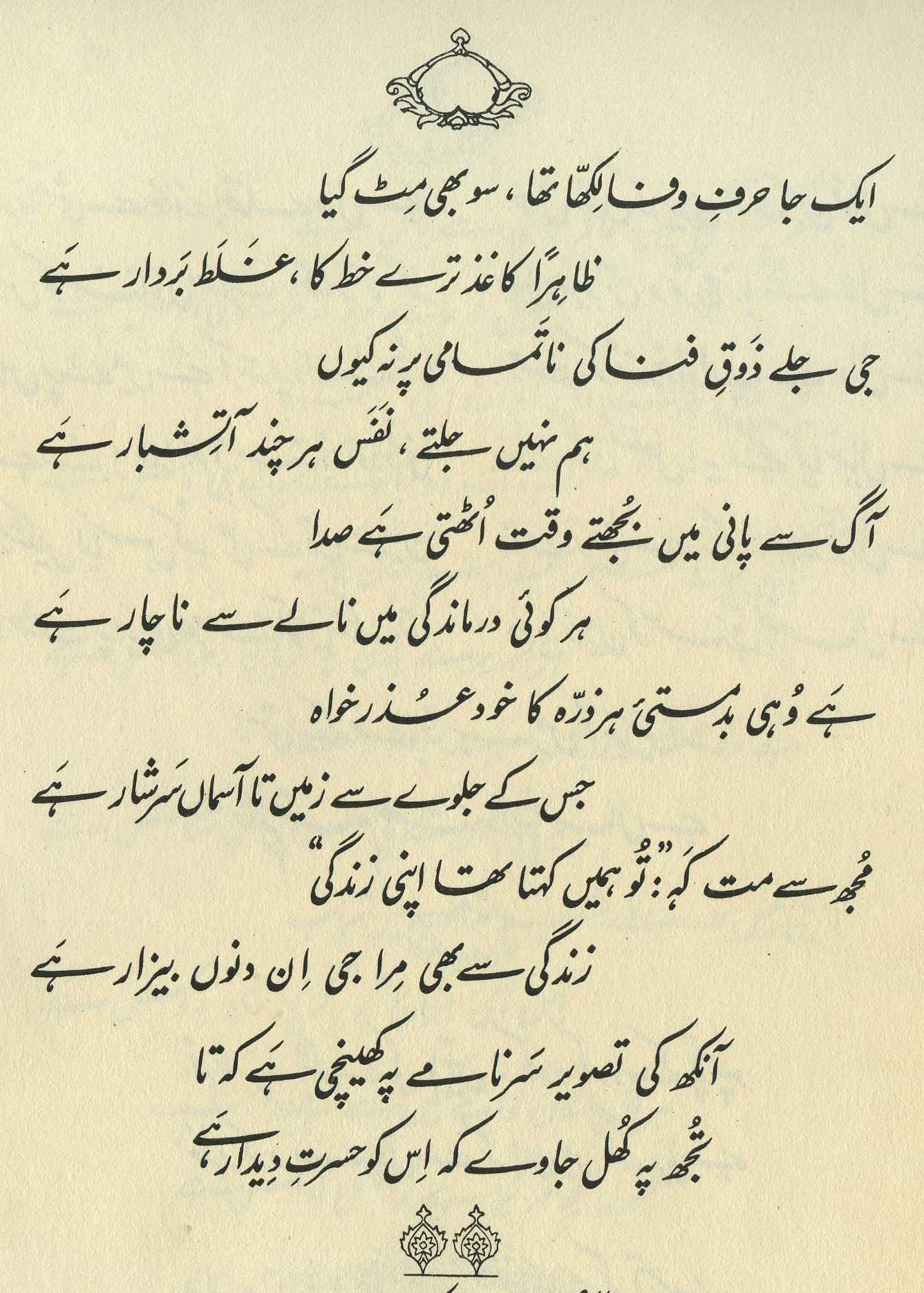
Oh Asad, there are many houses which the mischievousness of the claim has caused to be trodden under foot. Understand that the shadow of the wall is in this regard, for the door and wall, like a flood that destroys and ruins it.
== Asi, p. 238
= vaunting, challenging, boasting, showing off. = that is, the mischievous claim of the family members.
The meaning is that false boasting and display have destroyed home after home. The claim of false boasting he has called the shadow of the wall because it too, like a shadow, is insubstantial and a thing that quickly decays.
== Zamin, p. 359
Someone swaggeringly claims that no flood can knock down his wall-- that this wall will continue to stand strongly, and the wealth and property within the house will be secure. In fact, this claim, this vaunting itself becomes a cause of the destruction of the house, and ruins the household. The 'shadow of the wall' is a sign of the stability of the wall, but for how long? Sometime or other, even if fifty or a hundred years later, this wall will certainly fall, and this 'shadow of the wall' will prove to be a 'flood of the wall'.
'Flood' and 'shadow' both have a relationship with the bottom of the wall.
== Gyan Chand, p. 366
For background see S. R. Faruqi's choices . This verse is NOT one of his choices; I thought it was interesting and have added it myself. For more on Ghalib's unpublished verses, see the discussion in 4,8x .
Zamin and Gyan Chand to the contrary, nothing in this verse makes any reference to the owners of the wall in question, or to their boasts that then (how? why?) cause the house to be destroyed. In my view this verse is of quite a different kind: it's a forerunner, composed ten years earlier (c.1816), of the inexhaustibly provocative 10,6 (composed c.1826).
For in {10,6} we learn that in someone's very 'construction' is contained one particular type of ruin; thus the hot blood of the farmer somehow 'is' the essence of the lightning that strikes and burns the harvest. Similarly, in the present verse the boldness or insolence of the 'claim' is something that seems to be implicit in (the building of) the wall itself. The very act of building the wall creates a 'shadow' beneath it, and that shadow somehow 'is' the dark, irresistible flood that will one day undermine and destroy the whole house.
In fact we know from the first line that this shadow will cause the house, along with many others, to be 'trodden under foot'-- an initial image that works disruptively, to mislead us, so that we're not at all prepared for the metaphorical structure of the obscurely beautiful second line.
Of course the second line is cryptic, gnomic, unmotivated, whatever. The verse is not nearly as effective as {10,6}. But it's fascinating to see the young poet's imagination working along the same lines of force that will later prove both so powerful and so characteristic.
graphics/wall.jpg