Verse 11816aarhai
G1
1
in one place you had written an obliqueness/letter/word/censure of faithfulness-- so even/also that became erased
2
plainly/seemingly, the paper of your writing/letter is erasable/'error-remover'
'Changing, altering; inverting, turning (as a coat);... —nib (of a writing-reed) obliquely cut; a crooked pen; writing obliquely; —a letter of the alphabet; (in Gram.) an indeclinable word, a particle; —a word (so used in lexicons, &c.); —blame, censure, reproach, stigma, animadversion'.
zaahira;n>> : 'Outwardly, openly, publicly, manifestly, evidently, plainly, apparently, to all appearance, seemingly, ostensibly'.
t>> : 'A line, a streak, or stripe, a mark; lineament; —writing, character, handwriting chirography; a letter, epistle'.
t-bardaar>> : 'Error-remover'; an eraser'.
| References | |
|---|---|
| Arshi, Imtiyaz Ali | Ghazal# 159 |
| Raza, Kalidas Gupta | 240-41 |
| Nuskhah-e-Hamidiyah | 233-234 |
| Asi, Abdul Bari | 237-238 |
| Gyan Chand | 364-366 |
| Hamid Ali Khan | Open Image |
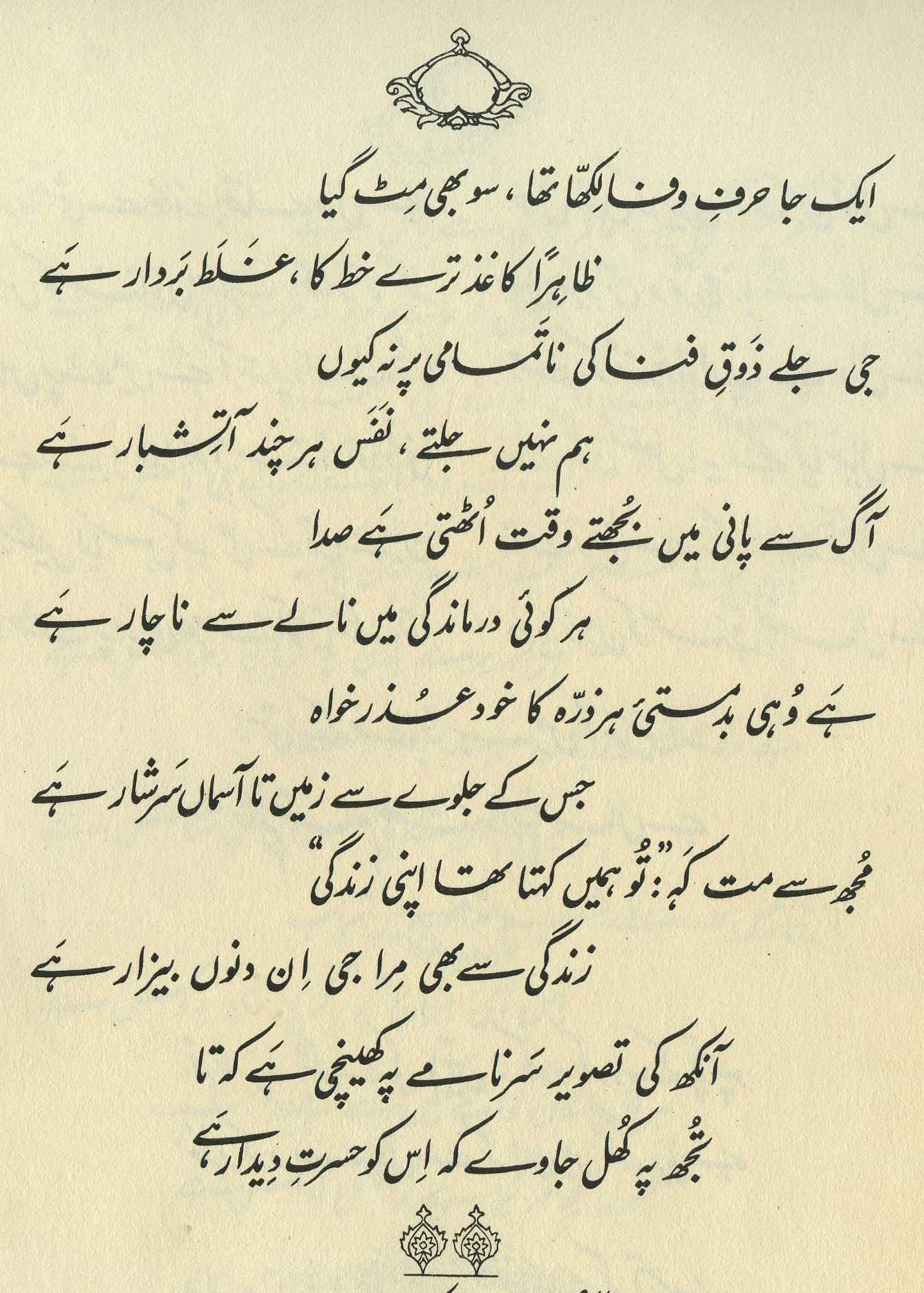
They call a paper 'error-remover' when a letter can easily be removed from it by means of a penknife/scraper, etc., and no sign of it would remain on the paper. But here, by way of a witticism, 'error-remover' has been taken to mean 'from which an incorrect letter would spontaneously vanish'. He says, 'You had written a word of faithfulness at only one place in your letter, and even that vanished; from this it seems that the paper of your letter is 'error-remover': whatever word is not written on it with a true heart, spontaneously vanishes'.
==Urdu text: Yadgar-e Ghalib , p. 155
That is, you wrote the word of faithfulness falsely. In reality, it was incorrect; thus it was erased. From this the subtlety is created that the paper of your letter is 'error-remover'-- that is, your paper is such a thing as the scribe uses to remove a wrong word. (153)
== Nazm page 153

In the whole letter, you had written a word of faithfulness in only one place-- and that too was erased. From this, the mischievous author has created the idea that the paper of your letter seems to be 'error-remover', in that it erased one word that you had written wrongly. That is, you are unfaithful. (279)
Poor Ghalib! Such a cleverly designed little frivolous gem, in classic mushairah -verse form-- and now we have to struggle to recover, somewhat laboriously, what should have been an instantly apparent, amusing twist on a well-known word. The word is duly placed in the potent last slot in the second line, where the punch-word of a mushairah-verse so properly goes. But alas, that doesn't help. Hardly any joke is funny when it has to be explained, and the rule seems to apply even to great poets.
Literally (in Persian) a is an 'error-remover'. Steingass gives (p. 892) exactly the same simple, textbook definition as does Platts: it's an 'eraser'. But plainly a soft rubber rectangle is not what Ghalib intends. The commentators seem to describe something like what used to be called 'erasable' bond (back in the days when people typed): a heavy, rather slick-surfaced paper designed to withstand the stress of having errors rubbed or scraped off its surface. Thus since the erroneous had been removed, the paper must have been 'erasable'.
But the grammar of the name 'error-remover' also suggests an alternative sense of its meaning: as a kind of magically self-correcting paper from which all errors would simply vanish. (The intransitive pointedly doesn't provide any hint of a lurking agent.) Thus the beloved's erroneous had spontaneously disappeared. Probably the joke was very funny to the original mushairah crowd. (If nobody had understood it, why would he have included it in his divan ?)
It's also enjoyable that what the beloved wrote was a single of faithfulness. This could have been a 'changing, altering' of faithfulness, or a 'writing obliquely' of faithfulness (thus a change away from faithfulness); or a single 'letter [of the alphabet], word' of faithfulness (thus the most minimal profession of faithfulness); or even a 'censure, reproach' of faithfulness (thus a mention of faithfulness only in the form of criticism of it). In addition, also refers, with appropriate wordplay, to the obliquely-cut nib of a pen (see the definition above). Needless to say, any of these senses of can be enjoyably, though of course variously, linked to the possibilities of the second line. We in the ghazal world know all too well what kind of connection the beloved will have with even the most passing reference to 'faithfulness'.
Moreover, right at the start of the second line we have , with its two possibilities (see the definition above): either 'manifestly, evidently, plainly' (thus conveying an assurance of entire reliability) or 'seemingly, ostensibly' (thus warning of a display made deceitfully or 'outwardly'). So the paper may not be 'erasable' or 'eraser-like' after all, and the responsibility for any erasures or other changes must be lodged elsewhere.
Compare 110,3 , which makes a narrower but most poignant use of .
graphics/erasure.jpg