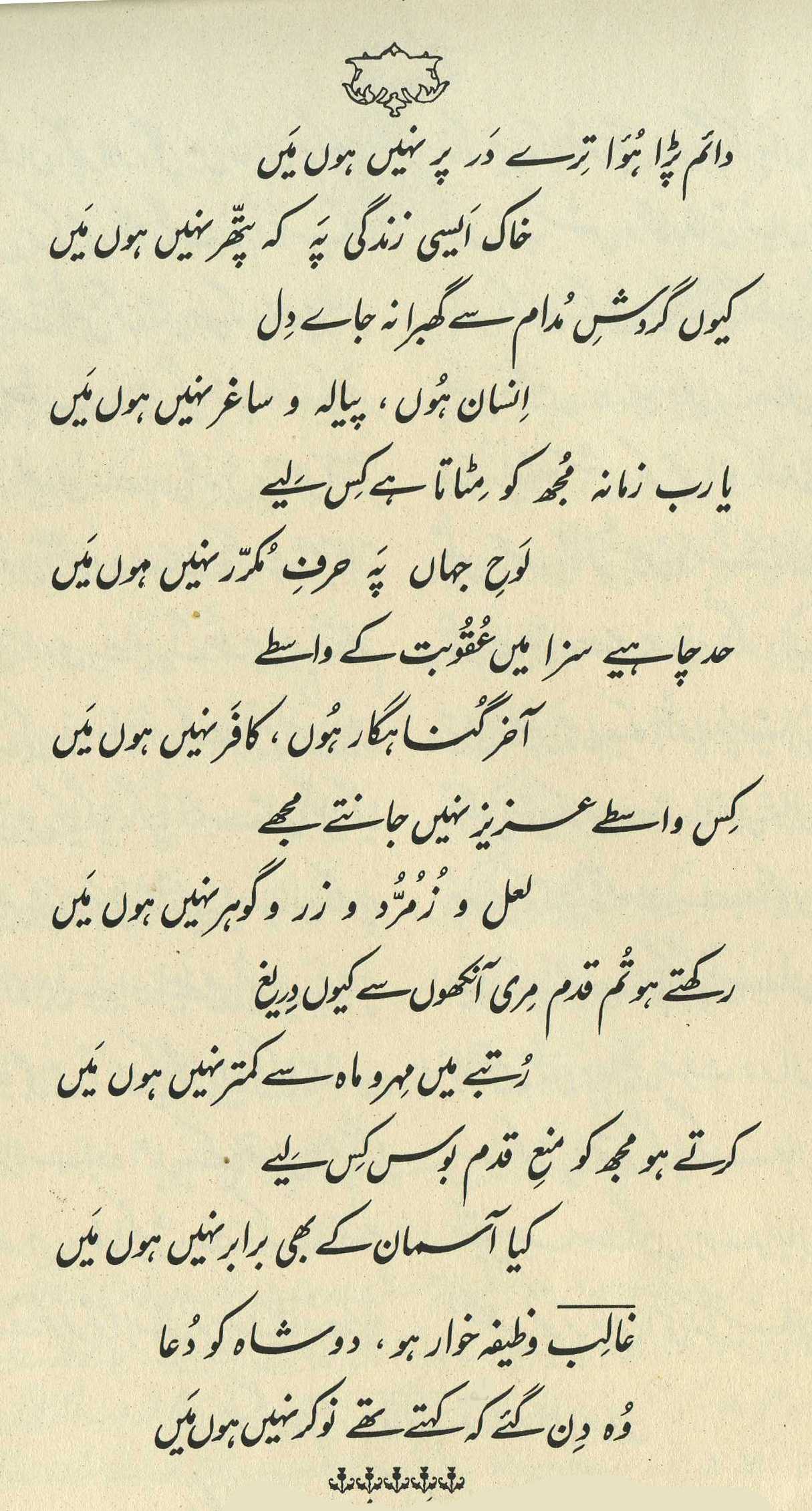
Verse 31850arnahii;N huu;N mai;N
G3
1
oh Lord , why does time/fate erase me?
2
on the tablet of the world I am not a 'repeated letter'
'Time, period, duration; season; a long time; an age;... —the world; the heavens; fortune, destiny'.
'A table; a tablet; a plank, a board (especially on which anything is written); — a title-page'.
| References | |
|---|---|
| Arshi, Imtiyaz Ali | Ghazal# 112 |
| Raza, Kalidas Gupta | 410 |
| Hamid Ali Khan | Open Image |
The theme is that he has given to his own erasure the simile of a mistaken letter. But if he had said 'the age erases me like a mistaken letter', then it wouldn't have been as eloquent [] as it is now. And the reason for eloquence is intensity of meaning; that is, now the meanings are being further increased: since I am not a 'repeated letter', there's no other reason for my erasure. Still, the age is erasing me. From this verse can be understood what are the means of giving rise to intensity of meaning from one single excellently-bestowed simile; and then, to what extent intensity of meaning increases eloquence. (115)
== Nazm page 115

He says, for what reason does the age erase me? Besides the fact that I'm not a 'repeated letter', there's no other reason adduced for my erasure. It's considered necessary to erase a 'repeated letter'; I am not that. (165)
= that letter that in error would be written two times, and would be scraped off.... That is, I'm not something to be erased. In the world there's great necessity for me, and there's also the point that up till now no one like me has appeared. I am not like anyone else. So I ought to have received respect. Why are the people of the world bent on erasing me? (217)
A lovely, classic ' mushairah verse'. The first line sounds broad, vague, and conventional: the metaphorical discription of time as 'erasing' things (including us) is as established in Urdu as it is in English. Under mushairah performance conditions, we are made to wait a bit before we're allowed to hear the second line.
Then when we do get to hear it, in proper mushairah-verse style we have to wait for the zinger until the last possible moment. The phrase 'repeated letter' [] is positioned as close to the end as it can possibly be. And, also in classic mushairah-verse style, we 'get it' with a sudden burst of revelation and pleasure-- and once we've gotten it, there's nothing more there to 'get'; it's a verse that doesn't demand further study or long reflection.
A 'repeated letter' is, as the commentators make clear, one that's accidently written twice. It's a common error in calligraphy, and when it's discovered, the obvious thing to do is to erase the undesired duplicate letter. But the speaker can claim to be a unique letter on the tablet of the age-- no 'letter' like him precedes him, nor will another such 'letter' ever appear. So why is he being erased? Obviously, erasing him represents a real loss of data from the tablet of the world, and shouldn't be permitted! Yet of course this erasure is inescapable; in fact it's happening already []. Appealing to the Lord is not a real remedy, but merely a gesture of protest and unreconciledness. The speaker may be doomed, but he rejects the injustice of his fate.
This, and the rest of the verses in this ghazal ({110,3-7}) right up until the very different closing-verse , seem clearly to be addressed to a divine beloved rather than a human one. For other such examples, see 20,10 .
Compare the unpublished 280x,3 , in which existence is a mirror that melts our image away.
Compare Mir's meditation on the irrevocable loss of a unique (?) individual: M 453,6 .
graphics/calligraphy.jpg