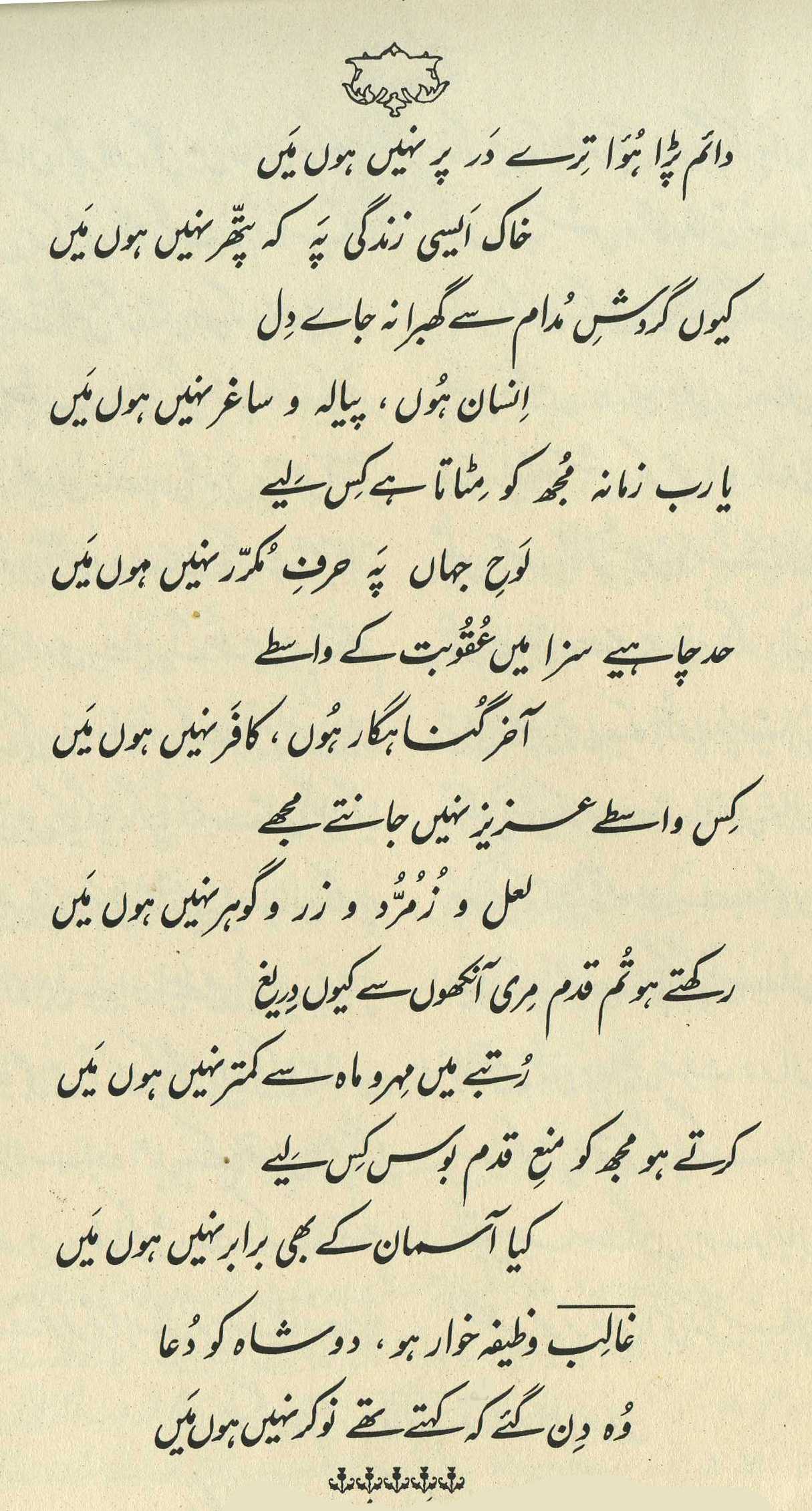
Verse 81850arnahii;N huu;N mai;N
G3
1
Ghalib, you're a pension-{receiver/'eater'}, give a blessing to the King !
2
those days are gone when you used to say, 'I am not a servant'
'Prayer, supplication (to God); an invocation of good, a blessing, benediction; wish; congratulation, salutation'.
| References | |
|---|---|
| Arshi, Imtiyaz Ali | Ghazal# 112 |
| Raza, Kalidas Gupta | 410 |
| Hamid Ali Khan | Open Image |
Look-- this too is one aspect of the expression of gratitude. (116)
== Nazm page 116

This is a new aspect of the expression of gratitude. A salary that is given regularly without fixed work is called a . The rest of the verse's meaning is clear. (166)
Oh Ghalib, now you are a pension-receiver from the Shah-- give blessings to the Shah! Formerly you always used to say, 'I am not the King's servant, I'm not obliged to express blessings to the king.' Now to give blessings is incumbent upon you. (218)
Some manuscripts, and some modern editions (including Hamid's), have instead of in the second line. As always, I follow Arshi. See his discussion in his introduction, p. 123.
Ghalib is here reminded-- by someone else admonishing him, or by his own inner voice-- of his duties as a pension-receiver: he should give thanks and blessings to the King for the financial support he's receiving. If read in the right tone, this is surely one of the bitterest verses he ever composed.
When writing in 1866 to his last major patron, Navab Kalb-e Ali Khan of Rampur, Ghalib proudly copied out in his letter all the verses of the present ghazal (see 110,1 )-- except this one. The other verses were all present and all in order, so it's almost certain that was using a written text rather than working casually from memory. (People almost never memorized whole ghazals in exact order, and when writing from memory Ghalib very often recorded his own verses in different sequences from those of the divan , and was also likely to omit a few.) In a systematic presentation of the ghazal like the one he sent to the Navab, his omission of this striking closing-verse is very unlikely to have been accidental. It's not hard to think of reasons he might have had for leaving it out.
In fact Ghalib lived his whole life on a patchwork of small pensions from the British and from various Indian princes and nobles, supplemented by occasional gifts and by all-too-frequent loans. But he seemed to find his service in the Red Fort particularly galling, perhaps because it was clear that in Bahadur Shah's opinion his poetry was decidedly inferior to Zauq 's. For a more general reflection on the relationship between poet and patron-- or beggar and giver-- see 167,10 .
Note for grammar fans: Here's one more case in which we're one step further in the past in Urdu than we would be in English. Because of the present-tense verb [] in the first line, in normal English the second line would begin 'those days have gone', and this is how I've translated it. The literal Urdu would of course be 'those days went'. For more on this, see 38,1 .
For another, even bleaker occurrence of , see 130x,2 .
graphics/courtscene.jpg
