Verse 41850arnahii;N huu;N mai;N
G3
1
there ought to be a limit in punishment, with regard to torment/torture
2
after all, I'm a sinner, I am not an infidel
'Correction, chastisement, punishment; penalty, retribution'.
'Punishment, chastisement, torture, torment'.
| References | |
|---|---|
| Arshi, Imtiyaz Ali | Ghazal# 112 |
| Raza, Kalidas Gupta | 410 |
| Hamid Ali Khan | Open Image |
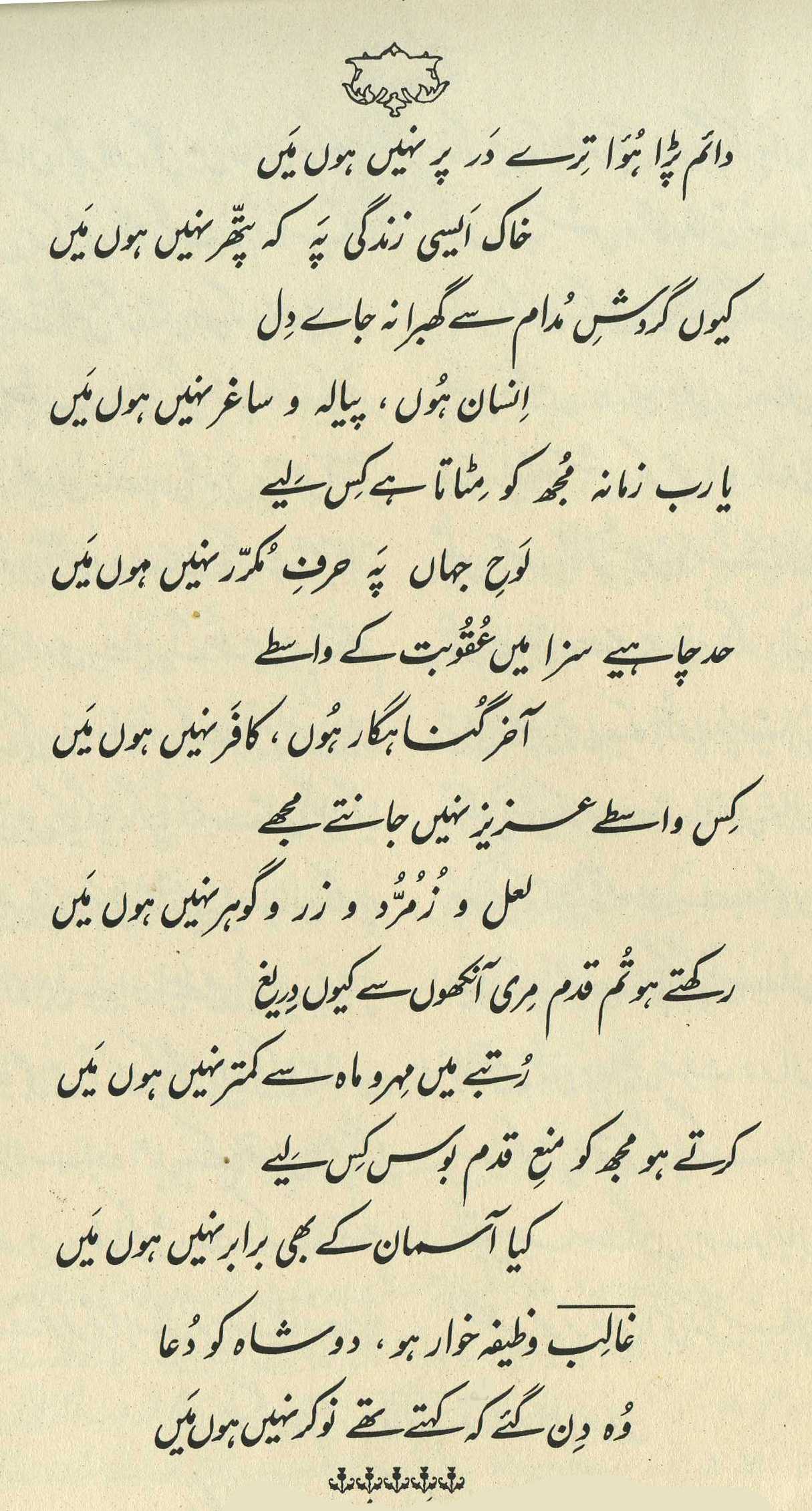
[A shamefaced account of how the youthful Hali thoughtlessly reproached Ghalib for his religious laxness, and how Ghalib responded.]
==Urdu text: Yadgar-e Ghalib , pp. 52-53
In the word , expert language-knowers [] read the with a [making it ]. But in the colloquial idiom of Persia, there's a [making it ]. For this reason, he uses it as a rhyme with .... The meanings of and are exactly the same; because of this repetition, the first line has become limp/loose []. (115)
== Nazm page 115

He says, for infidels, the torment of hell will continue forever; and for Muslim sinners, the measure of punishment will be decided. So why have I always been immersed in torment, and why do I find no release? (165)
[Nazm is wrong about the first line:] here, means 'torment', and means 'vengeance'. (217)
Like the previous verse, 110,3 , this one too is a classic mushairah verse. The first line is broad and vague, giving us listeners little clue of what is to come. What kind of a limit? Why should there be one? What kind of punishment?
Only after a suitably suspense-building interval do we get to hear the 'mischievous' [] second line. We learn that the speaker is negotiating with God about, it seems, the fires of hell. There ought to be some kind of limit to his torment, he is urging, because after all he's only a sinner, not an infidel. This is one of those verses of theological vocabulary, such that it does seem to be addressed wholly or chiefly to God, not to a human beloved.
It seems that the speaker might even be already enduring the torments of hell. Or else he's sure that he will endure them, and already knows what they will like, and has sufficient foreknowledge and status to have bargaining power with God. He presses his case with energy and wit (though perhaps with an underlying alarm). After all, a mere sinner is not nearly as evil and culpable a creature as an infidel!
He seems to use the privileged position of an intimate, to urge God to reconsider, to urge Him to be reasonable. The tone is everything. And the punch-word -- here spelled for the sake of the rhyme -- is withheld, in true mushairah-verse style, until the last possible moment.
For other such verses that seem to be addressed to a divine Beloved, see 20,10 .
graphics/hellfire.jpg