Verse 21850arnahii;N huu;N mai;N
G3
1
why wouldn't the heart be worried/distressed by perpetual 'going-round'?
2
I'm a human, I'm not a glass and flagon!
'Going round, turning round, revolution; circulation;... turn, change; vicissitude; reversion; --adverse fortune, adversity; --wandering about, vagrancy'.
'Continuous; continual, lasting; perpetual; eternal... --wine; spirits'.
'Perpetual, continual, perennial, unceasing, lasting long, fixed, established; always; a continual but gentle rain; wine, especially drunk all day long'. (Steingass p.1200)
'To be confused, confounded, flurried, or flustered (by, or in consequence of, ); to be perplexed, bewildered, or embarrassed (by); to be perturbed, disturbed in mind, agitated, disquieted, distracted; to be alarmed, scared, dismayed'.
| References | |
|---|---|
| Arshi, Imtiyaz Ali | Ghazal# 112 |
| Raza, Kalidas Gupta | 410 |
| Hamid Ali Khan | Open Image |
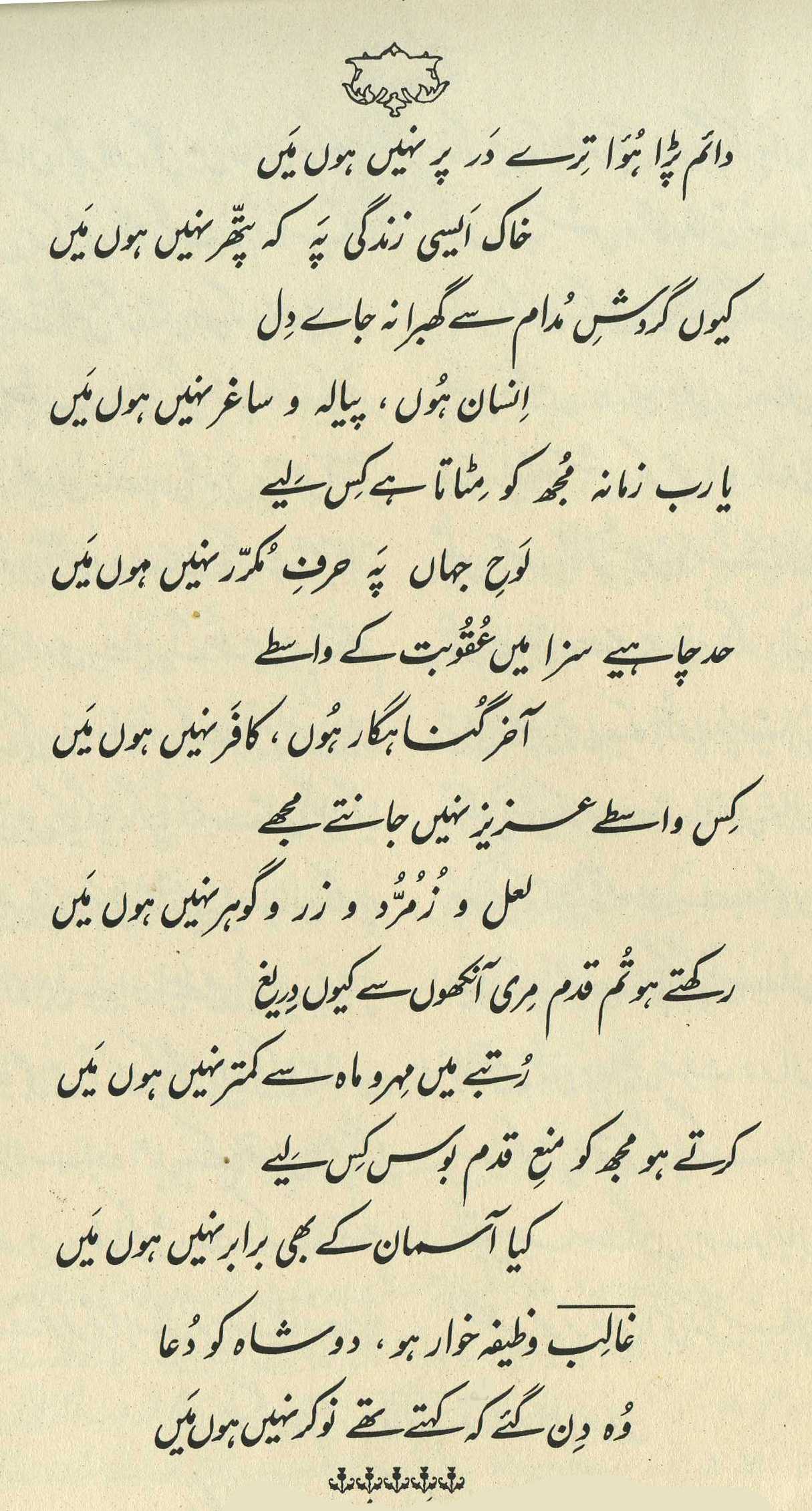
That is, those people who have eternal wine, their flagon always keeps circulating. That is the basis on which he says, I am a human-- for me, why this perpetual circling? (114-15)
== Nazm page 115

He says, like the wine-glass and flagon, circling day and night is destined for me. It's a lifeless thing. If it remains circling day and night because of eternal wine, then what difficulty does it experience thereby?.... I'm human, for how long can I remain ensnared in such circling? Why wouldn't my heart be worried/distressed? (165)
Being human, why wouldn't my heart be worried/distressed by this perpetual circling? I'm not a wine-glass and flagon that would not feel trouble or ease. (217)
In fine mushairah -verse style, the first line is indignant, vivid, and somewhat opaque. What sort of 'circling' or 'going around' is being referred to? Only after a suitable delay are we allowed to hear the answer; even then, it's only a suggestion of a reply: 'I'm a human, not a wineglass and flagon!' And it's uttered in a tone of indignation that surely verges on the comic. We're left to realize only by implication that a wineglass and flagon are not disturbed by perpetual circling or circulating among the drinkers in the winehouse. (And the 'perpetual' [] itself has a secondary meaning of 'wine', making for a lovely wordplay, as Zaff Syed points out; see the definitions above.) So if the wineglass and flagon are not disturbed by such 'going round', we can well imagine the reasons: it is the proper, natural destiny for which they were created.
But as for us humans, what kind of do we experience, and why does it trouble our hearts? Just look at the possibilities, all fully available through the many extended senses of the word:
=The endless cycling of night and day and night and day troubles us and makes us dizzy.
=Our little world careens wildly around the sun like an eternal merry-go-round; for more on Ghalib's scientific knowledge about the sun, see 105,2 .
=Seeing the constant 'revolutions' of the wheel of time and fate arouses anxiety and distress.
=Our own fortune so often 'turns' on us-- and so often the new turn is for the worse.
=Our own personal wandering, roaming, uncertainty seems to have no end.
The wineglass and flagon were born for their own kind of 'circling'; but we are not born for ours. There are too many kinds, all happening at once, and nothing about their movement that warrants confidence or serene acceptance on our part. Although this verse has a light touch, its deeper layer is one of serious complaint. For another, more ominous verse about perpetual , see 46,2 .
And how perfect, in wordplay terms, that a secondary meaning of would be 'wine'! The two senses converge in Steingass's explanation, 'wine, especially drunk all day long' (see the definitions above).
graphics/turningwineglass.jpg