Verse 41816aarhai
G1
1
only/emphatically he, for the deep intoxication of every sand-grain, is himself excuse-needing
2
with whose glory/manifestation from earth to sky is saturated/intoxicated
'Excuse, apology, plea; pretext'.
'Wishing, willing, desiring, soliciting, requiring, wanting'.
'Overflowing, brimful, full.... steeped, soaked (in, ); intoxicated, drunk'.
| References | |
|---|---|
| Arshi, Imtiyaz Ali | Ghazal# 159 |
| Raza, Kalidas Gupta | 240-41 |
| Nuskhah-e-Hamidiyah | 233-234 |
| Asi, Abdul Bari | 237-238 |
| Gyan Chand | 364-366 |
| Hamid Ali Khan | Open Image |
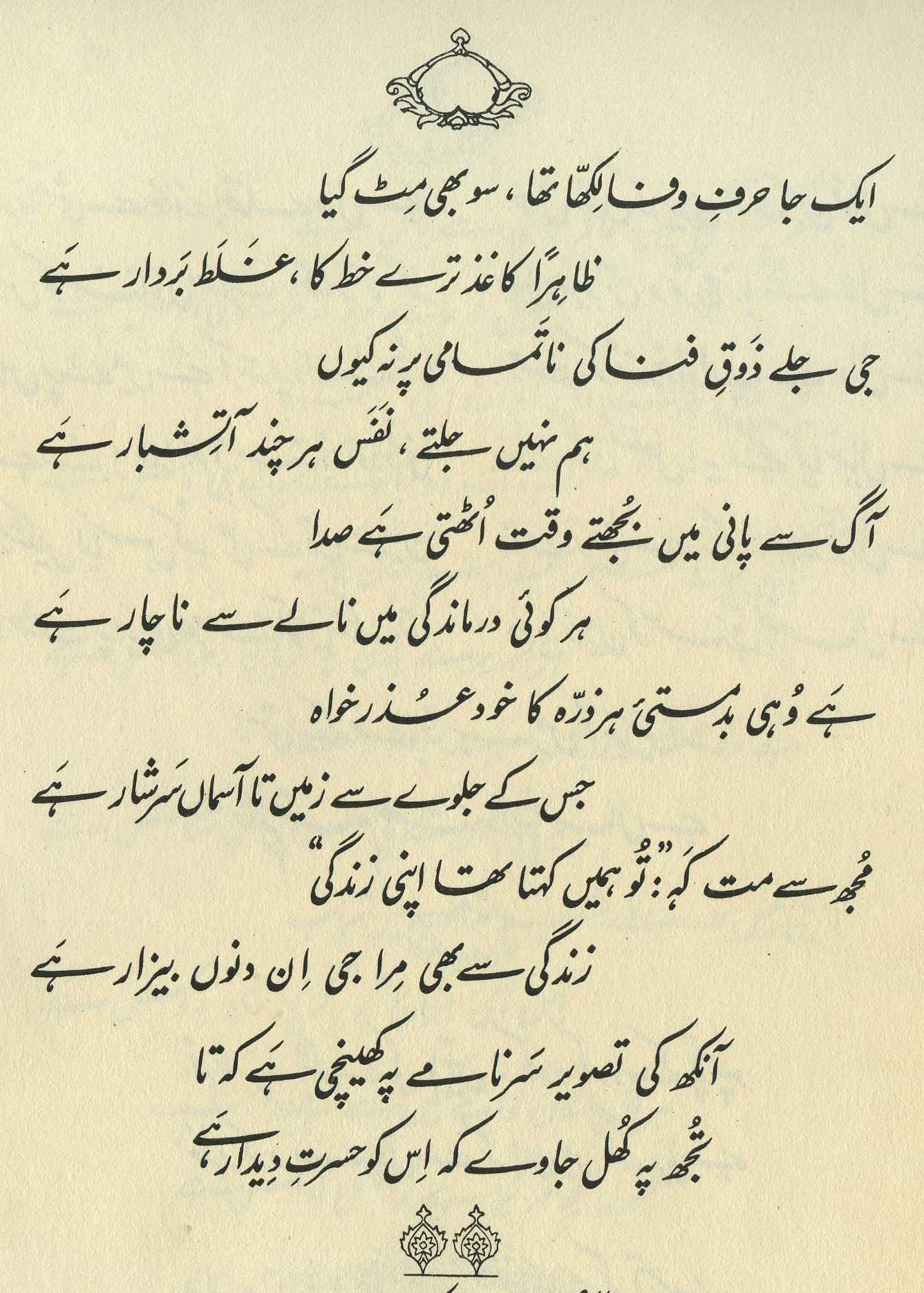
Every grain, that is to say every creature, is in need of excuse, seeking pardon, or entitled to exemption. In this verse the claim has been made in such a manner that the proof is contained in the claim itself. The meaning is that the sand-grains of the world, that is, all creation, which in reality have no existence-- the one who asks excuse for their intoxication and heedlessness is the One from the radiance of whose being all this nonexistence breathes the breath of existence.
==Urdu text: Yadgar-e Ghalib , p. 155
That is, for him to make it happen by itself, and the blame to be upon us-- this is impossible. He has constructed the dance of sand-grains as deep intoxication. This is ' elegance in assigning a cause '. (153)
== Nazm page 153

The one from whose glory/appearance everything, from earth to sky, is intoxicated-- he is the excuse-seeker for the deep intoxication of every sand-grain. That is, nothing in the world is able to resist. Because the maker of all, present and active and energizing within all, is that very Lord.
[Or:] No matter what we may do, we are not responsible, because he is our Creator. Our body, our spirit, everything is in his control; what he wants, that very thing is what we do. This is a belief of the determinists []. The author composed it according to their taste. (280)
Every 'sand-grain' glitters unpredictably, flashes intermittently in the sun, slides around with every footstep, is blown here and there with the breeze. (Or perhaps they are 'dust-grains' that seem to dance in a beam of sunlight; the word can be used for them too.) By invoking the device of ' elegance in assigning a cause ', Nazm takes the verse to mean that the real cause of their movement is deep intoxication.
But surely the verse goes beyond merely that assertion. God-- since a divine Beloved seems to work better here (on this see 20,10 )-- has deeply intoxicated all Creation, by making it, in a beautifully chosen adjective, 'overflowing, saturated, intoxicated' [] with his own manifestation/glory. His glory thus appears as a kind of liquid flood, like wine.
So since he himself, Islamically speaking, forbade intoxication, naturally he's looking for reasons to excuse the intoxication that he himself created. The intriguing ambiguity in the verse thus becomes: is he 'excuse-seeking' on behalf of the sand-grains in their drunkenness; or is he 'excuse-seeking' for his own behavior in intoxicating them?
Moreover, in between God and the sand-grains, what about the rest of us? Does the first line imply that he is looking to excuse even the very sand-grains-- and thus, by extension, the rest of his creatures-- from blame? Or are the sand-grains uniquely excusable, because of their unique vulnerability? Or are we ourselves metaphorically sand-grains? Bekhud Mohani seems to suggest an excessively broad and (conveniently?) deterministic reading; but even if it's true that intoxication is excused, it doesn't follow from the verse that everything is excused. Maybe the rest of us are supposed to become Sufis?
As Arshi says, 95,3 and 138,2 are good verses for comparison.
graphics/sandglitter.jpg