Verse 31826ednahii;N
G11
In this meter the first long syllable may be replaced by a short; and the next-to-last long syllable may be replaced by two shorts.
1
your splendor is the means/equipment of existence/substance
2 a
the sand-grain is not without the radiance of the sun
2 b
there is no sand-grain {apart from / except for} the radiance of the sun
'Manifestation; clearness, lustre, brightness, brilliancy, splendour, glory'.
'Furniture, baggage, articles, things, paraphernalia; requisites, necessaries, materials, appliances; instrument, tools, apparatus; provision made for any necessary occasion, necessary preparations; pomp, circumstance; —measure, quantity, proportion; order, arrangement, disposition; mode; custom, habit; power, strength; probity; opulence; understanding, reason, intellect; —boundary, limit; landmark'.
'Being found; invention; —being, existence; entity; life; essence, substance; —body; person, individual'.
| References | |
|---|---|
| Arshi, Imtiyaz Ali | Ghazal# 98 |
| Raza, Kalidas Gupta | 364 |
| Hamid Ali Khan | Open Image |
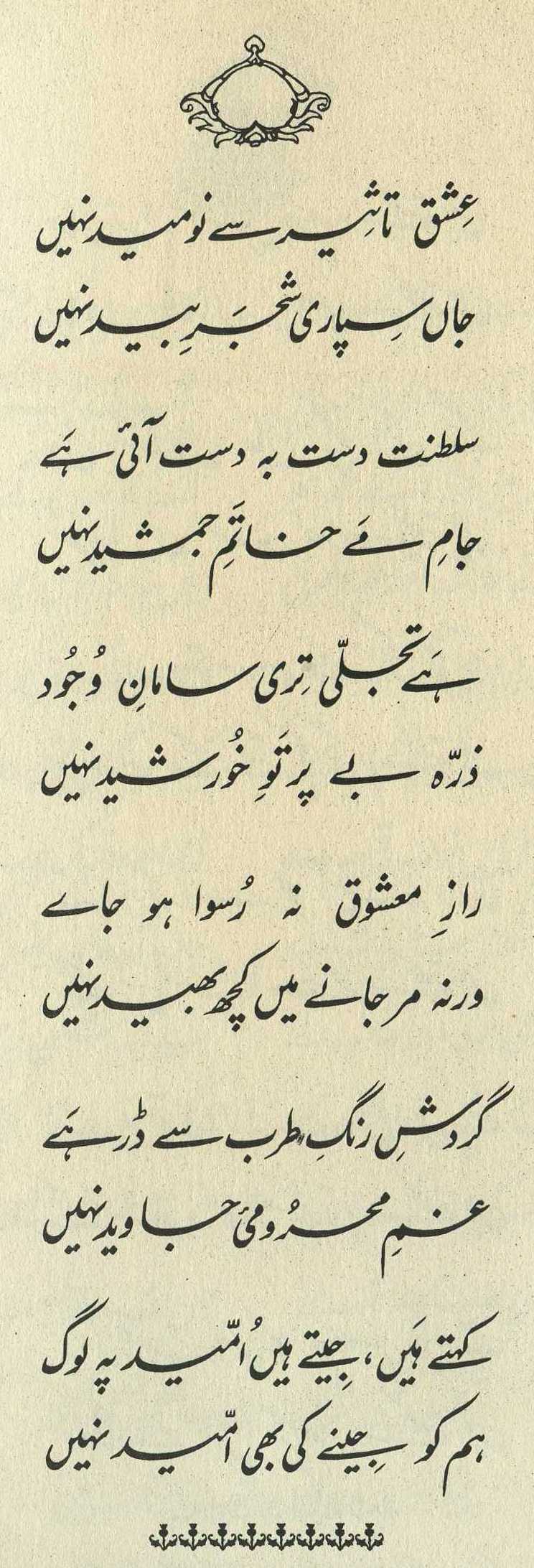
That is, the radiance/manifestation of the Praised Exalted One is the cause of the presence of the world, the way the sun-rays are the cause of visibility for the sand-grains. The true form of the first line is like this: . Causing to vanish like this is a special feature of poetry. [In speech, it would not be correct.] (96)
== Nazm page 96

The way sunlight is apparent in a sand-grain, in the same way everything present in the world is an expression of Your essence. (83)
While reading this verse, another verse of Ghalib's comes to mind: 138,2 ....
If is taken to mean [not 'without' but] 'other than' or 'except for', then the interpretation will be that the sand-grain has no existence at all, except that it's a sun-ray. 'Sand-grain' and 'sun-ray' are two names for the same thing. The existence of everything is in You, as if You alone are every existing thing. In this way the verse presents the theme of the 'oneness of creation' [].
It can also be said that a sand-grain doesn't come into existence at all until such time as a sun-ray falls on it. The sand-grain on which a sun-ray doesn't fall is dead, without existence. The thing on which Glory doesn't fall, is uncreated....
It can also be said that the Divine Power is like the sun, the rays of which fall on everything. So that even the lowliest sand-grain is not deprived of the grace of the sun-ray (divine spirit).
== (1989: 124-25) 2006: 147-48
On the pronunciation of the rhyme -words in this ghazal, see the discussion in 95,1 .
As Arshi and Faruqi note, this isn't Ghalib's only verse involving sun and sand-grains. In fact he has quite a set of them, and often they're connected to mirrors too. (My own favorite sand-grain verse is the stark, eerie, almost terrifying 16,4 .)
Conspicuously, the first line doesn't tell us whose presence we're talking about. If it's God's presence, then the glitter in the sand-grain tells us that He is behind it. If it's the presence of the sand-grain itself, then we have the two, or perhaps three, possibilities enumerated by Faruqi.
This is a verse that feels very congenial if read sufistically, as addressed to God, but there's no reason in principle that it couldn't be (extravagantly, hyperbolically) addressed to a human beloved as well. In the ghazal world, it's often hard to tell the beloved and the Beloved apart.
graphics/sunrays.jpg