Verse 41821aarthaa
G3
1
the wave of the mirage of the desert of faithfulness-- don't ask about its condition!
2
every sand-grain, like the temper of a sword, was glittering/'water-bearing'
'Absolute or essential property; skill, knowledge, accomplishment, art; excellence, worth, merit, virtue; ...the diversified wavy mar streaks, or grain of a well-tempered sword'.
'Polished, bright; of a good water (as gems); well-tempered (as steel, &c.); sharp (as a sword, &c.); pure, clean, white'.
| References | |
|---|---|
| Arshi, Imtiyaz Ali | Ghazal# 15 |
| Raza, Kalidas Gupta | 326-327 |
| Nuskhah-e-Hamidiyah | 58-59 |
| Asi, Abdul Bari | 63-64 |
| Gyan Chand | 92-95 |
| Hamid Ali Khan | Open Image |
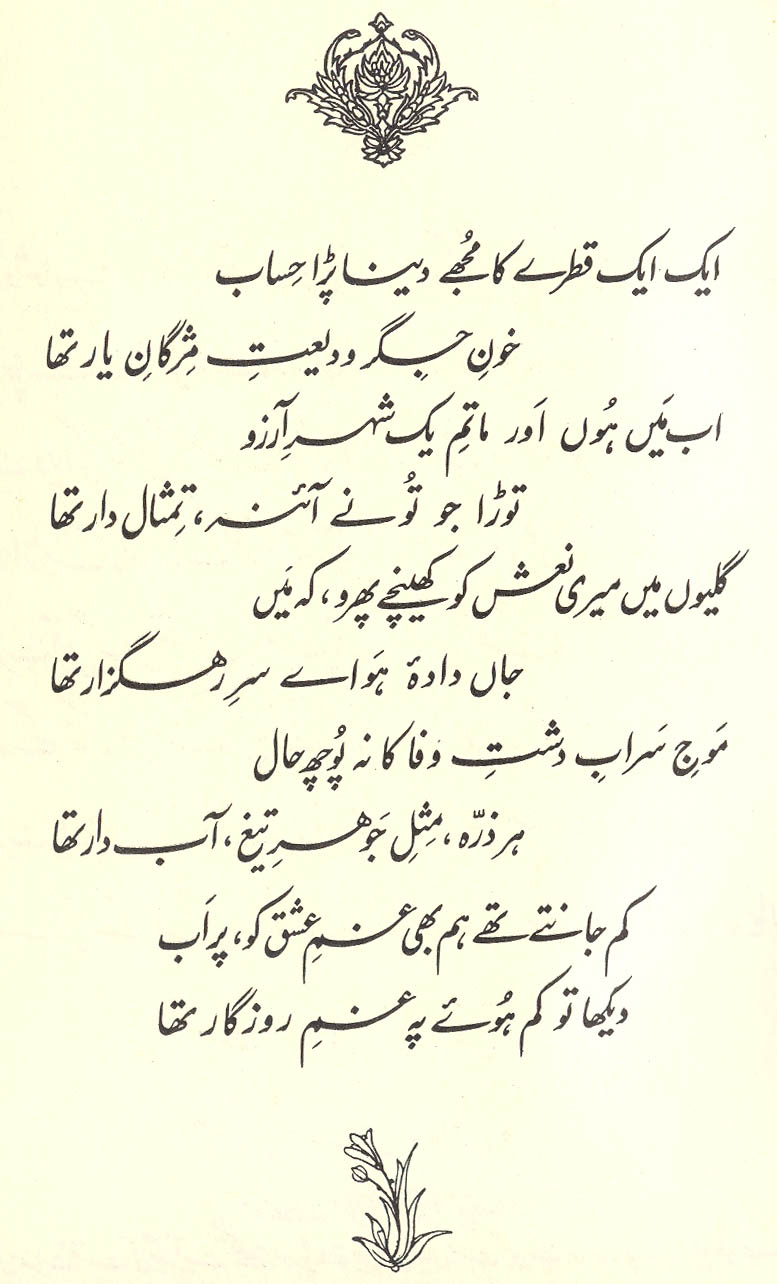
That is, the way the temper-lines of a sword are , in the same way so were the sand-grains of the wave of the mirage. The result is that in the land of passion, swords rain down. (17)
== Nazm page 17

Urdu text: Vajid 1902 {16}
The way a wave in a mirage gives the illusion of water and causes the death of the water-seeker, in the desert of faithfulness there can be no success except an imaginary hope. An example of this is given: the sand-grain of the desert of faithfulness is like the temper of a sword. The point is that faithfulness, in the end, takes the lover's life. (36)
At first glance, what claims our attention in this verse is the admirably contradictory use of the word . In place of only 'sword', by means of 'temper of a sword' the effect of the simile is augmented. And to the extent that the generality of 'every sand-grain' increases its intensity, to the same extent it also increases the meaningfulness of the simile (because the aspect of the temper of a sword, since it resembles small dots, is similar to sand-grains). means 'glittering'. Sand-grains also glitter, and in a desert this glitter not only increases the feeling of heat and thirst, but also makes the effect of stoniness and unkindness and dryness more powerful.
[literally] means 'water-bearing'. This is the opposite of the first meaning, but the basis for the simile even now remains perfect and just as it was. If we take to mean 'water-bearing', then the simile becomes that every sand-grain was ready to offer water-- but in the same way as the temper of a sword remains ready to offer water to its prey; that is, to take him down into the valley of death.... Such an extraordinary and remarkable simile, at which even a metaphor would gaze in stupefaction-- not to speak of other poets, even in Ghalib's poetry such things are rarely to be found. (120-121)
When you draw near to an ordinary mirage, you realize that this too, like the rest of the desert, is a patch of ground; but when you draw near to the mirage of the desert of faithfulness, you realize that this patch of ground is distinct from the rest of the desert of faithfulness, because in this patch of ground every sand-grain is like the temper of a sword. That is, unlike ordinary mirages, the mirage of the desert of faithfulness does not content itself with merely not satisfying your thirst; rather, it brings you additional troubles. (122)
In the word 'was' the implication 'is not' is present....
From the above interpretation we have seen that in the mirage of the desert of faithfulness there's no water to be seen; something like a wave of sand-grains glittering like the temper of a sword is to be seen. (129)
[If we remove the optional after , we have a vocative: 'Oh Wave of the Mirage! Don't ask about the state of the desert of faithfulness', which yields further interpretive possibilities.]
== ( 1973: 129, 131-132 )
ABOUT MIRAGES: Mirages are not common in Ghalib's imagery, but in the divan , besides the present verse there's 97,12 , and there's also the unpublished 130,5x . Compare Mir's use of a mirage in M 485,1 .
It's an almost frightening verse-- harsh, eerie, ominous. It sticks in my mind like a thorn. Naiyar Masud's detailed explication is many pages long and well worth reading in full. I have very little to add to it.
The key to the verse, as the commentators have pointed out, is the versatility of , with its literal meaning of 'water-possessing' and its actual sense of 'glittering'. Thus in this verse the word is 'doubly activated'-- both meanings are fully invoked by the verse (for more such cases, see 120,3 ). The itself is also echoed in , 'mirage'. The glitter of a sword or of water; the threat/promise of sword/water (and to the passionate lover a sword may be a promise too). The mirage as a real vision of a false hope; the 'desert of faithfulness' as a lonesome, deadly wasteland. Do mirages actually come in waves? They seem to shimmer on the horizon, perhaps in a wave-like way.
If we really wanted to slice and dice the three constructions in the first line, we could choose among: 'the wave of the mirage (of the desert of faithfulness)'; 'the wave (of the mirage of the desert) of faithfulness'; and '(the wave of the mirage) of the desert of faithfulness'. Each of these readings could be interpreted slightly differently. But the level of abstraction is so high, that the whole process could hardly be very rewarding.
The verse is resonantly full of long vowels in general-- emotional-sounding vowels, aren't they? like the of a sigh-- with the next largest group their short form .
graphics/sandgrain.jpg