Verse 8x1821aarthaa
G3
1
like the bud and the rose, the disaster of the omen of gaze/sight-- don't ask!
2
from your arrowhead, the glory/appearance of the wound was revealed
'Bane, pest, plague; any evil affection; evil, disaster, trouble, misfortune, calamity; wretchedness, misery, hardship, difficulty'.
'An omen, augury, presage; --enchantment, spell'.
'Apparent, manifest, clear, plain, open, public, known, revealed'.
| References | |
|---|---|
| Arshi, Imtiyaz Ali | Ghazal# 15 |
| Raza, Kalidas Gupta | 326-327 |
| Nuskhah-e-Hamidiyah | 58-59 |
| Asi, Abdul Bari | 63-64 |
| Gyan Chand | 92-95 |
| Hamid Ali Khan | Open Image |
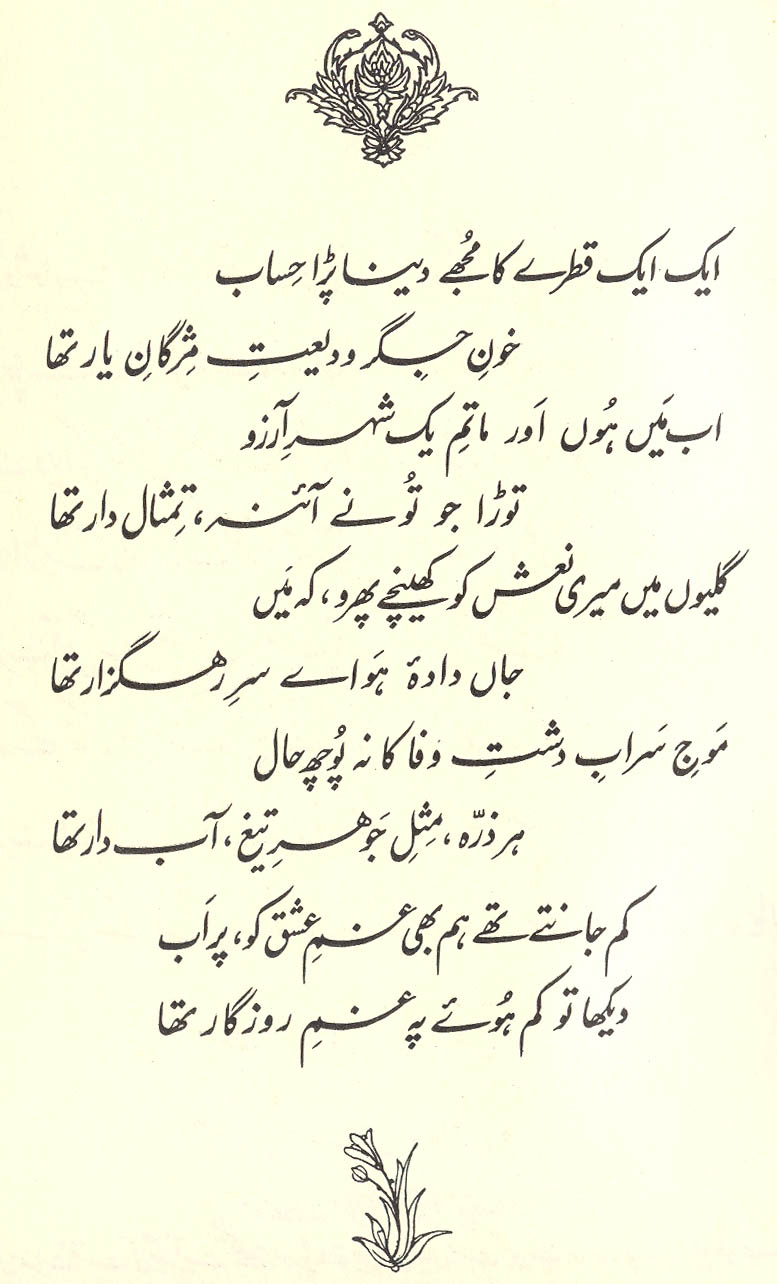
Don't ask anything about the disaster of our omen of sight/vision. As soon as we looked toward your arrowhead, we began to fear that we would be wounded, because like the rosebud, through your arrowhead too the glory/appearance of a wound was being revealed/opened. Or else: the way that disaster came upon bud and rose through an omen of sight/vision, in the same way we too fear that we might be wounded.
== Asi, p. 63
That is, why do you (oh beloved) ask about the inauspiciousness of your gaze?! From it clearly emerges the omen of the bud and rose-- that on the one hand the bud opened/bloomed, and on the other hand the rose's liver has fallen into fragments. Here the simile for the sight/gaze is the arrowhead, because both have the same [sharp, penetrating] shape.
Thus the way that through the arrowhead of the bud the rose's wounded liver becomes manifest (in the eye of imagination, because the rose has not bloomed yet), in the same way through the arrowhead of your gaze/sight a glimpse of my wounded liver comes-- that your gaze/sight fell on the liver, and the liver became lacerated (this situation too, since it has not yet presented itself, has been called an omen of gaze/sight).
== Zamin, p. 57
The 'omen of the gaze/sight' [] is a method of divination, like the 'omen of the ear': the thing about which you want to have the omen, you keep in your heart, and go among others; and from the first words that fall on your ear, an omen is taken about your purpose. In the same way, the 'omen of the gaze' can be taken: having placed something in your heart, you go outside, and besides the ordinary surroundings, whatever would first come into view-- from that an omen is taken.
The prose of the verse is: 'Don't ask about the disaster of the omen of the gaze. From your arrowhead, like the bud and rose, the glory/appearance of the wound was revealed.'
When at dawn we went to take an 'omen of the gaze', then first of all your arrowhead came into view. In the arrowhead, the glory/appearance of the to-be-inflicted wound was clearly visible. The arrowhead was like the bud, and the shape of the wound like the rose. It's clear that the arrowhead will strike me, and a wound will occur. This 'omen of the gaze' turned out to be a great disaster!
The bud and rose can also mean that just as I took an 'omen of the gaze' and first of all your arrowhead was visible, that wouldn't be content until it had made a wound-- in the same way the bud and rose had taken an 'omen of the gaze'. Both of them saw the arrowhead. The result of which was that both of them were wounded. The glory/appearance in the arrowhead of the wound, is revealed in the imagination of the beholder. As in a verse of Iqbal 's:
[the event that now/still is in the veil of the skies
its reflection is in the mirror of my senses]
== Gyan Chand, pp. 93-94
For background see S. R. Faruqi's choices . This verse is NOT one of his choices; I thought it was interesting and have added it myself. For more on Ghalib's unpublished verses, see the discussion in 4,8x .
The bud is a small tight compressed little object, more or less triangular when seen from the side; and in it is latent the whole of the wide, round, brilliantly red, fully opened rose. Not only might it appropriately appear as an 'omen of the gaze' to evoke the rose itself, but it also itself creates or gives birth to the rose.
Almost the same relationship obtains for the arrowhead and the wound. The arrowhead has not only 'revealed' the wound by divination, but has also literally 'opened', and thus created, the wound. And as always, means both 'appearance' and 'glory, radiance', so that the verse can take full advantage of both senses.
When both the rose and the wound are so beautiful and (to the lover) desirable, why is their divination a 'disaster' or 'calamity'? Perhaps because the lover is taking refuge in the inexpressibility trope ('don't ask!'), and is thus using language his ordinary, limited listener can understand. But may also be colloquially used here the way 'Doomsday' is sometimes used-- to mean, by extension, anything amazing, compelling, extremely powerful. (For 'Doomsday' examples, see 10,11 .)
graphics/arrowhead.jpg