Verse 11821aarthaa
G3
1
of every single drop, I was compelled to give an account
2
the blood of the liver was a trust from/for/'of' the eyelashes of the beloved
'A deposit, trust, whatever is committed to another's charge'.
| References | |
|---|---|
| Arshi, Imtiyaz Ali | Ghazal# 15 |
| Raza, Kalidas Gupta | 326-327 |
| Nuskhah-e-Hamidiyah | 58-59 |
| Asi, Abdul Bari | 63-64 |
| Gyan Chand | 92-95 |
| Hamid Ali Khan | Open Image |
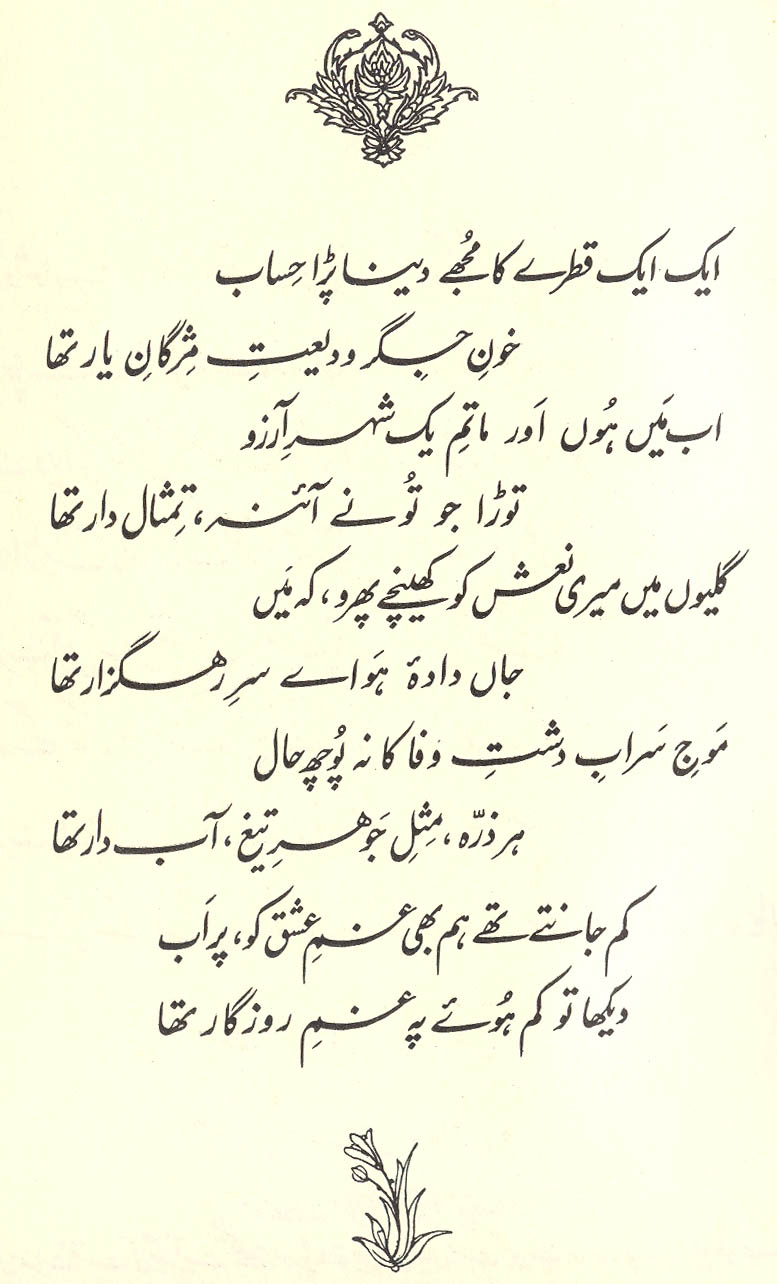
That is to say, blood keeps flowing from the eyes to such an extent, as if all the blood in the liver were a trust from the eyes of the beloved, and for this reason I will have to give an account of every drop of it-- the way one has to give an account of a trust.
==Urdu text: Yadgar-e Ghalib , pp. 139-40
-- that is, I was forced to cause it to flow from the eyes, as if the blood of the liver were a trust from her. (17)
== Nazm page 17

Thus the special trait of the beloved's eyelashes is that their arrows wounded the liver, and told it to yield up its trust. (71)
Compare 113,3 . (221)
ABOUT the construction: The creatively complex use of the construction is one of Ghalib's favorite devices. Another example occurs in the next verse, 16,2 ; see also 18,5 ; 33,2 (where the range of possibilities is explained more carefully); 38,5 , 39,3 , 49,10 , and many others, such as those listed above. The form is used equationally in 173,8 . Just for interest, consider also 56,2 , in which the poet uses four forms in a row and is criticized for it by the commentators. (In 77,2 he uses five forms in one line, but they aren't all in a row, so nobody complains.) And then there's 71,3 , in which two (optional) forms are exploited to the fullest, to make one of the most radically multivalent verses in the world.
On the conspicuous ambiguity of, for example, as both 'the beloved's thought' and 'the thought of the beloved', see 41,6 . For a grammatical analysis of the , see C. M. Naim's account .
The divan version of this ghazal has no opening-verse ; in the form in which it was originally composed, 16,6x was its opening-verse, and 16,7x was a second opening-verse.
Is the or trust one given by the beloved's eyelashes, or one destined for the beloved's eyelashes, or one that's associated with the beloved's eyelashes through identity, possession, or in some other (unspecified) way? Usually such choices aren't even mutually exclusive. After all, we know from 10,2 what destiny the beloved's eyelashes have in mind for the lover's drops of blood. And we know from 26,7 that it's sometimes hard to tell who owes what to whom. But like a reliable trustee, the lover must account for every tiny bit of the estate that he is charged with administering. Every drop of the blood of the liver must be monitored and reported on individually, for we know the possessive beloved will insist on a detailed reckoning; for another such depiction see 113,3 .
graphics/blooddrops.jpg