Verse 21821aanamak
G1
1
the dust of the beloved's path/road is the equipment/measure/limit of the heart-wound's coquetry
2 a
otherwise, to what an extent salt/piquancy is created in the world!
2 b
otherwise, to what extent is salt/piquancy created in the world?
'Furniture, baggage, articles, things, paraphernalia; requisites, necessaries, materials, appliances; instrument, tools, apparatus; provision made for any necessary occasion, necessary preparations; pomp, circumstance; —measure, quantity, proportion; order, arrangement, disposition; mode; custom, habit; power, strength; probity; opulence; understanding, reason, intellect; —boundary, limit; landmark'.
'Salt; —savour, flavour; —bread, subsistence; —(met.) piquancy; spirit, animation; —grace, beauty'.
| References | |
|---|---|
| Arshi, Imtiyaz Ali | Ghazal# 77 |
| Raza, Kalidas Gupta | 333-334 |
| Nuskhah-e-Hamidiyah | 127-128 |
| Gyan Chand | 237-238 |
| Hamid Ali Khan | Open Image |
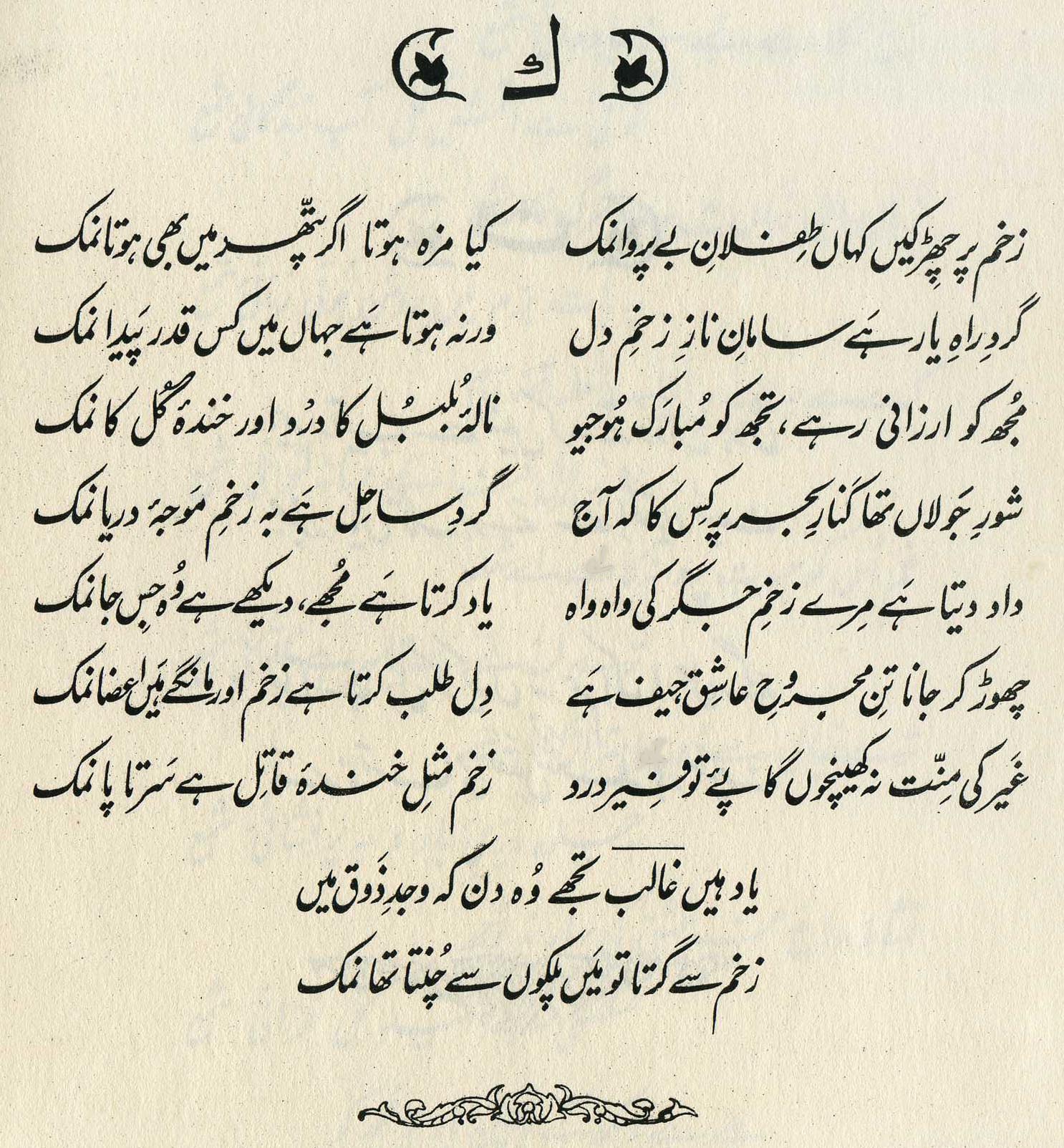
He says, the existence of salt in a wound is no such cause for pleasure. My wound plumes itself greatly on being full of the dust of the path of the beloved. Otherwise, what lack of salt is there in the world? Another aspect is that we would take to mean, how/where [] is so much salt possible in the world, about which the wound in my liver could be proud? (78)
== Nazm page 78

Plenty of salt is produced in the world anyway, but what do we care about it? Here, the possession of the wound in the heart is the dust of the beloved's path. (72)
The phrase cannot be for disdain. Because this line starts with . And in the first line the poet has said that only the dust of the beloved's path is a cause for pride to the wound. (161-62)
Nazm points out that can be taken to operate the way does; in my terms, it's a variant of the 'kya effect'. Nazm points out two rhetorical possibilities of the second line. First, the affirmative (2a): how much salt is created in the world! (There's so much of it, but what good is any of it to the lover? He disdains and rejects it all, since his own preferred salt is the dust of the beloved's path). Second, the negative rhetorical question (2b): how much salt is created in the world-- how could it possibly be enough?! (The lover uses so much of it that he could never find enough merely from the normal supply, so he must improvise and find his own private source.)
As so often, this unresolvable back-and-forthness between two opposite meanings, both of which go so perfectly with the first line, is the real charm and relish of the verse. Ghalib is almost to the point of madness sometimes.
Note for grammar fans: The first line, shown with five constructions, is really structured like this:
(-e) (-e) (-e)
In other words, three of those constructions are optional, rather than being required by the meter. (As usual, I follow Arshi, who puts in all five.) By removing a selected one or more of them, we could alter the grammar considerably. For example, if we delete the one after , we could make, 'the dust of the beloved's path is equipment, oh Coquetry of the wound of the heart!' By deleting the first one, we could make 'oh Dust, the beloved's path is the equipment of the coquetry of the wound of the heart'. And so on, with several more possibilities available. Perhaps they aren't profound in their effects, but nevertheless they can't be ruled out by any kind of fiat. And surely if we can notice them, Ghalib himself would have noticed them-- and left them there for our imaginations to play with.
graphics/roaddust.jpg