Verse 61821aanamak
G1
1
to abandon the lover's wounded body, and go-- it's a shame/cruelty!
2
the heart seeks for a wound, and the limbs have demanded salt
'Iniquity, injustice, oppression; a pity; —intj. Ah! alas! what a pity!'.
'Salt; —savour, flavour; —bread, subsistence; —(met.) piquancy; spirit, animation; —grace, beauty'.
| References | |
|---|---|
| Arshi, Imtiyaz Ali | Ghazal# 77 |
| Raza, Kalidas Gupta | 333-334 |
| Nuskhah-e-Hamidiyah | 127-128 |
| Gyan Chand | 237-238 |
| Hamid Ali Khan | Open Image |
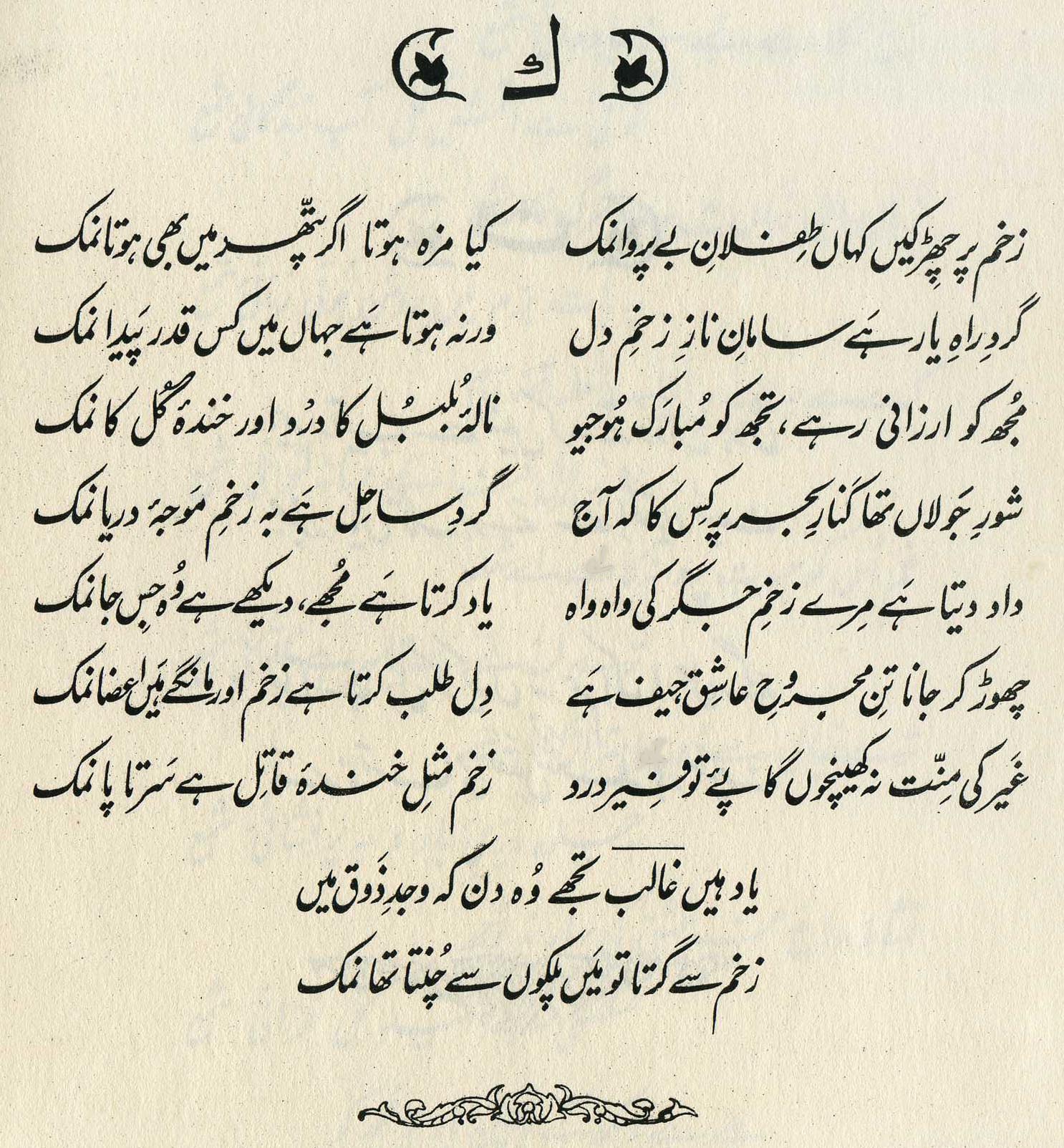
That is, the limbs have already been wounded; they are demanding salt. And the heart has not yet been wounded, and it wants a wound. In such a difficulty, where/how [] can you abandon them and go away? (79)
== Nazm page 79

He says, in such a time your going, and leaving the lover's wounded body, is a cause for regret-- when the heart is in search of a wound, and the limbs of the body are seeking salt; that is, when the wounds aren't as yet filled with salt, and neither has the yeart been wounded at all. (125)
That is, having wounded only the body, why are you going? My heart too seeks a wound, and the limbs too want a sprinkling of salt. This half-finished cruelty is a cause for regret. The point of the utterance is that to satiate my relish for suffering, this much cruelty cannot be enough. (163)
It's clear from the first line that this verse reproaches the evil behavior of the beloved. How could she go off and leave her lover wounded, helpless, alone? For shame! Just at the time when his need is most dire, she cold-heartedly refuses to care for him. We are invited to share the lover's indignation.
The enjoyableness of the verse depends, in fact, on a mushairah -like separation of the lines. After the first line has left us feeling righteous indignation, we have to wait for the second line to discover more details of the beloved's callous behavior.
Then, of course, we learn the real nature of her guilt: she has not sufficiently tormented her lover. How can she leave the poor heart to beg in vain for a wound, while all the limbs of the body are vainly beseeching her for salt? It is cruel of her not to tend to their needs, as they writhe and plead pathetically in their suffering.
This could almost be taken as the kind of complaint made against a hunter who has not humanely finished off the wounded prey. Almost, but not quite. For the hunter who has wounded the prey owes to it, in common humanity, a quick and relatively painless death. It's the hunter's duty to seek it out and administer the coup de grace. But here, of course, what is wanted is more wounds, more lingering pain, more degrees and kinds of agony. How indignantly the lover itemizes his body's claims! In a light, witty verse like this, tone is everything.
In fact, this beloved is being reproached for not acting like the beloved in 2,1 , who visits her lover in his time of need, and kindly (?) brings him all manner of thoughtful little attentions-- gifts of pain and suffering, wounds, and ground glass.
Note for grammar fans: How are we to read that ? It could be an archaic form of , (For more on this form, see Grammar .) But then we'd have the modern standard form , and the archaic form , placed in the closest possible juxtaposition. I can't think of a single verse where Ghalib has done this. So we will probably want to read it as an idiomatically shortened form of the adverbial past participle , 'are in a state of having demanded'. A similar form occurs in 77,5 .
graphics/salt.jpg