Verse 71821aanamak
G1
1
I won't seek/implore the kindness/favor of {another / the Other concerning an increase of pain
2
the wound, like the murderer's/murderous smile, is, from {end to end / 'head to foot'}, 'salt'
'Kindness or service done (to); favour, obligation; —grace, courtesy; —entreaty, humble and earnest supplication; —grateful thanks, praise'.
'Making complete or perfect; increasing, multiplying; completion; increase, augmentation; abundance; excess, surplus, savings; —perquisites, pickings'.
'Salt; —savour, flavour; —bread, subsistence; —(met.) piquancy; spirit, animation; —grace, beauty'.
| References | |
|---|---|
| Arshi, Imtiyaz Ali | Ghazal# 77 |
| Raza, Kalidas Gupta | 333-334 |
| Nuskhah-e-Hamidiyah | 127-128 |
| Gyan Chand | 237-238 |
| Hamid Ali Khan | Open Image |
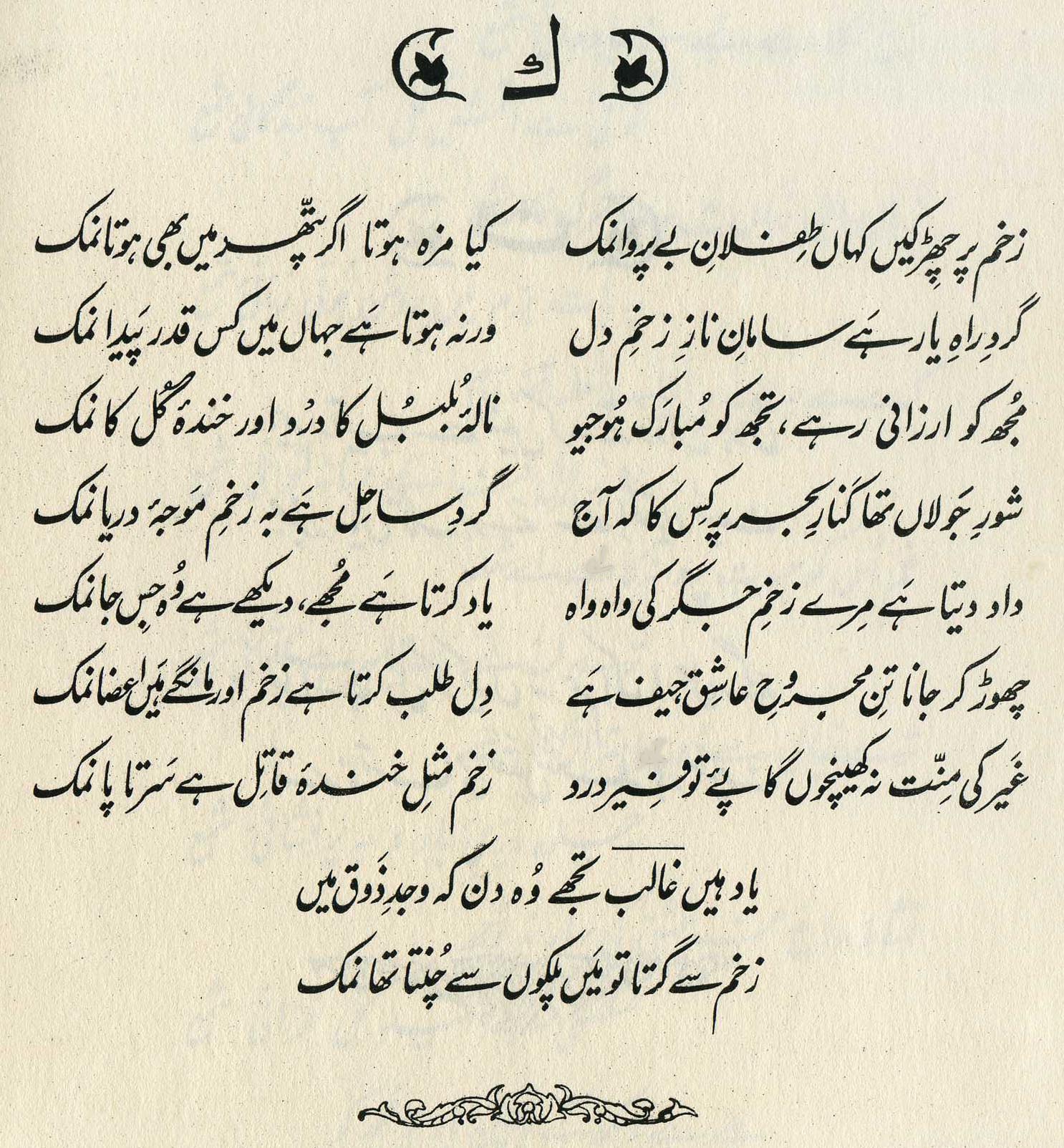
The 'smile of the wound' is a famous metaphor ; here, the writer has made the invention of giving it the simile of the smile of the beloved. And the cause of similitude he has declared to be its being salty. And the wound in which there's salt-- how can its pain be described? (79)
== Nazm page 79

He says, 'I don't like to plead with the Other', and that too with the wordplay of pain: 'My wound, like the murderer's smile, is end-to-end salt'. (126)
Why would I become indebted to anyone's kindness for increasing pain? For my wound of itself, like the beloved's smile, consists of salt. That is, my wound itself is giving the extreme of pain-- what need is there of sprinkling salt on it? (163)
(1) 'Other' can mean the Rival, and the beloved too, [or 'other people' who might sprinkle salt either out of enmity or because the lover begged them to]. The beloved smiles because a smile is becoming to her, and also because when she sees the lover's wretched condition she smiles/laughs sarcastically, but the lover has no need of any kind of external help.
(2) is a compound phrase [] meaning 'the smile of the murderer'. But we can also consider it a descriptive phrase[], that is, 'the smile that is murderous'.
(3) The wound is called 'smiling' because it's open like lips, and is red. The smile is salty, so the wound too is salty. The salty smile is beautiful, so the salty wound is beautiful too. However beautiful the smile is, that's how salty it will be. However deep the wound is, that's how salty it will be. My wound is from head to foot, so it's extremely deep [and thus provides its own supreme pain].
(4) The salty wound is extremely beautiful. The speaker sees beauty in his wound. (In one place Shakespeare has called a wound 'ruby lips'.)
== (1989: 96-97) 2006:117-18
Normally refers to the Other as the Rival , and that is certainly possible here. The speaker might refuse to receive any extra salt for his wounds at the cost of being beholden to the patronizing, snide generosity (?) of his competitor in love. But given the generality of the first line, the reference might also be, as Faruqi notes, to the 'other' in a more abstract sense-- to any 'other' at all. This second reading is made more plausible by Ghalib's frequent insistence on independence and radical non-indebtedness (for more on this see 26,1 ).
And after all, why does the speaker need to even think of such indebtedness to another or an Other anyway? All that he might need is more pain-- more salt for his wounds-- and he has an ample supply of that! The wound is end-to-end salt already, and could hardly even accommodate any more.
Best of all is that wry little aside, 'like the murderer's (or murderous) smile'. It is presented as a mere simile, and as Nazm points out, it cleverly evokes the 'smile of the wound'. (In English too, a wound has a 'mouth' and can be 'gaping'-- though it cannot really 'smile'.) The beloved's smile as end-to-end salt is so evocative! The wider her smile, the more it stretches the length of her lips, and so the more salt it contains. The more sincere and affectionate she might intend/pretend her smile to be, the more salt it provides for the wounds of the lover who knows she will always be beyond his reach. (The verse also offers wordplay for the smiling 'mouth', through 'on the foot of' and 'head to foot', with an echo in .)
And of course, 'saltiness' is part of the beloved's beauty. And providing salt for the lover's wounds is not only or always an act of cruelty, but is even part of her proper duty as a beloved. Not only this verse but most of the verses of this ghazal, after all, reflect the lover's search for more, or better, salt for his wounds. We are back again in the world of hopelessly entangled opposites-- pain and joy, cruelty and kindness-- in which the lover pursues his passionate madness.
graphics/allsalt.jpg