Verse 81821aanamak
G1
1
you remember, Ghalib, those days when, in a transport of relish/delight
2
[when it] fell from the wound, then with my eyelashes I used to gather the salt
'Ecstasy, rapture, transport; excessive love; religious or poetic frenzy'.
'Taste, enjoyment, delight, joy, pleasure, voluptuousness'.
'Salt; —savour, flavour; —bread, subsistence; —(met.) piquancy; spirit, animation; —grace, beauty'.
| References | |
|---|---|
| Arshi, Imtiyaz Ali | Ghazal# 77 |
| Raza, Kalidas Gupta | 333-334 |
| Nuskhah-e-Hamidiyah | 127-128 |
| Gyan Chand | 237-238 |
| Hamid Ali Khan | Open Image |
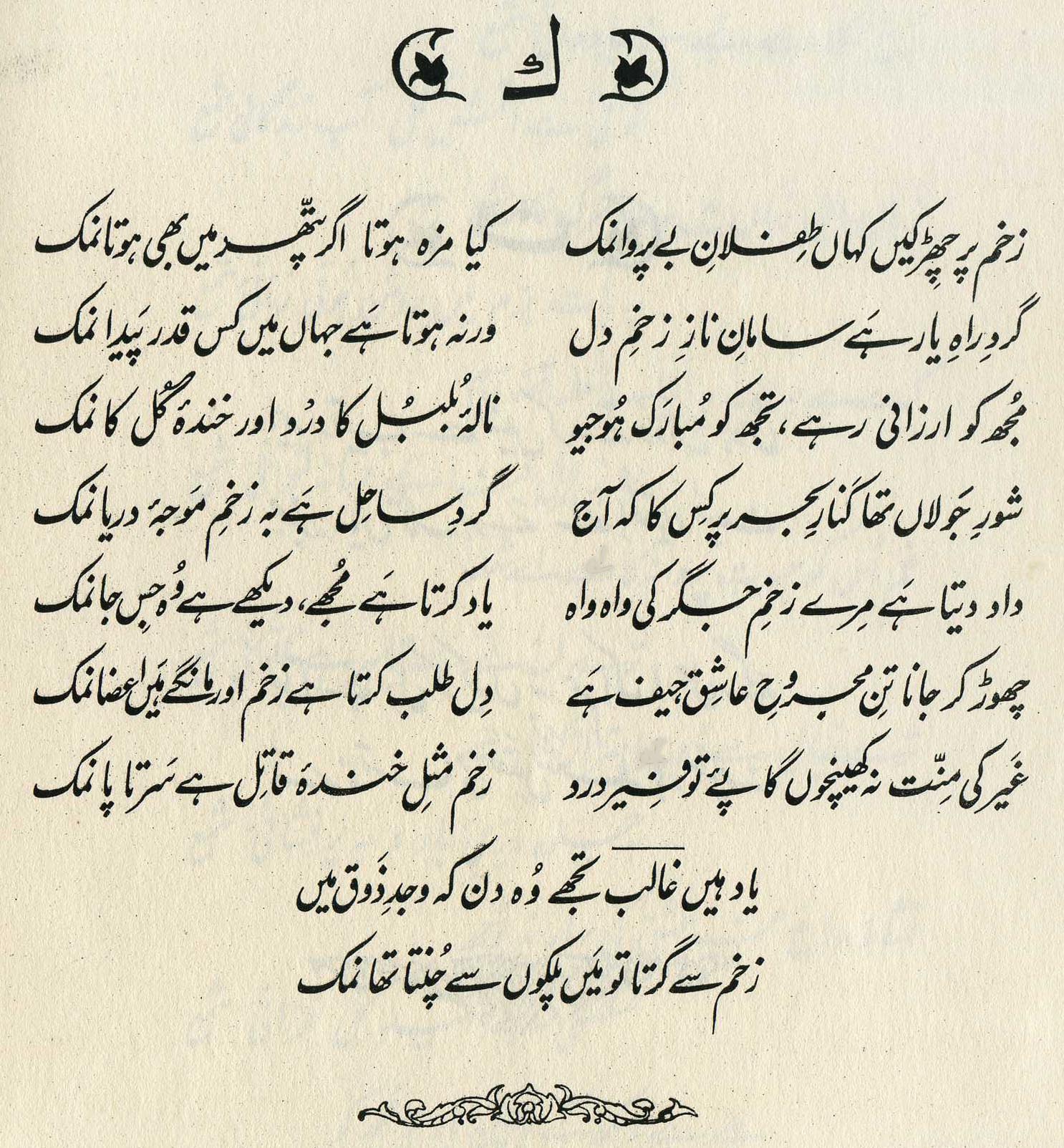
It's a famous idea that if salt falls on the ground, then it ought to be picked up with the eyelashes. (79)
== Nazm page 79

He says, oh Ghalib, you're an old friend and sympathizer. You've always remained with me. You remember those days too, when grains of salt fell from my wounds, and I used to pick them up with my eyelashes. In this expression two excellences have been created. One is this: that I was so devoted to suffering that the portion of salt that was lost from my wounds, I used to ardently pick it up again and restore it to the wound. The second excellence is this: that there's a gesture toward this famous idea that if salt falls on the ground, it ought to be picked up with the eyelashes. (126)
The old idea is that you shouldn't let a single grain of salt fall on the ground; otherwise, you will be forced to pick it up with your eyelashes [on Doomsday]. That is, you'll be punished for this sin. Zauq has said:
[however much salt there is, use it up in my wounds!
you will lift it with your eyelashes-- don't drop it from your hands!]
The meaning of the verse is, oh Ghalib, you surely remember those days when, intoxicated with your relish/delight, you yourself filled your wounds with salt, and were so careful in this task that if any grain of salt fell from the wound, then you picked it up with your eyelashes and returned it to the wound. It's a pity that in this limit of despair now neither has that intoxication remained, nor has that relish remained. (163-64)
If we put the commentators together, I think they make this one pretty clear. The belief that one must not spill even a grain of salt is perhaps based not only on salt's once-great value and rarity, but also on its unique usefulness as a spice and preservative. What might in fact be a prudent, sensible reluctance to waste a valuable foodstuff is here wittily transmuted into a sign of the lover's former condition, his virtual 'trance' of passion. As Bekhud Dihlavi observes, that time is over now-- it is pointedly contrasted with the (despairing? apathetic? burnt-out? salt-jaded? salt-lacking? salt-oversupplied?) present.
But whose voice are we hearing? Who is the 'I' who addresses Ghalib as 'you', using the intimate ? The question surely must remain perplexing. Nazm, Chishti, Mihr, and some other commentators consider the textual warrant for replacing with in the first line, or else with in the second line; as always, I follow Arshi. The simplest solution is just to say that Ghalib is addressing himself in both the first and intimate second persons. For after all, who else would be a likely candidate for picking up salt grains with his/her eyelashes and restoring them carefully to the lover's wound? Certainly not the cruel or indifferent beloved; hardly the lover's friend or confidant; and who else is there? Perhaps the lover talks to himself in this complex, intimate way simply because he has no one else with whom to reminisce.
graphics/salttreasure.jpg