Verse 9x1821aanamak
G1
1
in that act the relish/taste of luxury/enjoyment is not available, Asad
2
powerfully, it maintains a relationship with wine-- the 'salt' of the Christians
'Strength, power, vigour, virtue; force, strong effort, exertion, strain; stress; weight; violence; coercion; —adv. Vigorously, powerfully; violently, forcibly; extremely, very'.
'Referring (to, - ); deriving (from); —reference, respect, regard (to); attribute; relation, connexion; affinity; analogy; comparison; —ratio; proportion; ... —a relation, or connexion; —a conundrum'.
'Arabic: ... —(pl. of ), Nazarenes, Christians'.
| References | |
|---|---|
| Arshi, Imtiyaz Ali | Ghazal# 77 |
| Raza, Kalidas Gupta | 333-334 |
| Nuskhah-e-Hamidiyah | 127-128 |
| Gyan Chand | 237-238 |
| Hamid Ali Khan | Open Image |
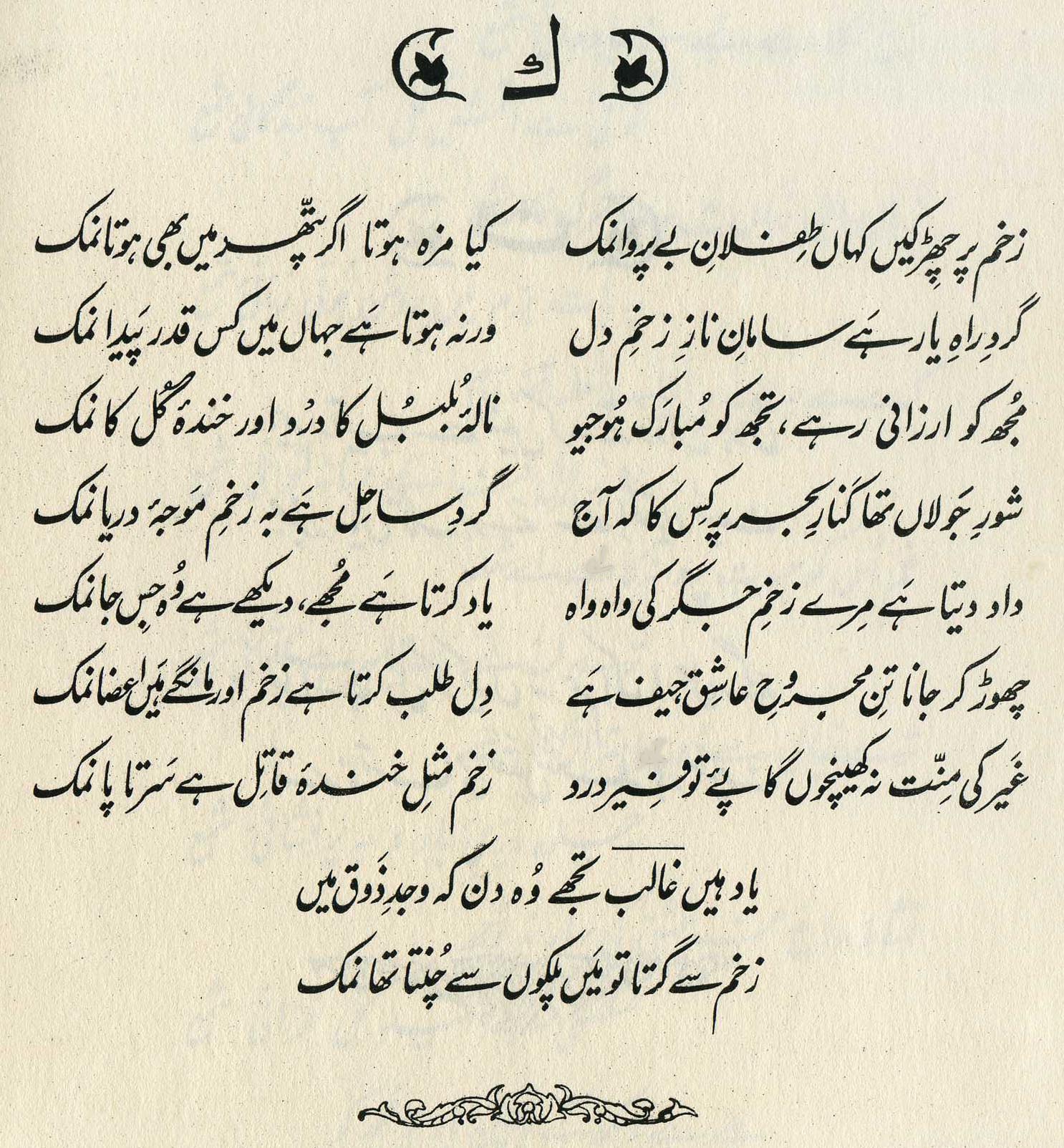
Now the scribe/copyist has become a chronically shameless debauchee [that is, the text has been miscopied]. [Zamin's text has .] Now the verse is to be rejected [].
== Zamin, p. 209
By 'in this action' wine-drinking is meant, but it's not clear what is meant by . I met with Malik Ram Sahib and Qazi Abd ul-Vudud Sahib, and inquired about the meaning of this construction. They too did not know. Arshi Sahib wrote down the meaning of this verse and sent it to me:
(1) 'By is meant the pension that Ghalib always used to receive. It was very small, so that it was impossible for Ghalib to arrange for wine-drinking to his heart's content. Thus it was as if the 'Christians' salt' that he ate, instead of increasing the relish of luxury/enjoyment, acted the way salt acts if put in wine-- that is, the intoxication of the wine is ended and it turns to vinegar.'
This is quite a fine commentary, but it has the small problem/flaw that this verse is from the Nuskhah-e Bhopal-- that is, before 1821. At that time, Ghalib did not receive a pension directly from the English. He had various sources of income, so it's very doubtful whether at that time he would make a complaint about eating the salt of the English.
Another meaning can be this:
(2) By is meant the 'salt' of the beauty of lovely Christians. Later in Calcutta, Ghalib cast a very desirous eye on the beauty of 'Mems' [=' ', western women], as is seen in his Persian masnavi s. Certainly in Delhi too he will have seen some English beauties. The problem/flaw is that in their fairness, where is the 'saltiness'/savor []? In any case, in the act of wine-drinking I don't obtain relish/taste unless some salty snack [] would be with it. The 'salty snack' of Christian beauties has a deep relationship with wine. If this 'salt' would be available to be given along with wine-drinking, then the relish/taste of luxury/enjoyment would be obtained.
== Gyan Chand, pp. 237-238
For background see S. R. Faruqi's choices . This verse is NOT one of his choices; for its unusual interest, and also for the sake of completeness, I have added it myself. For more on Ghalib's unpublished verses, see the discussion in 4,8x .
In general, Gyan Chand is the one indispensable commentator on the unpublished verses, and here we can see why. When he is baffled, he consults well-known scholars in the field; he treats the resulting ('natural poetry') thoughts politely but not uncritically. Then he provides his own best interpretation, and for that too he presents its problem/flaw [] along with the points in its favor. This is one of all too few examples of the best kind of commentarial process in action, and I cherish it-- and Gyan Chand-- accordingly. The verse is not exactly clear, and I certainly can't come up with a better interpretation than his.
Nowhere in the published divan does Ghalib mention 'Christians', and for that reason alone this verse is worth our attention. The appeal of a tawny or 'salty' beauty versus that of a fair ('creamy') complexion is explored at length, with many examples, by Faruqi in M 1815,2 .
graphics/namkeen.jpg