Verse 41821aanamak
G1
1
whose turmoil/bitterness/saltiness of movement/shackles was at the edge of the sea? --that today
2
the dust of the shore is, with the wound of the sea-wave, 'salt'
'Din, clamous, uproar, tumult, disturbance; ... --adj. Disturbed (in mind), mad (= ); --salt, brackish...; very bitter; -- unlucky'.
'Wandering up and down, wandering about; ... moving around (as a horse in a manege [=riding school]), coursing; ... Fetters, irons'.
'Salt; —savour, flavour; —bread, subsistence; —(met.) piquancy; spirit, animation; —grace, beauty'.
| References | |
|---|---|
| Arshi, Imtiyaz Ali | Ghazal# 77 |
| Raza, Kalidas Gupta | 333-334 |
| Nuskhah-e-Hamidiyah | 127-128 |
| Gyan Chand | 237-238 |
| Hamid Ali Khan | Open Image |
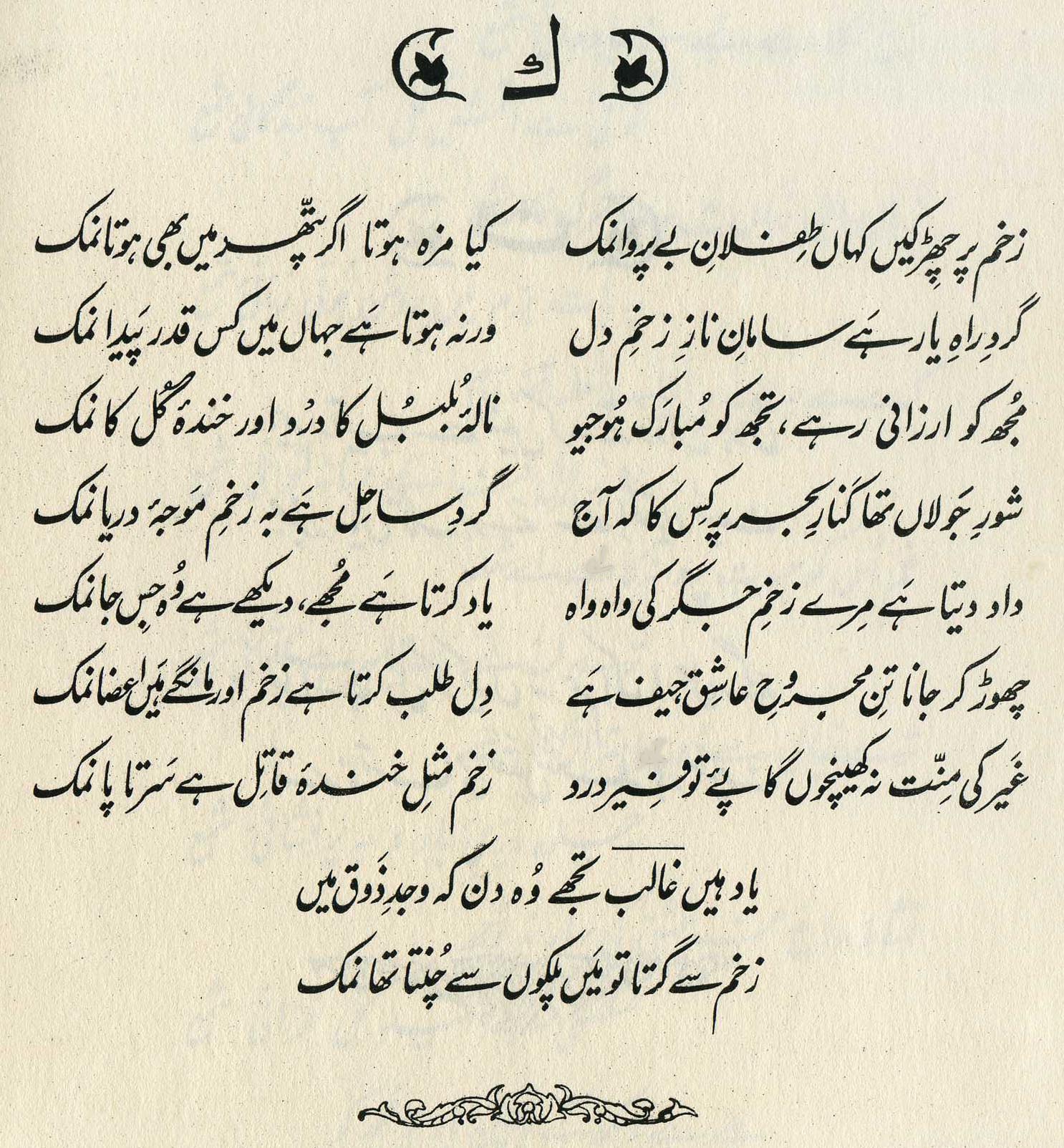
At the edge of the sea, the movement of the beloved's horse was so full of that it turned the sand-grains of the shore into salt. Energy and are among the qualities of the ocean; seeing this quality in her movement, salt began to enter the wounds of the waves-- that is, from envy. (79)
== Nazm page 79

He says, what pearl of the sea of delicacy runs her horse across the sands of the ocean, such that the dust of the horse's hooves act as salt to the wounds of the sea waves? The meaning is that my beloved's horse was swifter than even the sea waves, and quickly responded to the reins, so that envy of this sprinkled salt in the wounds of the sea waves. (125)
has a number of meanings. Here, it means 'shackles'. means 'turmoil', and also 'salt'. Here advantage has been taken of both meanings. He says, the turmoil/bitterness of which madman's shackles was on the seashore, that the ground of the shore too became turmoil/bitterness? And the dust that flew up from this ground and went toward the water, it too was scattering salt on the wounds of the sea waves. (162-63)
The interpretation of the verse is entirely clear. [An approving summary of the consensus expressed by Nazm and Bekhud Dihlavi.] After this explication of the verse, there remain some important points in the verse itself.
(1) In this verse Ghalib has used in an extremely beautiful manner a central subject of his-- that is, movement. [A discussion of Ghalib's treatment of movement versus stillness, through the concept of .]
(2) In the verse under discussion, the metaphor of ocean/sea for movement has been searched out. Even the quietest sea or ocean is in motion at every instant.
(3) In fact for this reason, the sea is a symbol of time. Thus in the present verse we can also take the sea to be the sea of time, and adopt the the interpretation that compared to the beloved's swiftness of gait, even/also the movement of the ocean of time is slow.
In the dictionary meanings of the words, the following points are hidden:
(1) No matter how swift-moving the ocean may be, it doesn't cause dust to fly. [The beloved's horse does, which increases the ocean's envy.]
(2) The beloved's nut-brown beauty [] has created in the sand of the shore the qualities of salt.
(3) The sea water is salty because the kicked-up salty dust of the beloved's steed has become mixed into it.
(4) The movement of clear water is not very apparent, but if something like dust should fall in, then through its movement the movement of the water becomes clear. This can also be described by saying that the grains of dust have given the water more movement. Movement is a symbol of restlessness. In this way the dust that has fallen into the water has made the sea more restless, as if it sprinkled salt on a wound.
(5) The opposite can also be the case. If dust would fall into water, then from the burden of the dust the movement of the water can also become less. If the extent of the water and the movement of the current would not be very great, then from the settling of dust into the water the movement of the river/sea would become reduced, and this would become a cause for further envy.
(6) From the phrase 'that today' in the first line, the conclusion can also be drawn that the river/sea is more wounded than formerly....
(8) [=7] The wordplay is worthy of attention: (meaning 'tumult', and meaning 'salt' or 'salty'); (meaning 'gallop of a horse', 'movement', and 'chains for the feet'); the saltiness of the sea (brackishness), the wound (which is like a smile, and a smile is 'salty'). If means the galloping of a horse, then this horse can be actual, or else the 'steed of coquetry'; if it means shackles, then waves are given the simile of shackles [because they curl into a rounded shape].
(9) [=8] Except for the last two feet, in this verse all the metrical feet end just where the words end. This is a form of parallelism . Perhaps Asar Lakhnavi was the first to suggest the abundance of this kind of parallelism in Ghalib's poetry. This excellence certainly plays some part in the individuality of Ghalib's verbal harmony.
== (1989: 93-95) 2006: 114-16
[See also his commentary on Mir 's M 584,8 .]
An elegant verse based on complex wordplay . The commentators appreciate the play on salt, but they miss-- or perhaps deliberately reject-- the play on . Most of them prefer its meaning of 'movement', while Josh insists on 'shackles'. Needless to say, Ghalib surely intended us to relish the interplay of both, as Faruqi indicates. For another such double use of , see 23,1 , and especially Faruqi's commentary.
It's the 'double (or even triple) activation' of the word that helps to pull everything together (see the definition above). Turmoil, madness, bitterness, saltiness-- its range of meanings contains suitable matches for both as 'movement' and as 'chains'. With, of course, the sense of 'saltiness' left over to go with the in the second line. On the tawny or 'salty' [] quality of the beloved's body, see Faruqi's commentary on M 1815,2 .
Salt is a property of the sea anyway, and to connect it to the salt that is sprinkled on the lover's wounds is an enjoyable notion. But what is the relationship of the sea-salt to the shore-salt described in the second line? Here again, we have two choices, thanks to the versatility of the little Persian preposition . If we take to mean 'from', then it is the salt received from the wound of the waves that has made the shore sands salty, since the waves constantly come lapping over them. If we take it to mean 'along with', then both the wound of the waves and the sands of the shore are equally salty.
In either case, the shore sands are salty because someone has passed by who either has made them envious (and thus rubbed salt in their wounds); or else has conveyed to them a sense of his own bitterness, passion, and suffering, such that they have become salt-- either to enhance his pleasure in suffering, or in some kind of self-sterilizing response to his bitter pain.
Most of the commentators think the shore sands are simply jealous of the beloved's horse with its fast movement, and of her beauty and power over it. Surely that's a bit limited and deflating. Why not leave the question as a question, and let it haunt the salty air of the seashore? After all, whose passing has left the shore-sands in this condition? Rhetorically, it's almost the same kind of question as the one asked in the first line of 1,1 .
graphics/saltyshore.jpg