Verse 11816andaayaa
G2
1 a
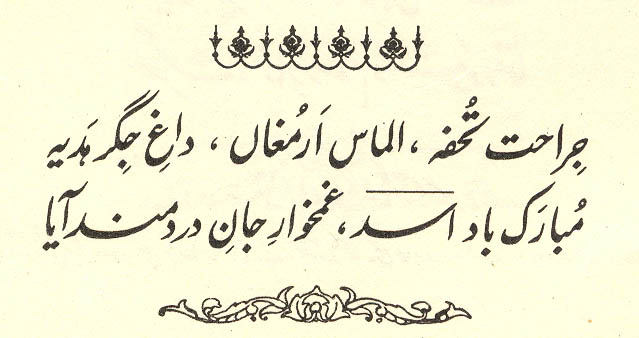
wounds, a present; diamond, a gift; liver-wound, an offering
1 b
wounds, present, diamond, gift, liver-wound, offering
2 a
congratulations, Asad -- the comforter of an afflicted soul came by!
2 b
congratulations, Asad -- the sympathizer with the compassionate soul came by!
'Afflicted, compassionate, sympathizing'. .
''Devouring sorrow'; afflicted, sorrowful, sad; --commiserating, pitying, condoling, sympathetic; one who commiserates, or condoles, or sympathizes (with), a consoler, comforter; a sympathetic or intimate friend'.
| References | |
|---|---|
| Arshi, Imtiyaz Ali | Ghazal# 2 |
| Raza, Kalidas Gupta | 140-141 |
| Nuskhah-e-Hamidiyah | 29-30 |
| Asi, Abdul Bari | 50-51 |
| Gyan Chand | 61-63 |
| Hamid Ali Khan | Open Image |

Urdu text: Vajid 1902 {2}
The , who had gone to persuade the beloved and induce her to meet with me, has come back from there bringing gifts. (21)
By the is meant the Executioner , the beloved, Passion, or the Advisor . (16)
If anyone swallows a diamond, then his heart and liver are wounded, and if diamond powder is applied to a wound, there is extreme pain in the wound. (28)
can mean passion, and also the Advisor . Here only passion is meant, because these gifts come to the lover from the court of passion alone. (237)
There are some differences of arrangement with this verse. Arshi and Hamid place it as a right after the first ghazal; Bekhud Dihlavi and Bekhud Mohani and some other editions insert it as the last verse of 8 . On matters of ghazal ordering, I follow Hamid.
This is the first closing-verse in the divan that uses Ghalib's early pen-name , 'Asad'. For Ghalib's own account of how he came to change his pen-name, see 219,1 .
This is also the first verse to mention the 'liver' []. Not much is made of it here, but I wanted to start gathering together the 'liver' references. In the ghazal world, the liver appears to best advantage when contrasted with the heart; for extensive discussion, see 30,2 .
Faruqi maintains that the bringer of gifts could be the beloved, or the Advisor; but it could not be Passion itself (July 2000). I agree with Nazm and Faruqi. Why personify the abstract 'Passion' as a solicitous friend, when we have more developed and provocative candidates available? If the gift-giver is the beloved or the Advisor, we can also then reflect on their reasons for giving such gifts. How different, in fact, are the motives of the beloved and the Advisor?
The cleverly versatild epithets and (see the definitions above), literally 'pain-possessing' and 'grief-eating', can apply to either the visited one (as in 2a), or the visitor (as in 2b). In either case, they can be read either ironically or sincerely (since in his heart the lover desires his destiny). This is the real relish of the verse-- isn't the visitor really doing the lover a favor, bringing him what he wants? And is the visitor truly a sympathizer who has a compassionate soul, or simply a visitor to one in need of compassion? The ironies and complexities are unresolvable. Again we see the in all its multivalent glory. For another look at a , see 11,5x .
The three kinds of gift have different nuances of meaning, but such nuances don't seem to be exploited here, except to show that every possible kind of gift is involved in this transaction. The more obvious reading (1a) groups the six items into three sets of two. But the reading (1b) is also enjoyably ironic; it evokes the coming of a visitor, arms loaded with a jumble of all kinds of amusements and comforts and thoughtful things for the sick or suffering one.
Such is the image of the kind (?) beloved; for her cruel counterpart, see 77,6 . On the general theme of the beloved as visiting the lover, see 106,2 . For another consoling sick-room visit, see 233,5 .
More to the point, this is also the first verse that employs Ghalib's excellently fruitful 'list' technique; grammatically, the first line consists of a sequence of six nouns, so that it remains quite opaque to interpretation until we hear the second line-- at which time it becomes radically open-ended. For for discussion and examples of 'list' verses, see 4,4 .
graphics/diamonddust.jpg