Verse 21833aarko dekhte hai;N
G9
In this meter the next-to-last long syllable may be replaced by two shorts.
1
she came into our house-- it's the power of the Lord !
2
sometimes we look at her, sometimes at our house
'Power, ability, potency, vigour, force, authority, virtue; divine power, omnipotence'.
| References | |
|---|---|
| Arshi, Imtiyaz Ali | Ghazal# 106 |
| Raza, Kalidas Gupta | 381 |
| Hamid Ali Khan | Open Image |
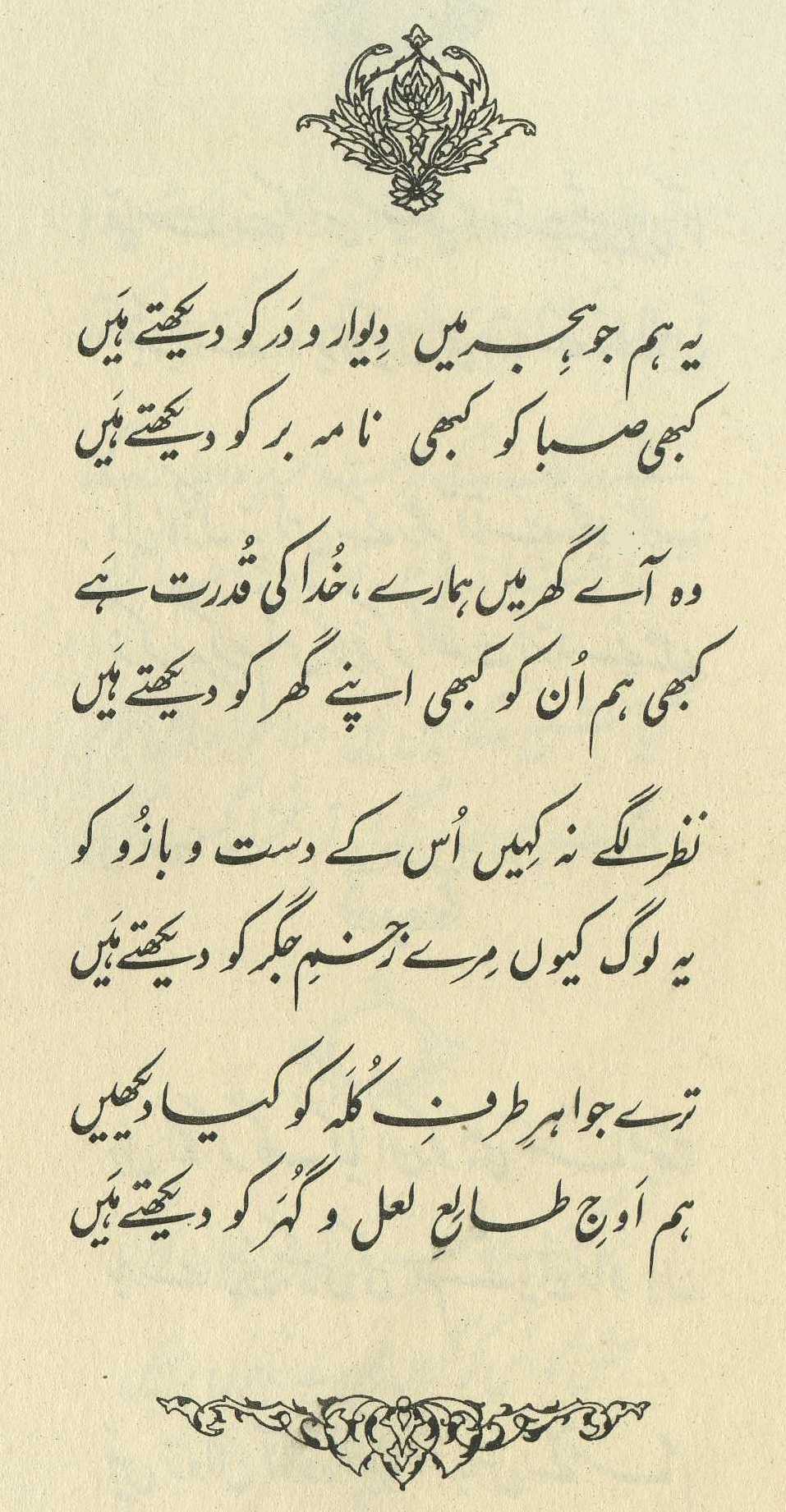
The surprise and amazement at the beloved's coming into his house-- in the second line, what an excellent picture of it he has drawn! That is, sometimes he looks at the beloved, and sometimes he looks at his house: in this house, and the coming of such a beloved!
==Urdu text: Yadgar-e Ghalib , p. 151
The reason for looking at her is that every time he doubts that she has come. And the reason for looking at his house is that when he believes that she has come, he doubts that it's really his house. (110)
== Nazm page 110

The beloved has come. The lover regards the loftiness of her rank, and the lowness of his own, and looks again and again at the beloved, to see whether it is she or someone else-- that is, how could she be here? He looks at the house because again and again he begins to doubt-- if the beloved has come, then this must not be my house, otherwise she would not have come.
It's not a verse, it's a tour de force. The state the lover may be in on seeing the beloved-- it's unlikely that anybody else has ever captured such a picture. (212)
THE BELOVED VISITS THE LOVER: On the extremely rare occasions when the beloved visits the lover, it always seems to be a token of some kind of disaster. Compared to the occasion of the present verse, her other visits are even more inauspicious. She brings death with her, as in 2,1 ; or she comes (or at least, is expected) just when the lover hasn't even got a straw mat available, as in 26,5 ; or she finally turns up just as the lover is on the point of death, as in 52,1 and 72,3 ; or when he's sick, as in 194,3 ; or she might come in a dream, as in 97,3 ; or she might briefly drop by late at night, intoxicated, with the Rival in tow, as in 116,3 ; or is it all a dream, as in 121,7 ? In 199,4 , she's begged to come to the dying lover's bedside-- but does she really do it? And in 202,7 and 204,10 , the question is once again left open.
The commentators capture the mood of helpless amazement with which the lover contemplates the situation. The poor lover! Who could fail to feel for him? Perhaps the beloved expects extreme formality and a show of abasement; perhaps she expects lavish hospitality; perhaps she merely expects a few amusing anecdotes and some witty repartee. Whatever she expects, she's out of luck. The lover stands gawking at her with a stupefied expression on his face, occasionally varying his pose to look around and gawk at his own house. Is this not a colossal social disaster in the making?
I always feel this verse as wonderfully funny, but since its effect is all in the tone, it could also be read seriously, and treated as evoking a reverent, beyond-words kind of mystical experience. For in the first line initially reads as a typical exclamation of surprise, like 'My God!' or 'It's a miracle!' (or, as my grandmother used to say, 'The hand of the Lord is in this!). But when we hear or read the second line, we realize that the speaker is so staggered, he's in such a state of amazement (on the nature of see 51,9x ), that her coming could in fact be taken as a direct manifestation of the 'power of the Lord'; thus in retrospect the petrified phrase in the first line would be meaningful in a literal way as well.
graphics/tentcamel.jpg
(by Wahab Haidar)