Verse 31833aarko dekhte hai;N
G9
In this meter the next-to-last long syllable may be replaced by two shorts.
1
may the evil eye not somehow attach itself to her arm and shoulder!
2
why do these people stare at the wound in my liver?
zar lagnaa>>: 'To fall under the gaze of a malignant eye; to be influenced by an evil eye'.
| References | |
|---|---|
| Arshi, Imtiyaz Ali | Ghazal# 106 |
| Raza, Kalidas Gupta | 381 |
| Hamid Ali Khan | Open Image |
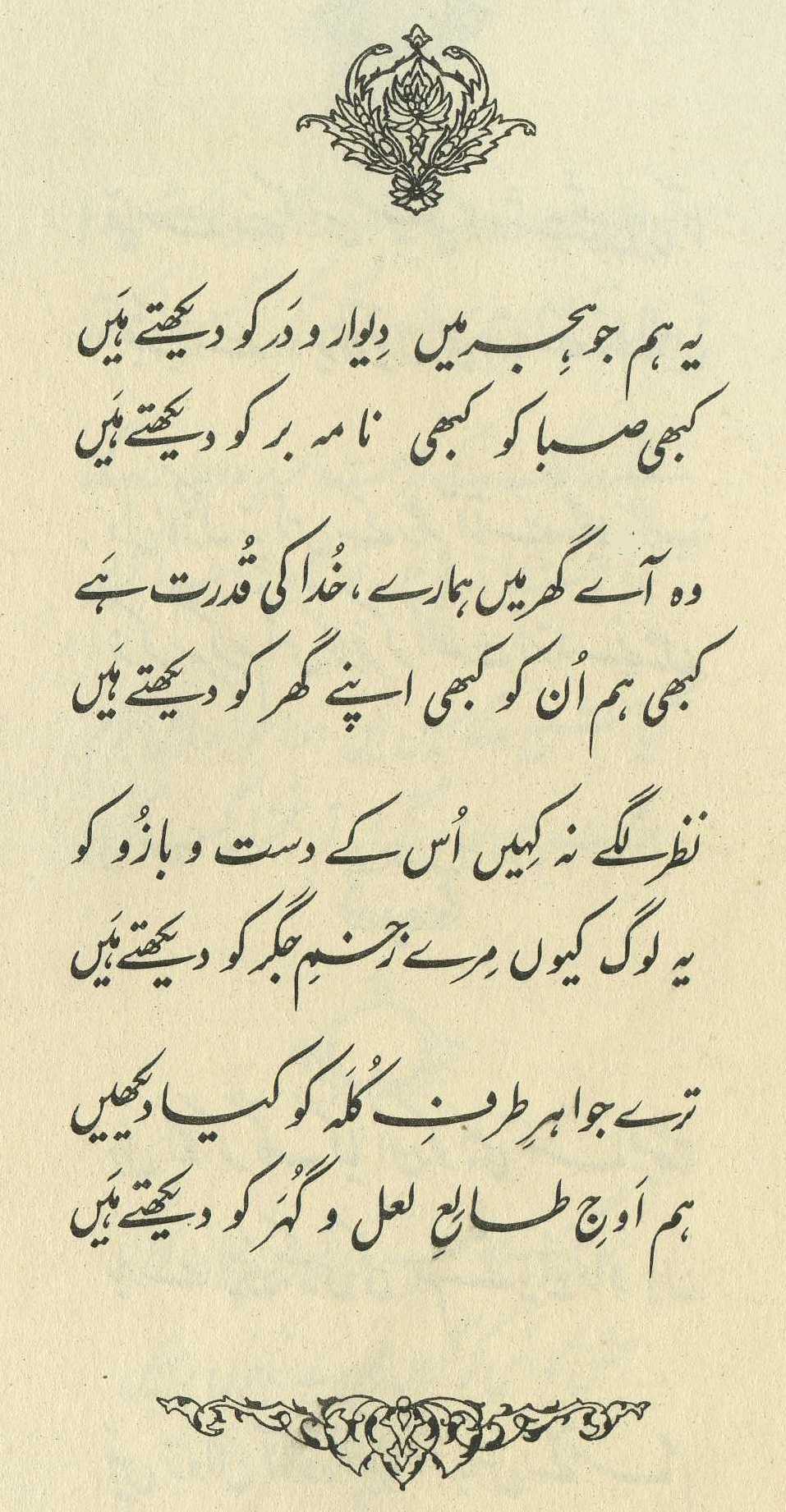
Whether it be Divine love [] or creaturely love [], the depth of his wound can’t be expressed in any better manner than this.
== Urdu text: Yadgar-e Ghalib , p. 124
That is, may the evil eye not attach itself to her subtle wounding and skilful marksmanship! And the excellence of this verse is beyond expression; in the divan s of many great and famous poets its equal cannot be found. (110)
== Nazm page 110 ; Nazm page 111


This verse is incomparable. If people wouldn't look at the wound in my liver, it would be a good thing. May the evil eye not attach itself to her arm and shoulder! In this verse the meaning emerges that the wound is so deep that there's a fear of the evil eye attaching itself to her. It also emerges what a longing there was for that wound, so that no thought of saving oneself remained. Even now the thought is, may the evil eye not attach itself to her. (212-13)
Even under normal circumstances, the lover in his jealousy hates to attract attention to the beloved. In 159,2 he requests not to be buried in the beloved's street after he's been killed (presumably by her), so that people won't thus learn where she lives. In 132,9x , the lover worries about effect of an evil eye on his sleep. So naturally when he fears she herself might be put at risk of the evil eye, his paranoia is extreme. Why are people looking at the wound in his liver? The lover catches on at once: they're looking at it with admiration for the excellent swordsmanship that made it. And admiration is what, even accidentally, can cause the admired one to be afflicted by the evil eye.
The notion of the dangerous effects of a hostile ' evil eye ' caused by envy goes back at least to the Greeks (who sometimes imagined not only human but also divine jealousy of the too-successful mortal). Belief in the 'evil eye' is widespread in South Asia. Three-wheeled scooters sometimes even have signs on their rear bumpers like 'may the evil eye be far off!' [] or 'evil-eyed one, may your face be blackened!' []. Foreigners like me are sometimes reminded in whispers not to over-praise children or express too much admiration in general. Some security can be had by explicitly invoking God's agency ('your child is so pretty, '), but that still doesn't seem enough for perfect reassurance.
We know the lover's paranoia and general craziness, so perhaps people aren't staring at his liver-wound at all, and he only imagines it. But after all, they might indeed be staring. If they are, it's probably, we guess, because they feel horror, shock, and pity at how deep and dreadful it is. The difference between what bystanders would actually feel, and what the lover thinks they would feel, is the difference between normal human attitudes, and the madness of the lover. Far from complaining of his wound, the lover is proud of it; far from expecting pity, he expects envy; far from worrying about his own dire situation, he worries only that some harm might come to the beloved from those envious of her superior martial skills.
The whole verse rests on implication ; even the basic fact that it's the beloved who has caused the wound in the liver is not stated, but can only be deduced or guessed. Just as others might stare at the lover's wound and speculate, we too, confronted with a carefully cryptic and doubly verse like this, are invited (and compelled) to speculate. Still, I can't see why the commentators (and especially Nazm) praise the verse so extravagantly.
graphics/swordarm.jpg